


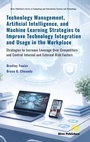
Technology Management, Artificial Intelligence, and Machine Learning Strategies to Improve Technology Integration and Usage in the Workplace
Description

Technology Management: AI and Machine Learning Strategies for the Workplace delivers a globally compliant framework that integrates incident response planning, disaster recovery, industrial-organizational psychology, information security policy templates, auditing framework, and innovative managerial methods to mitigate risk and ensure a seamless adoption and advancement of technology tools and applications across diverse workplace environments. Enveloped are current trends of cybersecurity. Trusted paths to mitigate personnel noncompliance. This is best suited for all levels of technology personnel, i.e., entry level to C-suite executive leaders.
Neglecting to integrate the audit frameworks this technology management tool offers your workplace will impact your leverage over competitors. Each reference derives from 2023 to present research studies and will be substantial in supporting your quest to understand technology management effectively for the next 4 years before modifications are required. This crucial investment is your knowledge partner to steer your path towards excellence in governance and reducing human error in your workplace.
Understanding 2025 enacted NIST special publication policies, you need to be familiar with and learn how to adopt them and integrate them into your workplace policy. Gain the courage to educate executive leaders about the role technology management plays in supporting decision success. And improve compliance with personnel on the value of technology adoption and artificial intelligence and machine learning. Most importantly, learn why industrial organizational psychology is required to introduce effective change management that aligns with technology management your workplace can understand, help manage, and appreciate.
More details
Other editions
Additional editions
Persons
Dr. Bradley Fowler Ph.D. is instrumental in supporting information technology, information systems, cybersecurity, cloud computing, and cyberpsychology practitioners at the graduate level as adjunct professor at Capitol Technology University and Avila University. Dr. Fowler's teaching philosophy is encouraging students to always conduct research to stay current with trends and to rely on scholarly peer-reviewed research to validate their facts. Dr. Fowler has conducted extensive research on cybersecurity public policy enacted across 43 countries, and research encompassing cybersecurity leadership for healthcare organizations and institutions of higher education. His research is published in the World Journal of Advanced Engineering Technology and Sciences and the Global Journal of Engineering and Technology Advances. Dr. Fowler has published textbooks such as Cybersecurity Public Policy SWOT Analysis for 43 Countries, AWS for Public and Private Sector Cloud Computing Architecture for Government and Business, and otherd. Dr. Fowler is currently Chief Technology Officer of DOC Technology Systems, LLC., and a peer review journal article reviewer for River Publishing in the Journal of Cybersecurity and Mobility. Dr. Fowler's has earned a Bachelor of Arts in eMarketing and Master of Arts in Teaching and Learning with Technology from University of Arizona Global Campus, Master of Science in Cybersecurity from Bellevue University, Master of Public Policy in Cybersecurity Policy from American Public University System, Master of Science in Management Information Systems from Bellevue University, Master of Science in Cloud Computing Architecture from University of Maryland Global Campus, Master of Research in Cyberpsychology and Doctor of Philosophy in Cybersecurity Leadership from Capitol Technology University. In 2026, Dr. Fowler will be conferred with a Doctor of Education in Administration from California Coast University and Doctor of Management in Information Systems and Technology from University of Phoenix.
Bruce Chaundy earned a Bachelor of Arts in Psychology from University of Arizona Global Campus, a Master of Science in Industrial Organizational Psychology from Southern New Hampshire University and will confer with a Master of Science in General Psychology from American Public University System in 2026. Mr. Chaundy is co-author of Cyberpsychology Can Help Us Understand Cybercrime and Cybersecurity Leadership for Healthcare Organizations and Institutions of Higher Education. He has 45 years of managerial experience in industrial and occupational commercial corporations and is a member of Phi Beta Kappa Honour Society and a certified Personal Fitness Trainer and Nutritional Specialist.
Content
1. Technology and Information Assurance 2. Technology Management Guidelines and Standardizations 3. Threat Modeling 4. Auditing and Accountability for Effective Technology Management 5. Public Policies and Implementation Procedure 6. Risk Factor Security Controls 7. Incident Response Planning 8. Disaster Recovery for Technology Management 9. Artificial Intelligence and Machine Learning for Technology Management 10. Industrial Organizational Psychology for Technology Management
