

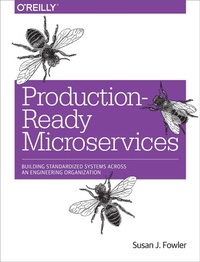
Production-Ready Microservices
Building Standardized Systems Across an Engineering Organization
Published on 30. November 2016
172 pages
978-1-4919-6594-8 (ISBN)
Description

One of the biggest challenges for organizations that have adopted microservice architecture is the lack of architectural, operational, and organizational standardization. After splitting a monolithic application or building a microservice ecosystem from scratch, many engineers are left wondering whats next. In this practical book, author Susan Fowler presents a set of microservice standards in depth, drawing from her experience standardizing over a thousand microservices at Uber. Youll learn how to design microservices that are stable, reliable, scalable, fault tolerant, performant, monitored, documented, and prepared for any catastrophe.Explore production-readiness standards, including:Stability and Reliability: develop, deploy, introduce, and deprecate microservices; protect against dependency failuresScalability and Performance: learn essential components for achieving greater microservice efficiencyFault Tolerance and Catastrophe Preparedness: ensure availability by actively pushing microservices to fail in real timeMonitoring: learn how to monitor, log, and display key metrics; establish alerting and on-call proceduresDocumentation and Understanding: mitigate tradeoffs that come with microservice adoption, including organizational sprawl and technical debt
More details
Other editions
Additional editions
Susan Fowler
Production-Ready Microservices
Book
01/2017
O'Reilly
€40.00
Article not available at the moment
Content
- Intro
- Copyright
- Table of Contents
- Preface
- Who This Book Is Written For
- What This Book Is Not
- How To Use This Book
- How This Book Is Structured
- Conventions Used in This Book
- O'Reilly Safari
- How to Contact Us
- Acknowledgments
- Chapter 1. Microservices
- From Monoliths to Microservices
- Microservice Architecture
- The Microservice Ecosystem
- Layer 1: Hardware
- Layer 2: Communication
- Layer 3: The Application Platform
- Layer 4: Microservices
- Organizational Challenges
- The Inverse Conway's Law
- Technical Sprawl
- More Ways to Fail
- Competition for Resources
- Chapter 2. Production-Readiness
- The Challenges of Microservice Standardization
- Availability: The Goal of Standardization
- Production-Readiness Standards
- Stability
- Reliability
- Scalability
- Fault Tolerance and Catastrophe-Preparedness
- Performance
- Monitoring
- Documentation
- Implementing Production-Readiness
- Chapter 3. Stability and Reliability
- Principles of Building Stable and Reliable Microservices
- The Development Cycle
- The Deployment Pipeline
- Staging
- Canary
- Production
- Enforcing Stable and Reliable Deployment
- Dependencies
- Routing and Discovery
- Deprecation and Decommissioning
- Evaluate Your Microservice
- The Development Cycle
- The Deployment Pipeline
- Dependencies
- Routing and Discovery
- Deprecation and Decommissioning
- Chapter 4. Scalability and Performance
- Principles of Microservice Scalability and Performance
- Knowing the Growth Scale
- The Qualitative Growth Scale
- The Quantitative Growth Scale
- Efficient Use of Resources
- Resource Awareness
- Resource Requirements
- Resource Bottlenecks
- Capacity Planning
- Dependency Scaling
- Traffic Management
- Task Handling and Processing
- Programming Language Limitations
- Handling Requests and Processing Tasks Efficiently
- Scalable Data Storage
- Database Choice in Microservice Ecosystems
- Database Challenges in Microservice Architecture
- Evaluate Your Microservice
- Knowing the Growth Scale
- Efficient Use of Resources
- Resource Awareness
- Capacity Planning
- Dependency Scaling
- Traffic Management
- Task Handling and Processing
- Scalable Data Storage
- Chapter 5. Fault Tolerance and Catastrophe-Preparedness
- Principles of Building Fault-Tolerant Microservices
- Avoiding Single Points of Failure
- Catastrophes and Failure Scenarios
- Common Failures Across an Ecosystem
- Hardware Failures
- Communication-Level and Application Platform-Level Failures
- Dependency Failures
- Internal (Microservice) Failures
- Resiliency Testing
- Code Testing
- Load Testing
- Chaos Testing
- Failure Detection and Remediation
- Incidents and Outages
- Appropriate Categorization
- The Five Stages of Incident Response
- Evaluate Your Microservice
- Avoiding Single Points of Failure
- Catastrophes and Failure Scenarios
- Resiliency Testing
- Failure Detection and Remediation
- Chapter 6. Monitoring
- Principles of Microservice Monitoring
- Key Metrics
- Logging
- Dashboards
- Alerting
- Setting up Effective Alerting
- Handling Alerts
- On-Call Rotations
- Evaluate Your Microservice
- Key Metrics
- Logging
- Dashboards
- Alerting
- On-Call Rotations
- Chapter 7. Documentation and Understanding
- Principles of Microservice Documentation and Understanding
- Microservice Documentation
- Description
- Architecture Diagram
- Contact and On-Call Information
- Links
- Onboarding and Development Guide
- Request Flows, Endpoints, and Dependencies
- On-Call Runbooks
- FAQ
- Microservice Understanding
- Architecture Reviews
- Production-Readiness Audits
- Production-Readiness Roadmaps
- Production-Readiness Automation
- Evaluate Your Microservice
- Microservice Documentation
- Microservice Understanding
- Appendix A. Production-Readiness Checklist
- A Production-Ready Service Is Stable and Reliable
- A Production-Ready Service Is Scalable and Performant
- A Production-Ready Service Is Fault Tolerant and Prepared for Any Catastrophe
- A Production-Ready Service Is Properly Monitored
- A Production-Ready Service Is Documented and Understood
- Appendix B. Evaluate Your Microservice
- Stability and Reliability
- The Development Cycle
- The Deployment Pipeline
- Dependencies
- Routing and Discovery
- Deprecation and Decommissioning
- Scalability and Performance
- Knowing the Growth Scale
- Efficient Use of Resources
- Resource Awareness
- Capacity Planning
- Dependency Scaling
- Traffic Management
- Task Handling and Processing
- Scalable Data Storage
- Fault Tolerance and Catastrophe-Preparedness
- Avoiding Single Points of Failure
- Catastrophes and Failure Scenarios
- Resiliency Testing
- Failure Detection and Remediation
- Monitoring
- Key Metrics
- Logging
- Dashboards
- Alerting
- On-Call Rotations
- Documentation and Understanding
- Microservice Documentation
- Microservice Understanding
- Glossary
- Index
- About the Author
- Colophon
