

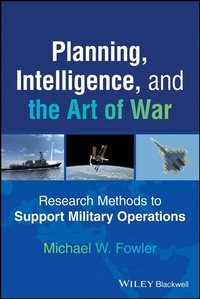
Planning, Intelligence, and the Art of War
Description

A practical framework for aligning intelligence analysis with operational military planning and forecasting
Planning, Intelligence, and the Art of War equips military planners and intelligence professionals with a clear methodology for synchronizing intelligence support with the demands of modern, multi-domain operations. With an emphasis on forecasting-anticipating how military force might resolve emerging crises-this comprehensive resource bridges the gap between theoretical understanding and real-world application. Michael W. Fowler guides planners in articulating their intelligence needs and offers analysts a systematic approach to meeting them, from the formulation of courses of action to the development of robust collection plans.
Through a focused exploration of operational-level research methods, Planning, Intelligence, and the Art of War equips practitioners with the analytical tools necessary to evaluate adversary capabilities, forecast behaviors, and support decision-making across. With practical examples applicable to air, maritime, space, cyber, and special operations domains, this book is structured to address the learning curve associated with transitioning to higher levels of command.
Tailored for those navigating the complexity of joint task forces and combatant commands, Planning, Intelligence, and the Art of War:
- Offers a step-by-step approach to creating intelligence forecasts at the operational level
- Organizes operational analysis around a phased model of conflict escalation for clarity and coherence
- Features a unique framework for analyzing partner nation behavior and military cooperation
- Provides specific techniques for aligning intelligence products with the needs of joint force commanders
- Addresses the critical challenge of building collection plans tied to priority intelligence requirements
Drawing from decades of operational lessons learned, Planning, Intelligence, and the Art of War: Research Methods to Support Military Operations is essential reading for military officers, analysts, and planners operating at joint or component command levels. It supports coursework in military and strategic studies, intelligence analysis, and security studies at both undergraduate and graduate levels. It is also a valuable tool for professional military education programs and wargame designers seeking to integrate realistic intelligence scenarios into operational simulations.
More details
Other editions
Additional editions
Person
MICHAEL W. FOWLER is Associate Professor of Military and Strategic Studies at the United States Air Force Academy. He holds a PhD from the Naval Postgraduate School and is the lead author of Military Strategy, Joint Operations, and Airpower. His research spans military intelligence analysis, collection management, targeting, and wargame design.
Content
List of Frequently Used Acronyms xi
About the Author xv
PART I: THINKING LIKE A MILITARY OPERATIONAL ANALYST 1
Chapter 1: Introduction to Military Intelligence and Planning 3
Chapter 2: Intelligence: The Process at the Operational Level of War 19
Chapter 3: Framing Military Problems: Selecting an Analytical Scheme 43
Chapter 4: Making the Analysis Customer-centric 57
PART II: OPERATIONAL FORECASTING 73
Chapter 5: Developing Rough Courses of Action 75
Chapter 6: Considering Security Partners 95
Chapter 7: Forecasting Detailed Courses of Action 117
PART III: DEVELOPING DETAILED OPERATIONAL COURSES OF ACTION 133
Chapter 8: A Framework for Estimating Feasibility and Viability 135
Chapter 9: Information Warfare: Space, Cyber, and Information Operations Capabilities 151
Chapter 10: Unconventional Forces 175
Chapter 11: Area Denial Capabilities 193
Chapter 12: Anti-access Capabilities 217
Chapter 13: Securing Sea Lanes 245
Chapter 14: Seizing Territory and the Close Fight 271
PART IV: DETECTION 291
Chapter 15: Prioritized Intelligence Requirements: Indicators and Decisions 293
Chapter 16: Collection Planning: What Is Knowable? 305
Chapter 17: Conclusion: Synchronizing Intelligence and Planning 327
Bibliography 337
Web Resources 345
Index 347
