

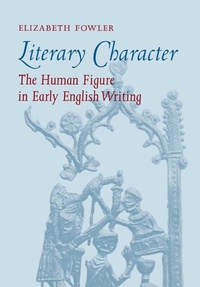
Literary Character
The Human Figure in Early English Writing
1st Edition
Published on 5. July 2018
280 pages
978-1-5017-2416-9 (ISBN)
Description

Chaucer introduces the characters of the Knight and the Prioress in the General Prologue to The Canterbury Tales. Beginning with these familiar figures, Elizabeth Fowler develops a new method of analyzing literary character. She argues that words generate human figures in our reading minds by reference to paradigmatic cultural models of the person. These models-such as the pilgrim, the conqueror, the maid, the narrator-originate in a variety of cultural spheres. A concept Fowler terms the "social person" is the key to understanding both the literary details of specific characterizations and their indebtedness to history and culture.Drawing on central texts of medieval and early modern England, Fowler demonstrates that literary characters are created by assembling social persons from throughout culture. Her perspective allows her to offer strikingly original readings of works by Chaucer, Langland, Skelton, and Spenser, and to reformulate and resolve several classic interpretive problems. In so doing, she reframes accepted notions of the process and the consequences of reading.Developing insights from law, theology, economic thought, and political philosophy, Fowler's book replaces the traditional view of characters as autonomous individuals with an interpretive approach in which each character is seen as a battle of many archetypes. According to Fowler, the social person provides the template that enables authors to portray, and readers to recognize, the highly complex human figures that literature requires.
More details
Language
English
Place of publication
NY
United States
Target group
College/higher education
Professional and scholarly
Edition type
Digital original
Illustrations
1 halftone
1 halftone
ISBN-13
978-1-5017-2416-9 (9781501724169)
Copyright in bibliographic data and cover images is held by Nielsen Book Services Limited or by the publishers or by their respective licensors: all rights reserved.
Schweitzer Classification
Other editions
Additional editions
Book
08/2003
Cornell University Press
€89.13
Shipment within 10-20 days
Person
FowlerElizabeth:
Elizabeth Fowler is Associate Professor of English at the University of Virginia. She is coeditor of The Project of Prose in Early Modern Europe and the New World, and is a general editor of the forthcoming Works of Edmund Spenser.
Elizabeth Fowler is Associate Professor of English at the University of Virginia. She is coeditor of The Project of Prose in Early Modern Europe and the New World, and is a general editor of the forthcoming Works of Edmund Spenser.
Content
- Cover
- LITERARY CHARACTER
- Title
- Copyright
- Dedication
- Contents
- Acknowledgments
- A Note on Textual Debts
- Introduction: The Arguments of Person
- Social Persons and Cognition
- The Four Parts of the Argument
- Social Persons among the Disciplines
- The Aims of This Book
- 1. Character and the Habituation of the Reader: The Pardoner's Thought Experiment
- Psyche's Priests: Chaucer's Project and the Pardoner's Intention
- The Pardoner's Intentions in the History of the Church
- Sexual Figuration and the Habitus
- Habitual Action and the Person
- Reading, Writing, and Habituation
- 2. Persons in the Creation of Social Bonds: Agency and Civil Death in Piers Plowman 9 5
- Sexual Agency: Contract, Coverture, and Legal Person
- The Case of Holi Chirche
- Economic Agency: Just Price and Mede Mesurelees
- Political Agency: Constitutional Monarchy and the Marriage of Males
- 3. The Temporality of Social Persons: Value in "The Tunnyng of Elynour Rummynge
- Seeing through Character
- The Alewife and the Economic Order
- Gender and Money
- Social Persons and the Topos of the Market
- Literary and Other Social Forms in Time
- 4· Architectonic Person and the Grounds of the Polity in The Faerie Queene
- Persons and the Polity
- Proteus' House and the Grounds of the English Constitution
- The Criterion of Fit and the Creation of Persons: Jurisprudence in Tudor Ireland
- Architectonic Character and Dominion in Two Cantos of Mutabilitie
- Afterword: The Obligations of Persons
- Index
