

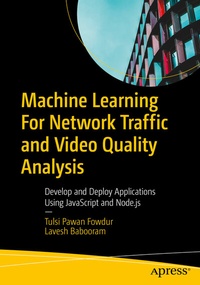
Machine Learning For Network Traffic and Video Quality Analysis
Description

This book offers both theoretical insights and hands-on experience in understanding and building machine learning-based Network Traffic Monitoring and Analysis (NTMA) and Video Quality Assessment (VQA) applications using JavaScript. JavaScript provides the flexibility to deploy these applications across various devices and web browsers.
The book begins by delving into NTMA, explaining fundamental concepts and providing an overview of existing applications and research within this domain. It also goes into the essentials of VQA and offers a survey of the latest developments in VQA algorithms. The book includes a thorough examination of machine learning algorithms that find application in both NTMA and VQA, with a specific emphasis on classification and prediction algorithms such as the Multi-Layer Perceptron and Support Vector Machine. The book also explores the software architecture of the NTMA client-server application. This architecture is meticulously developed using HTML, CSS, Node.js, and JavaScript. Practical aspects of developing the Video Quality Assessment (VQA) model using JavaScript and Java are presented. Lastly, the book provides detailed guidance on implementing a complete system model that seamlessly merges NTMA and VQA into a unified web application, all built upon a client-server paradigm.
By the end of the book, you will understand NTMA and VQA concepts and will be able to apply machine learning to both domains and develop and deploy your own NTMA and VQA applications using JavaScript and Node.js.
What You Will Learn
- What are the fundamental concepts, existing applications, and research on NTMA?
- What are the existing software and current research trends in VQA?
- Which machine learning algorithms are used in NTMA and VQA?
- How do you develop NTMA and VQA web-based applications using JavaScript, HTML, and Node.js?
Who This Book Is For
Software professionals and machine learning engineers involved in the fields of networking and telecommunications
More details
Other editions
Additional editions
Persons
Dr. Tulsi Pawan Fowdur received his BEng (Hons) degree in Electronic and Communication Engineering with honors from the University of Mauritius in 2004. He was also the recipient of a Gold medal for having produced the best degree project at the Faculty of Engineering in 2004. In 2005 he obtained a full-time PhD scholarship from the Tertiary Education Commission of Mauritius and was awarded his PhD degree in Electrical and Electronic Engineering in 2010 by the University of Mauritius. He is also a Registered Chartered Engineer of the Engineering Council of the UK, Fellow of the Institute of Telecommunications Professionals of the UK, and a Senior Member of the IEEE. He joined the University of Mauritius as an academic in June 2009 and is presently an Associate Professor at the Department of Electrical and Electronic Engineering of the University of Mauritius. His research interests include mobile and wireless communications, multimedia communications, networking and security, telecommunications applications development, the Internet of Things, and AI. He has published several papers in these areas and is actively involved in research supervision, reviewing papers, and also organizing international conferences.
Lavesh Babooram received his BEng (Hons) degree in Telecommunications Engineering with Networking with honors from the University of Mauritius in 2021. He was also awarded a Gold medal for having produced the best degree project at the Faculty of Engineering in 2021. Since 2022, he has been an MSc Applied Research student at the University of Mauritius. With in-depth knowledge of telecommunications applications design, analytics, and network infrastructure, he aims to pursue research in networking, multimedia communications, Internet of Things, artificial intelligence, and mobile and wireless communications. He joined Mauritius Telecom in 2022 and is currently working in the Customer Experience and Service Department as a Pre-Registration Trainee Engineer.
Content
Chapter 1: Introduction to NTMA and VQA.- Chapter 2: Network Traffic Monitoring and Analysis.- Chapter 3: Video Quality Assessment.- Chapter 4: Machine Learning Techniques for NTMA and VQA.- Chapter 5: NTMA Application with JavaScript.- Chapter 6: Video Quality Assessment Application Development with JavaScript.- Chapter 7: NTMA and VQA Integration.
