

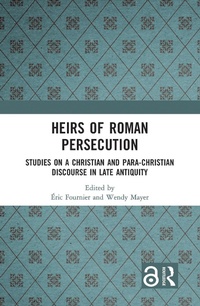
Heirs of Roman Persecution
Studies on a Christian and Para-Christian Discourse in Late Antiquity
1st Edition
Published on 10. October 2019
362 pages
978-1-351-24068-0 (ISBN)
Description

The subject of this book is the discourse of persecution used by Christians in Late Antiquity (c. 300-700 CE).
Through a series of detailed case studies covering the full chronological and geographical span of the period, this book investigates how the conversion of the Roman Empire to Christianity changed the way that Christians and para- Christians perceived the hostile treatments they received, either by fellow Christians or by people of other religions. A closely related second goal of this volume is to encourage scholars to think more precisely about the terminological difficulties related to the study of persecution. Indeed, despite sustained interest in the subject, few scholars have sought to distinguish between such closely related concepts as punishment, coercion, physical violence, and persecution. Often, these terms are used interchangeably. Although there are no easy answers, an emphatic conclusion of the studies assembled in this volume is that "persecution" was a malleable rhetorical label in late antique discourse, whose meaning shifted depending on the viewpoint of the authors who used it.
This leads to our third objective: to analyze the role and function played by rhetoric and polemic in late antique claims to be persecuted. Late antique Christian writers who cast their present as a repetition of past persecutions often aimed to attack the legitimacy of the dominant Christian faction through a process of othering. This discourse also expressed a polarizing worldview in order to strengthen the group identity of the writers' community in the midst of ideological conflicts and to encourage steadfastness against the temptation to collaborate with the other side.
Chapters 15 and 16 of this book are freely available as downloadable Open Access PDFs at http://www.taylorfrancis.com under a Creative Commons Attribution-Non Commercial-No Derivatives (CC-BY-NC-ND) 4.0 license.
Through a series of detailed case studies covering the full chronological and geographical span of the period, this book investigates how the conversion of the Roman Empire to Christianity changed the way that Christians and para- Christians perceived the hostile treatments they received, either by fellow Christians or by people of other religions. A closely related second goal of this volume is to encourage scholars to think more precisely about the terminological difficulties related to the study of persecution. Indeed, despite sustained interest in the subject, few scholars have sought to distinguish between such closely related concepts as punishment, coercion, physical violence, and persecution. Often, these terms are used interchangeably. Although there are no easy answers, an emphatic conclusion of the studies assembled in this volume is that "persecution" was a malleable rhetorical label in late antique discourse, whose meaning shifted depending on the viewpoint of the authors who used it.
This leads to our third objective: to analyze the role and function played by rhetoric and polemic in late antique claims to be persecuted. Late antique Christian writers who cast their present as a repetition of past persecutions often aimed to attack the legitimacy of the dominant Christian faction through a process of othering. This discourse also expressed a polarizing worldview in order to strengthen the group identity of the writers' community in the midst of ideological conflicts and to encourage steadfastness against the temptation to collaborate with the other side.
Chapters 15 and 16 of this book are freely available as downloadable Open Access PDFs at http://www.taylorfrancis.com under a Creative Commons Attribution-Non Commercial-No Derivatives (CC-BY-NC-ND) 4.0 license.
More details
Edition
1. Auflage
Language
English
Place of publication
London
United Kingdom
Publishing group
Taylor & Francis Ltd
Target group
College/higher education
File size
3,38 MB
ISBN-13
978-1-351-24068-0 (9781351240680)
Copyright in bibliographic data and cover images is held by Nielsen Book Services Limited or by the publishers or by their respective licensors: all rights reserved.
Schweitzer Classification
Other editions
Additional editions
Eric Fournier | Wendy Mayer
Heirs of Roman Persecution
Studies on a Christian and Para-Christian Discourse in Late Antiquity
Book
06/2021
1st Edition
Routledge
€68.20
Shipment within 10-20 days
Eric Fournier | Wendy Mayer
Heirs of Roman Persecution
Studies on a Christian and Para-Christian Discourse in Late Antiquity
Book
10/2019
1st Edition
Routledge
€207.20
Shipment within 15-20 days
Persons
Eric Fournier is Professor of History at West Chester University of Pennsylvania.
Wendy Mayer is Associate Dean for Research and Professor at University of Divinity, Australian Lutheran College.
Wendy Mayer is Associate Dean for Research and Professor at University of Divinity, Australian Lutheran College.
Content
Foreword
Acknowledgements
Abbreviations
Eric Fournier The Christian Discourse of Persecution in Late Antiquity: An
Introduction.
Part I: The Later Roman Empire of the 4th and 5th Centuries
Elizabeth Depalma Digeser Breaking the Apocalyptic Frame: Persecution and the Rise of
Constantine.
Nathaniel Morehouse Begrudging the Honor: Julian and Christian Martyrdom.
Maijastina Kahlos A Misunderstood Emperor? Valens as a Persecuting
Ruler in Late Antique Literature.
Byron MacDougall Theologies under Persecution: Gregory of Nazianzus and
the Syntagmation of Aetius.
Adam Ployd For Their Own Good: Augustine and the Rhetoric of
Beneficial Persecution.
Mattias Brand In the Footsteps of the Apostles of Light: Persecution and
the Manichaean Discourse of Suffering.
Part II: Post-Roman Kingdoms of the Western Mediterranean (5th and 7th Centuries)
Eric Fournier 'To Collect Gold from Hidden Caves.' Victor of Vita and the
Vandal 'Persecution' of Heretical Barbarians in Late Antique North Africa.
Samuel Cohen 'You Have Made Common Cause with their Persecutors':
Gelasius, the Language of Persecution, and the Acacian Schism.
Eric Fournier Everyone but the Kings: The Rhetoric of (Non-)Persecution in
Gregory of Tours' Histories.
Molly Lester Persecutio, Seductio, and the Limits of Rhetorical Intolerance in
Visigothic Iberia.
Part III: Eastern Mediterranean in the 5th-7th Centuries
Rebecca S. Falcasantos The City a Palimpsest. Rewriting Arian Violence in Fifth-
Century Historiography.
Jason Osequeda The Name of Ill-Omen: Basiliscus and the Church in
Constantinople.
Christine Shepardson Martyrs of Exile: John of Ephesus and Religious
Persecution.
Ryan Strickler Persecution and Apostasy: Christian Identity during the
Crises of the Seventh Century.
Concluding Reflections
Wendy Mayer Heirs of Roman Persecution: Common Threads in the
Discursive Strategies across Late Antiquity.
Index
Acknowledgements
Abbreviations
Eric Fournier The Christian Discourse of Persecution in Late Antiquity: An
Introduction.
Part I: The Later Roman Empire of the 4th and 5th Centuries
Elizabeth Depalma Digeser Breaking the Apocalyptic Frame: Persecution and the Rise of
Constantine.
Nathaniel Morehouse Begrudging the Honor: Julian and Christian Martyrdom.
Maijastina Kahlos A Misunderstood Emperor? Valens as a Persecuting
Ruler in Late Antique Literature.
Byron MacDougall Theologies under Persecution: Gregory of Nazianzus and
the Syntagmation of Aetius.
Adam Ployd For Their Own Good: Augustine and the Rhetoric of
Beneficial Persecution.
Mattias Brand In the Footsteps of the Apostles of Light: Persecution and
the Manichaean Discourse of Suffering.
Part II: Post-Roman Kingdoms of the Western Mediterranean (5th and 7th Centuries)
Eric Fournier 'To Collect Gold from Hidden Caves.' Victor of Vita and the
Vandal 'Persecution' of Heretical Barbarians in Late Antique North Africa.
Samuel Cohen 'You Have Made Common Cause with their Persecutors':
Gelasius, the Language of Persecution, and the Acacian Schism.
Eric Fournier Everyone but the Kings: The Rhetoric of (Non-)Persecution in
Gregory of Tours' Histories.
Molly Lester Persecutio, Seductio, and the Limits of Rhetorical Intolerance in
Visigothic Iberia.
Part III: Eastern Mediterranean in the 5th-7th Centuries
Rebecca S. Falcasantos The City a Palimpsest. Rewriting Arian Violence in Fifth-
Century Historiography.
Jason Osequeda The Name of Ill-Omen: Basiliscus and the Church in
Constantinople.
Christine Shepardson Martyrs of Exile: John of Ephesus and Religious
Persecution.
Ryan Strickler Persecution and Apostasy: Christian Identity during the
Crises of the Seventh Century.
Concluding Reflections
Wendy Mayer Heirs of Roman Persecution: Common Threads in the
Discursive Strategies across Late Antiquity.
Index
