

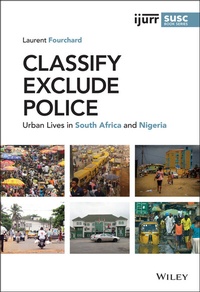
Classify, Exclude, Police
Description

More details
Other editions
Additional editions
Person
Laurent Fourchard is Research Professor at the Centre for International Studies (CERI) and at the Urban School of Sciences Po, Paris, France. His research is located at the intersection of comparative urban studies, African history, and African politics. He combines historical and ethnographic methods and privileges a comparative analysis through a description of everyday practices in Nigerian and South African cities. His interests focus on security practices, apparatus of exclusion, colonial and postcolonial governments and negotiation and conflicts in urban public places.
Content
Series Editors' Preface viii
Acknowledgements ix
Classify, Exclude, Police 1
Part I Governing Colonial Urban Space 21
1 Classifying and Excluding Migrants 25
Race and Urban Space 28
Differentiating Urbans from Migrants in South Africa 33
Stabilisation Policies and Urban Residential Rights 34
Reinterpreting the Riots in Sharpeville and Langa 38
Differentiating Natives from Non-Natives in Nigeria 45
The Birth of Territorial Enclaves: Non-Native Neighbourhoods 46
Regionalism and Decolonisation 49
The Kano Riots 52
Conclusion 54
Notes 58
2 The Making of a Delinquent 63
Rise of Urban Poverty and Delinquency Issues 66
Between Psychometric Expertise and Penal Reform in South Africa 68
The Empire's First Social Services in Lagos 71
Race, Gender and Welfare 73
From Preference to Racial Differentiation in South Africa 74
Juvenile Prostitution and the Construction of a Moral Space in Nigeria 77
A Coercive Incomplete Welfare State 81
From Financial Indigence to Flogging in Urban Nigeria 83
Violent Socialisation of Urban Youth in South African Institutions 85
Conclusion 88
Notes 90
Part II Policing the Neighbourhood 95
3 Vigilantism and Violence Under Colonialism and Apartheid 103
Policing in a Colonial Situation: Historiographical Detours 104
Violence and Vigilantism in South African Townships 107
Violence and the Making of Township Communities in the Cape Flats 111
Violence and Vigilantism in South-West Nigeria 117
Honour and Violence in the Centre of Ibadan 120
Conclusion 123
Notes 125
4 Commodification, Politicisation and Uneven Pacification of Contemporary Vigilantism 129
State Regulation and Commodification in Nigeria 133
Commodifying Protection and Regulating Vigilante Violence in Ibadan 135
Return to Democracy and Uneven Pacification of Vigilantism 139
Politicisation, Bureaucratisation and Feminisation of Vigilantism in the Cape Flats 142
Politicisation of Security Initiatives 145
Limited Pacification and Bureaucratisation of Vigilantism 147
Feminisation of Vigilantism 153
Conclusion 157
Notes 159
Part III Politics of the Street, Politics in the Office 165
5 Patronage, Taxation and the Politicisation of Urban Space 171
Patronage and Urban Projects 174
The Amala Politics in Ibadan 176
The Metropolitan Project in Lagos 180
Revenues, Violence and Politicisation in Motor Parks 184
Extorting Money or Levying Taxes? 186
Governing Transport Between Patronage and Bureaucracy 190
Violence, Loyalty and Politicisation in Motor Parks 194
Conclusion 198
Notes 200
6 Bureaucrats, Indigenes and a New Urban Politics of Exclusion 203
Institutionalising Exclusion, Manufacturing New Urban Belonging 207
Producing Certificates, Identifying Urban Ancestry 215
Indigeneity, Segregation and Patronage 223
Conclusion 229
Notes 230
Conclusion: The Urban Legacy of Exclusion, Policing and Violence 233
References 243
Appendix 1: Dictionary 273
Index 279
Classify, Exclude, Police
Nigeria, 2006: Human Rights Watch published a report on discrimination against the country's non-indigene*1 populations:
'The population of every state and local government in Nigeria is officially divided into two categories of citizens: those who are indigenes and those who are not. The indigenes of a place are those who can trace their ethnic and genealogical roots back to a community of people who originally settled there. Everyone else, no matter how long they or their families have lived in the place they call home, is and always will be a non-indigene.' (Human Rights Watch, April 2006, p. 1.)
The report indicates that many states refuse to employ non-indigenes in the civil service, discriminate against them in the provision of basic services, and often deny them the right to stand for office in local and state government elections, thereby treating them as second-class citizens. Furthermore, the report asserts that the division between indigenes and non-indigenes has led to extreme violence in some localities: 1,000 people died in the city of Jos (in the centre of the country) in September 2001, more than 600 in the small town of Yelwa (200 km from Jos) during the first half of 2004, and several hundred in 1997 and 2003 in the city of Warri (Niger Delta).
South Africa, May 2008: xenophobic violence engulfed the whole country during the month of May, leaving 60 dead, 700 injured, and more than 100,000 displaced. A third of the victims were South Africans, although foreigners from other African countries were the main targets (Landau 2011, p. 1). The violence began in the township of Alexandra in Johannesburg, then spread to other townships chiefly in the province of Gauteng, and later to the cities of Cape Town and Durban. The 140 zones involved were mostly townships and informal urban areas.
The violence of the attacks was unspeakable. For the moment, we would simply note that it was grounded in the exclusion of a group based solely on nationality (other than South African) or origin (non-indigene), and that it took place on a national scale and in urban environments.2 National affiliation or supposed origin are only one among numerous repertoires of exclusion and one of the categories that potentially generates the use of violence, but their repetition and widespread protean nature - offences against the integrity of persons, mob violence, repression by security forces - and the countless forms of exclusion are indeed at the core of the historiography of these two countries.
Metropolises function as command posts, overseeing a concentration of population, production and consumption. As such, they offer an ideal observation point for studying the day-to-day practices of power and the genealogy of forms of exclusion. Lagos, Ibadan and Kano in Nigeria and Cape Town and Johannesburg in South Africa have been metropolises for over a century (see Figures I.1 and I.2). All of them house government agencies and influential political networks.3 By the end of the nineteenth century, they had become leading labour markets at the regional or countrywide level, and their rapid growth (see Table I.1) soon gave rise to new forms of poverty and social violence (unemployment, delinquency, maltreatment, prostitution, gangsterism, procuring) and problems integrating migrant populations. Their increasing social diversity generated a profusion of discourses and they became privileged places for producing knowledge and testing, developing and implementing new apparatuses of power.4 These apparatuses contributed significantly to turning the metropolises into laboratories for exclusion and the use of violence. Some initiatives were introduced by state agents to target categories of people whose socialisation to urban life was deemed problematic (temporary migrants, non-natives*, delinquents, children in need of care, single women). Over time such instruments became permanent features of city life, but they remained politicised, conveying values that embodied a particular interpretation of society and ideas about how to regulate it (Lascoumes and Le Galès 2004, p. 13).
FIGURE I.1 States and cities in Nigeria
Source: Realised by Christine Deslaurier. IRD, UR 102, 2007.
FIGURE I.2 Provinces and cities in South Africa.
TABLE I.1 The population of Lagos, Ibadan, Kano, Johannesburg and Cape Town (in thousands)5
1866 1891 1911 1952 1963 1970 1991 2010 Lagos 25 32 73 272 542 1266 5195 8048 Ibadan 100 120 175 459 427 998 1835 2551 Kano 30 127 255 882 2167 2826 1866 1891 1904 1951 1960 1970 1996 2011 Johannesburg - 3 327 969 1247 1561 2638 4434 Cape Town 22 51 77 500 803 1300 2565 3740From the early twentieth century onwards, South African labour policies divided workers into two separate groups: on one hand, a category of urban workers who were to be made into stable residents by granting them rights related to housing, employment and family life, and on the other, a population of temporary migrants destined to return to the countryside once their labour contracts were completed. For the members of this second group, the hostel* - or more precisely the assignment of a bed ('bedhold') - became the institution structuring their daily lives, as well as relationships with their employers and administrative authorities, fellow workers at the hostel, apparently favoured neighbours living nearby in family quarters and women whose unauthorised residence depended on the goodwill of the men to whom they had to be attached (Ramphele 1993). During the same period, labour policies in Nigeria led to the creation of a new category of urban resident called 'non-native' - defined in opposition to 'native' - which was the norm at the time. These policies authorised the presence of migrants needed by the colonial economy, but required them to reside in reserved neighbourhoods and placed them under a separate authority to avoid diminishing the power of native chiefs.
The historical invention of these categories is at the heart of the processes of exclusion and the reification of differences between natives and non-natives, and between urbans and temporary migrants, which had enduring legacy in post-colonial and post-apartheid periods. In the 1930s, further categories were added in both countries to define and classify urban youth as delinquents, children in need of care and minor girls in need of protection. When South African social workers and their British imperial counterparts in Nigeria embarked on a mission to have boys released from prison and protect girls from the dangers of street life, they set up social services that criminalised the presence of these young people on the streets. In Lagos, they sent the boys to the countryside, and prohibited minor girls from street trading. Girls were regularly rounded up, forced to undergo gynaecological examinations, and confined to hotels in the company of prostitutes, thereby arousing the indignation of their parents. The notion of delinquency as a form of criminal behaviour came into being during this period, but it is difficult to ascertain whether it applied to street children, girl street vendors, occasional thieves or hardened criminals. A similar ambiguity surrounds contemporary local expressions (tsotsis or skollies in South Africa, boma boys or jaguda boys in Nigeria) used to describe groups of boys engaged in activities on the borderline between legality and illegality, ranging from shoplifters and groups of neighbourhood mates to hierarchically organised gangs.
These examples attest to the new mode of governing populations introduced during the colonial period. Migrants, non-natives, delinquents, children in need of care, minor girls and single women became administrative categories that had little in common other than being part of a nomenclature designed to rule by classification - a process that paralleled the invention and reification of ethnic groups in the countryside.6 Indeed, the new categories constituted more than just an administrative taxonomy: they were also associated with rights (regarding work, access to housing or place of residence), punishments (prison, deportation, fines, flogging) and prohibition (from circulating freely, engaging in trade, working, living alone or with a family). The individuals concerned used these categories to define and describe themselves as well as to describe, stigmatise and exclude other groups they considered their opponents. As a result, these categories left a deep imprint on the collective imagination long after such social engineering was...
