

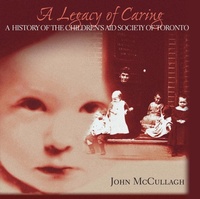
A Legacy of Caring
Description

Begun in 1891, the Children's Aid Society of Toronto is the largest child welfare agency in North America. It has played a leading roll as an advocate of children's welfare; it has been instrumental in influencing child welfare practice not only in Ontario but all of Canada and elsewhere. With an emphasis on the post-World War II period, A Legacy of Caring examines the political, social, and economic factors that led to changes within the society itself as well as developments in legislation and social policy. The society has been a training ground for many highly committed professionals who have gone on to be leaders in other governmental and nongovernmental agencies in Canada and abroad.
More details
Other editions
Additional editions

Persons
For 33 years until his retirement in 2001, John McCullagh was a child welfare worker in Canada, the United States, and the United Kingdom. During most of that time, he was employed by the Children's Aid Society of Toronto, where he held a number of front line and management positions.
Dr. Gail Aitken is an alumnus of the Hospital for Sick Children and University of Toronto schools of nursing. She received her MA in Social Welfare Policy from McMaster University, and her Ph.D. in Social Work from the University of Toronto. She has been a nursing instructor and supervisor, a community activist developing children's services, and a social policy analyst, and has taught social policy, administration, and community practice at Ryerson Polytechnic University. She and her husband, Dr. Don Bellamy, live in Meaford, Ontario.
Donald Bellamy holds an MSW from the University of Toronto and a Doctor of Social Welfare from Columbia in New York City. After experience in rehabilitation and community work, he was a faculty member in social work at the University of Toronto for thirty years teaching social policy, planning, and research. He served on the Ontario Children's Services Review Board during the 1970s and 1980s. He co-authored Neighbours, a history of three social settlements in Toronto, with Harriet Parsons and Allan Irving. He and his wife Gail have four children and six grandchildren between them.
Content
- Cover
- Half title
- Title
- Copyright
- Dedication
- Table of Contents
- Acknowledgments
- Foreword
- Chapter 1: The Infants' Home, 1875-1890
- The development of social services in nineteenth-century Toronto
- Baby farms
- The founding of the Infants' Home
- Staffing
- Medical care
- Admissions and discharges
- Breast-feeding
- Life at the Infants' Home
- Advocacy and community development
- Funding
- Chapter 2: A Society to Protect Children, 1891-1919
- John Joseph Kelso
- Kelso's campaign against child labour
- The Humane Society of Toronto is established
- Children's Protection Act, 1888
- The origins of the children's aid movement
- The founding of the Children's Aid Society of Toronto
- John Kidson MacDonald
- The Children's Charter
- Kelso as superintendent of neglected and dependent children
- The children's shelter
- Life at the shelter
- "It is less expensive to save children than to punish criminals"
- Summer camp
- Substitute family care
- Managing the work
- Funding the work
- Conflict and concern
- Chapter 3: The Growth of Professionalism, 1920-1939
- Life in early-twentieth-century Toronto
- Vera Moberly
- Institutional care to boarding home care
- The closing of the Infants' Home shelter
- Stable funding for the Infants' Home
- Reform at the CAS
- John Kidson MacDonald resigns
- Bob Mills
- "From a jail to a home"
- Administrative restructuring
- The move to Charles and Isabella streets
- Protection work
- The development of boarding home care at the CAS
- Financial stability
- The Infants' Home's work with unmarried mothers
- Adoption Act, 1921
- The end of the Kelso era
- Chapter 4: War and its Aftermath, 1940-1949
- Canada at war
- British "war guests"
- "Our boys in the King's Forces"
- Services to soldiers' families
- Post-war staffing challenges
- Foster home shortage and a new Receiving Centre
- Retirements of Vera Moberly and Bob Mills
- Belle Carver and Stewart Sutton
- Chapter 5: Amalgamation and Growth, 1950-1964
- Toronto at mid-century
- Amalgamation of CAS and Infants' Homes
- The challenges posed by amalgamation
- A new Child Welfare Centre
- Expansion to the suburbs
- Stewart Sutton resigns
- Lloyd Richardson
- Child Welfare Act, 1954
- "Changing the course of human life"
- Protection work
- Work with unmarried parents
- Adoption
- Foster family and group home care
- Institutional care
- The Receiving Centre
- Moberly House
- The society's busiest year
- Chapter 6: The Golden Years, 1965-1977
- Toronto in the 1960s and 1970s
- The role of children's aid societies
- Child Welfare Act, 1965
- The agency reorganizes
- Prevention and early intervention
- Family services
- Community development
- Homemaker service
- Alternate care
- Services to youth
- Child abuse and neglect
- Services to children in care
- Homefinding
- Foster family care
- Foster Parent Association
- Residences
- Adoption
- Medical services
- Volunteers
- Lloyd Richardson retires and is succeeded by Ed Watson
- Pressures for accountability, productivity and efficiency
- The society's response to provincial expectations
- Union certification
- A birthday celebration
- Ed Watson resigns
- Chapter 7: Improving the System, 1978-1988
- Toronto in the 1980s
- The death of Vicky Ellis
- The difficulties of protecting children
- Making it easier to protect children
- Child Welfare Act, 1978
- Doug Barr
- Child and Family Services Act, 1984
- A CAS Foundation to prevent child abuse
- The High Risk Infant Program
- Sexual abuse
- Adoption
- The changing role of foster parents
- Advocacy
- Multiculturalism
- Accountability
- Cost cutting
- Doug Barr resigns
- Mel Finlay
- The unionized staff go on strike
- Mel Finlay resigns
- Foster parent slowdown
- Pape Adolescent Resource Centre
- Innovation and leadership
- Chapter 8: Recession and Reform, 1989-1998
- Toronto in the 1990s
- Bruce Rivers
- Metro CAS in the Nineties
- Funding and service challenges of the early 1990s
- Early intervention and prevention
- Primary prevention through community development
- Community partnerships
- Young people at risk: homeless and runaway youth
- Young people at risk: lesbian, gay and bisexual youth
- Child welfare practice in a diverse community
- Growing up in care
- Continuity of Care
- Fostering for Metro CAS
- Adoption in the 1990s
- Volunteering at Metro CAS
- Looking back to the past and forward to the future
- A new direction for the CAS Foundation
- Child Mortality Task Force
- The deaths of Shanay Johnson and Jennifer Koval's'kyj-England
- Child Welfare Reform
- Epilogue
- Appendix 1: Names by which the Agency Has Been Known
- Appendix 2: Presidents and Chief Executive Officers
- Appendix 3: Administrative Offices and Shelters
- Appendix 4: Bibliography and a Note on Sources
- Index
