

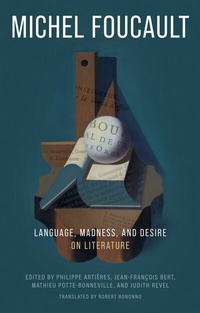
Language, Madness, and Desire
Description

As a transformative thinker of the twentieth century, whose work spanned all branches of the humanities, Michel Foucault had a complex and profound relationship with literature. And yet this critical aspect of his thought, because it was largely expressed in speeches and interviews, remains virtually unknown to even his most loyal readers. This book brings together previously unpublished transcripts of oral presentations in which Foucault speaks at length about literature and its links to some of his principal themes: madness, language and criticism, and truth and desire.
The associations between madness and language - and madness and silence - preoccupy Foucault in two 1963 radio broadcasts, presented here, in which he ranges among literary examples from Cervantes and Shakespeare to Diderot, before taking up questions about Artaud's literary correspondence, 'lettres de cachet', and the materiality of language. In his lectures on the relations among language, the literary work, and literature, he discusses Joyce, Proust, Chateaubriand, Racine, and Corneille, as well as the linguist Roman Jakobson. What we know as literature, Foucault contends, begins with the Marquis de Sade, to whose writing - particularly La Nouvelle Justine and Juliette - he devotes a full two-part lecture series focusing on notions of literary self-consciousness.
This volume makes clear the importance of literature to Foucault's thought and it is an indispensable text for anyone interested in his work and intellectual development.
More details
Other editions
Additional editions
Persons
Content
Editors' Introduction
Note on the Text
Language, Madness, and Desire
Language and Madness
The Silence of the Mad
Mad Language
Literature and Language
Session 1: What Is Literature?
Session 2: What Is the Language of Literature?
Lectures on Sade
Session 1: Why Did Sade Write?
Session 2: Theoretical Discourses and Erotic Scenes
Editors' Notes
Editors' Introduction
"At one time, I read a great deal of what is referred to as 'literature.' In the end, I rejected many of them because of inability, most likely because I didn't have the right code to read them. Now [1975] we have books such as Under the Volcano and The Opposing Shore. A writer I like very much is Jean Demelier; I was very impressed with Le rêve de Job. Tony Duvert's work as well. For those of my generation, great literature was American literature, it was Faulkner. It's reasonable to assume that having access to contemporary literature through foreign literature alone, whose source one can never reach, introduces a kind of distance with respect to literature. Literature was the great unknown."1
In this 1975 interview about Jacques Almira's Le voyage à Naucratis (the manuscript of which he received in the mail), Foucault indulged in a rare description of the literature in his library.2 As we can see, this short list is very diverse. The range of Foucault's readings extended from young authors like Jean Demelier3 and Jacques Almira to Julien Gracq. At the same time, he expressed his admiration for Thomas Mann, Malcolm Lowry, and William Faulkner,4 an admiration that, in 1970, led him to visit Faulkner's world, traveling the Mississippi River valley all the way to Natchez. Foucault's history as a reader has yet to be fully explored. According to his brother, in their childhood home in Poitou, two separate libraries confronted one another: one was paternal-learned, medical, and off limits-and resided in the office of his father, a surgeon; the other was maternal, literary, and open. There, Foucault discovered Balzac, Flaubert, and classical literature. At school, where he was educated by members of the Catholic clergy, he read Greek and Latin.5 It was on the Rue d'Ulm, where he had access to the amazing library of the École Normale Supérieure, one of the leading public libraries in France, which held poetry and philosophical treatises, critical essays and historical texts, that Foucault was able to experience a form of unrestricted reading. In the ENS library, maintained by Maurice Boulez, he deconstructed an order of discourse, and literature appeared before his eyes.6 Daniel Defert, in his chronology in Dits et écrits, provides some additional information: Foucault read Saint-John Perse in 1950, Kafka in 1951, Bataille and Blanchot in 1953, followed the progress of the nouveau roman (including the work of Alain Robbe-Grillet), discovered Raymond Roussel in the summer of 1957, the authors associated with Tel Quel (Philippe Sollers, Claude Ollier) in 1963, reread Becket in January 1968.
We cannot overlook the importance of Foucault's foreign travels in 1956: daily trips to the archives of the Maison de France in Uppsala and the Centre de civilisation française in Warsaw had a significant effect on Foucault's close relationship to literary language. Amid the solitude of the Swedish and Polish winter, Foucault read a great deal-René Char's poetry was his bedtime reading-and taught literature. It was there, surrounded by two languages that were foreign to him, that he underwent his first great experience with writing, there too that he taught French several hours a week and several courses on French literature, including a memorable lecture on love in French literature from Sade to Genet. In Sweden, Foucault led a theater club, where he put on several contemporary works with his students.7 In 1959, in Cracow and Gdansk, he gave lectures on Apollinaire. More anecdotal evidence in the history of Foucault the reader is found in his meetings, while in Uppsala, with Claude Simon, Roland Barthes, and Albert Camus, who had come to receive the Nobel Prize. Just as, toward the end of his life, he frequented several young writers (Mathieu Lindon, Hervé Guibert) without ever "discussing" literature, it is likely that he read these authors without ever entering into a dialogue with them, just as he never met Maurice Blanchot, claiming that "he admired him too much to become friends with him."8 During the early 1960s, Foucault engaged in an intimacy with literature that is apparent from an examination of his preparatory notes for the History of Madness. An investigation of the archives of institutionalization, registers from Bicêtre, as well as lettres de cachet served initially as a literary experience, which he would later describe to the historian Arlette Farge in the introduction to Le désordre des familles.9 Foucault was drawn to the beauty of the poetics of the archive, these pure graphic existences, which he himself referred to as "the course that literature would follow from the seventeenth century onward."10
Nonetheless, he continued to guard himself against such intimacy. For example, Foucault describes his first encounter with the work of Raymond Roussel, an author to whom he devoted an entire book in 1963, as follows: At the José Corti bookstore, "I found my attention drawn to a series of books of that faded yellow color used by publishing firms of the late nineteenth century . I came upon the work of someone I had never heard of named Raymond Roussel, and the book was entitled La Vue. Well, from the first line I was completely taken by the beauty of the style."11
The "great unknown" would, in fact, be a clandestine moment; for Foucault was not just a demanding reader and a writer whose style, with the release of each of his books, came to be admired and recognized. Reading him closely, at a time when we have access not only to his major publications but also to his collected writings (Dits et écrits) and his lectures at the Collège de France, it has become clear that the philosopher's relationship with literature-the documents contained in the present volume are a magnificent testimony to this-was complex, critical, and strategic.
In reading the many prefaces, interviews, and lectures that Foucault devoted to literature in the 1960s (whether they address writers such as Blanchot and Bataille directly or examine the traditional units of literary criticism in terms of a critique of the author or a general description of the space of language), and in recalling that these texts not only form an insistent counterpoint to the great "archaeological" works but reveal, even within those works, a discrete echo through their references to Orestes or Rameau's Nephew (The History of Madness), to Sade (Birth of the Clinic), or to Cervantes (The Order of Things), we obtain a better grasp of the singularity of this concern for the literary. Although it forms an integral part of the attitude of an entire generation and prolongs an insistent component of French thought that consists in treating fiction and poetry as touchstones of the philosophical act (a standard against which Bachelard, Sartre, and Merleau-Ponty are successively measured), Foucault's concern takes the form of an intensification of his own discourse. An intensification or, rather, a permanent doubling, that is to say, tentative, extreme, expressing both the order of the world and its representations at a given moment (which we know of, from the development of Foucault's research, as the archaeological description of a "system of thought") and what, paradoxically, would represent, in spite of everything, the dimension of excess, the immoderate, the outside. Where the great early works, notwithstanding the variations in their specific object (madness, the clinic, the birth of the social sciences), analyzed just how much our way of organizing discourse about the world owed to a series of historically determined divisions, the texts on literature, which are contemporary with them, appear, on the contrary, to employ an entire range of strange figures-intransigent writers, frozen words, labyrinths of writing-that embodied, if not an explicit refusal, at least a notable exception. Only once do the "orientation of the books" and that of Foucault's literary texts overlap. This occurs in Death and the Labyrinth,12 his book on Raymond Roussel, the only work in which historical and epistemic inquiry appear to have completely disappeared, to be reformulated, indirectly, in terms of precisely that which brings about the failure of the order of discourse: a gesture, no doubt-that of writing-but also something that immediately implies a way of using literature as a strategy. Throughout this period Foucault is led to simultaneously maintain, to bring into play both the non-specificity of literature and its opposite, its strategic centrality. In the first case-that of archaeological inquiry-literature possesses no specificity in comparison with other discursive productions (official documents, treatises, excerpts from archives, encyclopedias, scholarly works, private letters, journals); in the second ("literary" texts), it is a question of expressing, within literature itself, a relationship between a posture and procedures of writing that, because they appear in a particular form, engender something like an experience of dis-order, the realization of a rupture: a matrix of change, an operator of metamorphosis. In short, the implacable correlation of words and things, on...
