

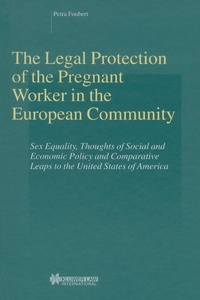
The Legal Protection of the Pregnant Worker in the European Community
Sex Equality, Thoughts of Social and Economic Policy and Comparative Leaps to the United States of America
Published on 1. July 2002
408 pages
978-90-411-7513-7 (ISBN)
Description

At the intersection of the private sphere of the household and the public sphere of the labour market and paid work lie four essential human realities: pregnancy, childbirth, breastfeeding, and childrearing. Do these factors make women unattractive as workers and cause them to be discriminated against in the labour market-place? This provocative study sets out to answer this question through an in-depth analysis of theory and actuality in the European Union, providing detailed analysis of EC legal measures and ECJ case law. The author's very convincing conclusions are bolstered by a revealing comparison with similar legislation and jurisprudence in the United States.
The focus of the study is on the relatively narrow area of sex discrimination, i.e., discrimination because of the biological factors of pregnancy, childbirth, and breastfeeding. The author demonstrates that an understanding of this specific and measurable kind of discrimination is the first step toward discrediting the wider category of gender discrimination, which penalizes women as full-time caregivers who cannot be relied upon as workers in the market-place. She examines numerous instances of unequal treatment on biological grounds, and in the process appraises the legal limits of accommodation of the biological di men and women.
Drawing on a wealth of interdisciplinary sources, the primarily legal dimension of this study is securely underpinned by reference to scholarship in the historical, social and economic rationales for discriminatory attitudes toward pregnancy, childbirth, and breastfeeding. The resulting work is an insightful investigation of the possible reasons why, despite legislative and judicial initiatives, both Europe and America have failed in putting equality into practice for male and female workers. It is a profound study that promises to generate a new and deeper level of discourse on this central issue at what seems to be a turning point in the field of labour law.
The focus of the study is on the relatively narrow area of sex discrimination, i.e., discrimination because of the biological factors of pregnancy, childbirth, and breastfeeding. The author demonstrates that an understanding of this specific and measurable kind of discrimination is the first step toward discrediting the wider category of gender discrimination, which penalizes women as full-time caregivers who cannot be relied upon as workers in the market-place. She examines numerous instances of unequal treatment on biological grounds, and in the process appraises the legal limits of accommodation of the biological di men and women.
Drawing on a wealth of interdisciplinary sources, the primarily legal dimension of this study is securely underpinned by reference to scholarship in the historical, social and economic rationales for discriminatory attitudes toward pregnancy, childbirth, and breastfeeding. The resulting work is an insightful investigation of the possible reasons why, despite legislative and judicial initiatives, both Europe and America have failed in putting equality into practice for male and female workers. It is a profound study that promises to generate a new and deeper level of discourse on this central issue at what seems to be a turning point in the field of labour law.
More details
Other editions
Additional editions
Petra Foubert
The Legal Protection of the Pregnant Worker in the European Market
Sex Equality, Thoughts of Social and Economic Policy and Comparative Leaps to the United States of America
Book
07/2002
1st Edition
Kluwer Law International
€139.10
Shipment within 10-20 days
Content
- Cover
- Half Title Page
- Title Page
- Copyright Page
- Table of Contents
- Preface
- List of Abbreviations
- Introduction
- A. BACKGROUND THOUGHTS
- B. SCOPE AND OBJECTIVE OF THIS STUDY
- Chapter I THEORETICAL FRAMEWORK
- A. SEX EQUALITY AND DISCRIMINATION: THE CASE OF THE LABOUR MARKET
- 1. Legal Theories of Sex Equality/Difference and Discrimination
- a. Legal Theories of Equality and Difference
- (1) Equality, Difference and Comparability
- (a) The influence of society
- (b) The purpose of the law
- (c) The importance of a comparator/standard
- (2) Different Approaches to Equality and Difference
- (a) Formal equality
- (b) Substantive equality
- (i) Affirmative/positive action
- (ii) Unequal treatment of factually and legally unequal situations
- b. Discrimination Sensu Lato
- (1) Different Forms of Discrimination Sensu Lato
- (a) Overt/direct discrimination
- (b) Covert/indirect discrimination
- (i) Neutral practices that disadvantage a subordinated group
- (ii) Discrimination through like treatment of legally unlike cases
- (2) Justifying Discrimination
- (a) Justification of overt/direct discrimination
- (b) Justification of covert/indirect discrimination
- (c) The limits of justification
- 2. Discrimination of Women in the Labour Market
- B. PREGNANCY DISCRIMINATION AS KEY ASPECT OF DISCRIMINATION AGAINST WOMEN IN THE LABOUR MARKET
- 1. Pregnancy, childbirth and breastfeeding as biological obstacles to a career
- a. Pregnancy and Maternity: Terminological Considerations
- b. Pregnancy, Childbirth and Breastfeeding as Unique Female Biological Conditions
- c. Pregnancy: Illness, Natural Condition or Sui Generis?
- 2. Pregnancy Discrimination as Economically Rational Discrimination: The Economics of Sex Discrimination in the Market Place
- 3. Theoretical Scheme
- C. THE EUROPEAN COMMUNITY AND THE UNITED STATES
- 1. The EC and the US as Laboratories for Legal Research on Pregnancy Discrimination
- 2. The Impact of Societal Values
- Chapter II PROTECTION OF PREGNANT EMPLOYEES AND EMPLOYEES WHO HAVE JUST GIVEN BIRTH OR ARE BREASTFEEDING IN THE EUROPEAN COMMUNITY (EC)
- A. A SNAPSHOT OF WORKING WOMEN IN THE EC
- 1. A European Woman's Work in Family and Wage Economies
- 2. Growing Female Labour Force Since World War II
- 3. Flexibility and the Understanding of What is Vital to Survival as Key Factors in the Evolution
- B. AN ANALYSIS OF THE EC MEASURES CONCERNING PREGNANT AND BREASTFEEDING EMPLOYEES
- 1. The Powers of the European Community in the Social Field
- a. A Sui Generis International Organisation
- b. EC Objectives in the Social Field
- c. The Principle of Attributed Powers
- 2. Overview of EC Legal Measures Regarding Pregnancy, Childbirth and Breastfeeding
- a. A Discrimination Issue
- (1) The Prohibition of Discrimination in the European Community
- (2) The Prohibition of Discrimination on Grounds of Pregnancy, Childbirth and Breastfeeding in the European Community
- (a) The equal treatment directive's provision regarding pregnancy and maternity
- (b) The correct interpretation of Article 2(3) of the equal treatment directive
- b. A Health and Safety Issue
- (1) The Member States' Protective Legislation for Women and the Equal Treatment Directive
- (2) The Pregnancy Directive
- (a) The relationship between the pregnancy and the equal treatment directives
- (b) The sex discriminatory traits of the pregnancy directive
- (i) Protection against hazardous agents, processes or working conditions
- (ii) Night work
- (iii) Maternity leave
- (iv) Time off for pre-natal examinations
- (v) Prohibition of dismissal
- (vi) Employment rights
- (vii) Defence of rights and implementation of the directive
- (3) Conclusion
- c. The burden of proof in cases of discrimination on grounds of pregnancy, childbirth and breastfeeding
- C. AN ANALYSIS OF THE RELEVANT CASE LAW OF THE EUROPEAN COURT OF JUSTICE
- 1. Introduction: The Role of the European Court of Justice (ECJ)
- 2. The Court of Justice's Interpretation of EC Measures Regarding Pregnancy, Childbirth and Breastfeeding
- a. Child-Care (Parental) Leave under the Guise of Maternity Leave
- (1) Commission v. Italy (1983)
- (2) Hofmann v. Barmer Ersatzkasse (1984)
- (3) Commission v. France (1988)
- (4) Burrill and Noriega Guerra v. Commission (1999)
- (5) Conclusion
- b. The Cornerstone Cases: Dekker and Hertz
- (1) Dekker v. VJV (1990)
- (2) Hertz v. DanskArbejdsgiverforening (1990)
- (3) Preliminary Conclusion from Dekker and Hertz
- c. Pregnancy Discrimination as (In)direct Discrimination: Possibility of Justification and Consequences for the Distribution of Costs
- (1) Habermann-Beltermann v. Arbeiterwohlfahrt (1994)
- (2) Mahlburg v. Land Mecklenburg-Vorpommern (2000)
- (3) Webb v. EMO (1994)
- (4) Tele Danmark v. Handels- og Kontorfunktionaerernes Forbund i Danmark (2001)
- (5) Preliminary Conclusion from Habermann-Beltermann, Mahlburg, Webb and Tele Danmark
- d. From 'Effective Interpretation' to 'Substantive Equality'
- (1) Gillespie v. Northern Health and Social Services Board (1996)
- (2) Abdoulaye and Others v. Renault (1999)
- (3) CNAVTS v. Thibault (1998)
- (4) Preliminary Conclusion from Gillespie, Abdoulaye and Thibault
- e. Pregnancy-Related Illness Beyond Maternity Leave: (Ir)relevance of a (Male) Comparator?
- (1) Larsson v. Fotex Supermarked (1997)
- (2) Brown v. Rentokil (1998)
- (3) Pedersen and Others v. Faellesforeningen for Danmarks Brugsforeninger (1998)
- (4) Preliminary Conclusion from Larsson, Brown and Pedersen
- f. The Pregnancy Directive: Pregnancy Lifted Out of the Equality Debate
- (1) Boyle and Others v. Equal Opportunities Commission (1998)
- (2) Lewen v. Lothar Denda (1999)
- (3) Preliminary Conclusion from Boyle and Lewen
- D. PRELIMINARY CONCLUSION
- 1. The Courts and the EC Legislators Proactive Approach Regarding Equal Pay for Work of Equal Value: An Anomaly?
- 2. The Court sand the EC Legislator s Reserved Approach with Respect to Pregnancy, Childbirth and Breastfeeding
- 3. Encouraging the Court of Justice
- Chapter III PREGNANCY PROTECTION IN THE UNITED STATES (US)
- A. THE WORKING WOMAN IN THE US
- 1. Women's Work in the Young American Nation
- 2. Women's Current Participation in the American Labour Market
- 3. The Link Between Sex Inequality in the Job Market and the Separate Spheres Ideology
- B. AN ANALYSIS OF AMERICAN MEASURES CONCERNING PREGNANT AND BREASTFEEDING EMPLOYEES
- 1. A State or a Federal Competence?
- a. The US: A Federal State
- b. The Division of Competencies in the American Federal State
- c. The Competence to Regulate the Effects of Pregnancy, Childbirth and Breastfeeding in the Labour Market
- 2. An Overview of American Pregnancy, Childbirth and Breastfeeding Measures
- a. Measures that Approach Pregnancy, Childbirth and Breastfeeding as a Discrimination Issue
- (1) The Equal Protection Clause of the Fourteenth Amendment
- (a) History of the clause
- (b) Personal scope
- (c) Material scope
- (2) The Due Process Clauses of the Fifth and Fourteenth Amendments
- (3) Title VII of the Civil Rights Act of 1964 as Amended
- (a) History of Title VII
- (b) Personal scope
- ( c ) Material scope
- (i) Disparate treatment
- (ii) Disparate impact
- b. Measures Approaching Pregnancy, Childbirth and Breastfeeding as a Health and Safety Issue
- (1) Negative/Restrictive Protective Measures
- (2) Positive/Enhancing Protective Measures
- (a) The American feminist debate
- (b) The States' response
- (c) The Federal Government's response
- C. THE INTERPRETATION OF AMERICAN PREGNANCY/ BREASTFEEDING MEASURES BY THE US SUPREME COURT
- 1. Introduction: The Role of the US Supreme Court
- 2. The Interpretation of Pregnancy, Childbirth and Breastfeeding Measures by the US Supreme Court
- a. Prior to the Adoption of the Civil Rights Act of 1964: Muller v. Oregon (1908)
- b. After the Adoption of the Civil Rights Act of 1964
- (1) Constitutional Cases
- (a) Cleveland Board of Education v. LaFleur (1974)
- (b) Geduldig v. Aiello (1974)
- (2) Title VII Case Law
- (a) Prior to the adoption of the PDA (1978)
- (i) General Electric Co. v. Gilbert (1976)
- (ii) Nashville Gas Co. v. Satty (1977)
- (b) 1978 and beyond
- (i) The PDA confirmed: Newport News Shipbuilding and Dry Dock Co. v. Equal Employment Opportunity Commission (1983)
- (ii) The fate of protective legislation
- D. PRELIMINARY CONCLUSION
- Chapter IV COMPARATIVE ANALYSIS AND SUGGESTIONS
- A. EUROPEAN AND AMERICAN PERSPECTIVES ON EQUALITY
- 1. Different Societies, Different Notions of Equality
- 2. Prohibition of Discrimination against Pregnant Employees and Employees Who Have Just Given Birth or Are Breastfeeding
- a. Childbirth Leave
- b. Pregnancy-Related Illness
- c. Breastfeeding
- d. The Comparative Standard
- 3. Preliminary Conclusion
- B. SUGGESTIONS FOR THE EC, AND FOR THE US
- 1. The Right Balance between Formal and Substantive Equality
- a. Childbirth Leave
- b. Pregnancy-Related Illness
- c. Breastfeeding
- d. The Comparative Standard
- 2. Flexibility and Understanding of What is Vital to Survival: A Lesson from the Past?
- a. Flexibility
- b. Understanding of What is Vital to Survival
- Bibliography
- Index
- Back Cover
