

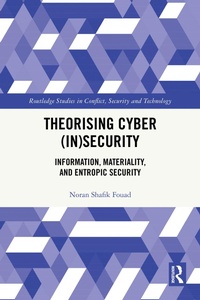
Theorising Cyber (In)Security
Information, Materiality, and Entropic Security
1st Edition
Published on 2. December 2024
176 pages
978-1-040-26315-0 (ISBN)
Description

This book argues that cybersecurity's informational ontology offers empirical challenges, and introduces a new interdisciplinary theoretical and conceptual framework of 'entropic security'.
Cyber-attacks have been growing exponentially in number and sophistication; ranging from those conducted by non-state actors to state-backed cyber-attacks. Accordingly, cybersecurity now constitutes an integral part of public, private, and academic discourses on contemporary (in)security. Yet, because its emergence as a novel security field occurred after many long-established frameworks had already been developed, cybersecurity has been repeatedly scrutinised for its compatibility with conventional security theories, concepts, and understandings, particularly with that of military security. This book, however, argues that cybersecurity differs profoundly from many other security sectors because of the ontological nature of 'information' that sits at the heart of this field. Through this new framework, the book investigates three key empirical challenges in cybersecurity that are co-produced by its informational ontology: (1) the disordered nature of cybersecurity and its tendency towards increasing insecurity as a manifestation of the intrinsic uncertainties in information systems; (2) the unpredictable and unintended consequences resulting from autonomous cyber-attacks that challenge human control of cybersecurity environments; and (3) the persistent harms engendered by 'mundane' cyber threats that do not fit within conventional understandings of existentiality in security theories. Through a detailed analysis of cybersecurity discourses and practices in the USA (2003-present), the book goes on to show how these complex cybersecurity challenges are better analysed and theorised through the new information-theoretic notion of 'entropic security'.
This book will be of much interest to students of cyber-security, critical security studies, science and technology studies and International Relations in general.
Cyber-attacks have been growing exponentially in number and sophistication; ranging from those conducted by non-state actors to state-backed cyber-attacks. Accordingly, cybersecurity now constitutes an integral part of public, private, and academic discourses on contemporary (in)security. Yet, because its emergence as a novel security field occurred after many long-established frameworks had already been developed, cybersecurity has been repeatedly scrutinised for its compatibility with conventional security theories, concepts, and understandings, particularly with that of military security. This book, however, argues that cybersecurity differs profoundly from many other security sectors because of the ontological nature of 'information' that sits at the heart of this field. Through this new framework, the book investigates three key empirical challenges in cybersecurity that are co-produced by its informational ontology: (1) the disordered nature of cybersecurity and its tendency towards increasing insecurity as a manifestation of the intrinsic uncertainties in information systems; (2) the unpredictable and unintended consequences resulting from autonomous cyber-attacks that challenge human control of cybersecurity environments; and (3) the persistent harms engendered by 'mundane' cyber threats that do not fit within conventional understandings of existentiality in security theories. Through a detailed analysis of cybersecurity discourses and practices in the USA (2003-present), the book goes on to show how these complex cybersecurity challenges are better analysed and theorised through the new information-theoretic notion of 'entropic security'.
This book will be of much interest to students of cyber-security, critical security studies, science and technology studies and International Relations in general.
More details
Series
Edition
1. Auflage
Language
English
Place of publication
London
United Kingdom
Publishing group
Taylor & Francis Ltd
Target group
College/higher education
Professional and scholarly
ISBN-13
978-1-040-26315-0 (9781040263150)
Copyright in bibliographic data and cover images is held by Nielsen Book Services Limited or by the publishers or by their respective licensors: all rights reserved.
Schweitzer Classification
Other editions
Additional editions
Book
approx. 07/2026
1st Edition
Routledge
€57.50
Not yet published

Book
01/2025
Routledge
Unfortunately, price unknown
Available (delivery time upon request)
Book
12/2024
1st Edition
Routledge
€197.00
Shipment within 10-20 days
Person
Noran Shafik Fouad is a Senior Lecturer in Digital Politics at Manchester Metropolitan University, UK, and has a PhD in International Relations from the University of Sussex, UK.
Content
1: Introduction 2: The Co-production of Cybersecurity: Conceptualisation and Historical Overview 3: Theorising Cybersecurity as an Infosphere: The Philosophy of Information Meets Security Studies 4: Uncertainties and Disorders in Information Systems: Cyber Defence and the Logic of Negentropy 5: Informational Contingencies: From Emergency to Emergence 6: The Complex (Non-)Physicality of Information: The Existential, the Mundane, and the Logic of Noise 7: Conclusion
