

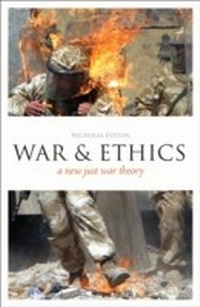
War and Ethics
A New Just War Theory
1st Edition
Published on 6. November 2007
192 pages
978-1-4411-4916-9 (ISBN)
Description

The US-led invasion of Iraq in 2003 prompted unprecedented public interest in the ethics of war, a debate that has raged furiously in the media, in politics and in the public consciousness ever since. In this fascinating and informative book, Nicholas Fotion, an expert on the ethics of military action, explores the notion of developing an ethical theory that guides the behaviour of those who are at war.
Fotion gives a clear account of just war theory, presenting it as a useful device in helping us make decisions about what we should do when war appears on the horizon. Examining conflicts such as Korea, Vietnam, Iraq, Israel, the Falklands and Afghanistan, the book interrogates the roles of the various parties involved in military action - the military, government officials, and the side-line judges (journalists, citizens, scholars, neutral nations) - and the role just war theory should play as a direct guide to behaviour. Articulate, provocative and stimulating, War and Ethics is an ideal introduction to this hugely important debate.
Fotion gives a clear account of just war theory, presenting it as a useful device in helping us make decisions about what we should do when war appears on the horizon. Examining conflicts such as Korea, Vietnam, Iraq, Israel, the Falklands and Afghanistan, the book interrogates the roles of the various parties involved in military action - the military, government officials, and the side-line judges (journalists, citizens, scholars, neutral nations) - and the role just war theory should play as a direct guide to behaviour. Articulate, provocative and stimulating, War and Ethics is an ideal introduction to this hugely important debate.
Reviews / Votes
'[This book] wrestles with one of the most compelling moral issues of this beginning century ... As always, Professor Fotion writes with conspicuous clarity in examining moral questions. Readers may not agree with some of his analyses and conclusions, but they will have no doubt about his position and his reasons for holding it. His compelling case studies demonstrate both the content of and the process of applying moral constraints on war. He shows us that the way a civilized society fights for survival not only determines whether it wins or loses, but also plays a major role in shaping its future when it wins, an obvious fact frequently forgotten in the urgency of armed conflict'. Colonel Anthony E. Hartle, Professor of Ethics at West Point, USA 'With this thought-provoking, incisive and yet wonderfully accessible book, Nick Fotion succeeds in showing that the centuries-old Just War Theory still has its use in our modern world'. Carl Ceulemans, Royal Military Academy, Brussels 'Nick Fotion's timely book rejects the view of many critics that just war theory is flawed beyond repair or hopelessly outdated...The book offers much food for thought for teachers and students of philosophy and politics. It is written in an accessible and lively way, and will also be of great interest to the general reader'. Igor Primoratz, Centre for Applied Philosophy and Public Ethics, University of Melbourne, Australia 'Fotion's treatment is exceedingly clear and chock full of concrete historical examples that make vivid the principles at stake. The style and content will be accessible and helpful to anyone concerned with these vital issues: the serious undergraduate, the military officer, the policy maker or the seasoned scholar'. Professor J. Carl Ficarrotta, United States Air Force Academy, USA "This excellent little book is part of the Think Now series, which according to the jacket notes "offer sophisticated and provocative yet engaging writing on political and cultural themes of genuine concern to the educated reader." If the other works in the series are of a similar standard as this book, then the series looks to be a very worthwhile one... This book is a well-written examination of modern Just War Theory, and well worth the time it takes to read and consider." Stephen Coleman, University of New South Wales, Australia, 2009.More details
Series
Edition
1. Auflage
Language
English
Place of publication
New York
United States
Target group
Professional and scholarly
ISBN-13
978-1-4411-4916-9 (9781441149169)
Copyright in bibliographic data and cover images is held by Nielsen Book Services Limited or by the publishers or by their respective licensors: all rights reserved.
Schweitzer Classification
Person
Nicholas Fotion is Professor of Philosophy at Emory University, USA. He has published widely on the ethics of military action. He is also author of John Searle in Acumen's Philosophy Now series.
Content
Preface
1. Introduction
2. Just War Theory
3. Objections to Just War Theory
4. Easy Cases: Germany, Japan, Korea
5. Harder Cases: Serbia, Russia, Kosovo, Iraq
6. Multiple Reasons
7. More Problems for Just War Theory
8. Prevention: Sri Lanka, Thailand
9. Two Just War Theories
10. Problems with Just War Theory I
11. Problems with Just War Theory II
12. Closing Thoughts
Notes
Bibliography
Index
1. Introduction
2. Just War Theory
3. Objections to Just War Theory
4. Easy Cases: Germany, Japan, Korea
5. Harder Cases: Serbia, Russia, Kosovo, Iraq
6. Multiple Reasons
7. More Problems for Just War Theory
8. Prevention: Sri Lanka, Thailand
9. Two Just War Theories
10. Problems with Just War Theory I
11. Problems with Just War Theory II
12. Closing Thoughts
Notes
Bibliography
Index
