

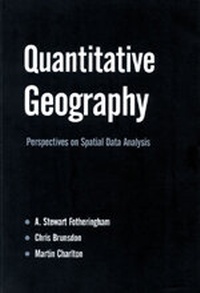
Quantitative Geography
Perspectives on Spatial Data Analysis
1st Edition
Published on 11. January 2000
288 pages
978-1-84787-641-6 (ISBN)
Description

Integrating a discussion of the application of quantitative methods with practical examples, this book explains the philosophy of the new quantitative methodologies and contrasts them with the methods associated with geography's `Quantitative Revolution' of the 1960s. Key issues discussed include: the nature of modern quantitative geography; spatial data; geographical information systems; visualization; local analysis; point pattern analysis; spatial regression; and statistical inference. Concluding with a review of models used in spatial theory, the authors discuss the current challenges to spatial data analysis.
Written to be accessible, to communicate the diversity and excitement of recent thinking, Quantitative Geography will be required reading for students and researchers in any discipline where quantitative methods are used to analyse spatial data.
`This is a veritable tour de force of everything that is exciting about quantitative geography and GIS. It is a timely, thorough and exciting account of the state of the art and science of spatial analysis' - Paul Longley, University of Bristol
`A highly innovative and up-to-date text. It is unique in its coverage of the many developments that have taken place in the field over the past few years. The book is one that is highly readable and stimulating for those with some background in the field, and its expositional style and many examples will make it stimulating to newcomers as well' - Peter Rogerson, State University of New York at Buffalo
`Brings the field thoroughly up to date, integrating modern methods of GIS with a comprehensive and easy-to-read overview of the most recent and powerful techniques of spatial analysis. The book will be valuable to students and researchers in any discipline that seeks to explore or explain phenomena in geographical context, and will make excellent reading for geographers, political scientists, criminologists, anthropologists, geologists, epidemiologists, ecologists, and many others. It offers a spirited challenge to critics of a scientific approach to social science, and demonstrates the value of its subject matter through abundant examples' - Michael Goodchild, National Center for Geographic Information and Analysis, University of California, Santa Barbara
`There is a view within some parts of academic geography that what used to be called "quantitative geography" is dead, having been subsumed within "geographical information systems" or else of no continuing interest. This book should correct this view. First, it shows that quantitative methods have remained an exciting area of development and, second, it shows that, if anything, they have more relevance to substantive problems of interest than they have ever had. Although not specifically about GIS, it is a book that should be read by everyone concerned with the analysis of geographical information' - David Unwin, Birkbeck College, University of London
Written to be accessible, to communicate the diversity and excitement of recent thinking, Quantitative Geography will be required reading for students and researchers in any discipline where quantitative methods are used to analyse spatial data.
`This is a veritable tour de force of everything that is exciting about quantitative geography and GIS. It is a timely, thorough and exciting account of the state of the art and science of spatial analysis' - Paul Longley, University of Bristol
`A highly innovative and up-to-date text. It is unique in its coverage of the many developments that have taken place in the field over the past few years. The book is one that is highly readable and stimulating for those with some background in the field, and its expositional style and many examples will make it stimulating to newcomers as well' - Peter Rogerson, State University of New York at Buffalo
`Brings the field thoroughly up to date, integrating modern methods of GIS with a comprehensive and easy-to-read overview of the most recent and powerful techniques of spatial analysis. The book will be valuable to students and researchers in any discipline that seeks to explore or explain phenomena in geographical context, and will make excellent reading for geographers, political scientists, criminologists, anthropologists, geologists, epidemiologists, ecologists, and many others. It offers a spirited challenge to critics of a scientific approach to social science, and demonstrates the value of its subject matter through abundant examples' - Michael Goodchild, National Center for Geographic Information and Analysis, University of California, Santa Barbara
`There is a view within some parts of academic geography that what used to be called "quantitative geography" is dead, having been subsumed within "geographical information systems" or else of no continuing interest. This book should correct this view. First, it shows that quantitative methods have remained an exciting area of development and, second, it shows that, if anything, they have more relevance to substantive problems of interest than they have ever had. Although not specifically about GIS, it is a book that should be read by everyone concerned with the analysis of geographical information' - David Unwin, Birkbeck College, University of London
Reviews / Votes
`This is a veritable tour de force of everything that is exciting about quantitative geography and GIS. It is a timely, thorough and exciting account of the state of the art and science of spatial analysis' - Paul Longley, University of Bristol`A highly innovative and up-to-date text. It is unique in its coverage of the many developments that have taken place in the field over the past few years. The book is one that is highly readable and stimulating for those with some background in the field, and its expositional style and many examples will make it stimulating to newcomers as well' - Peter Rogerson, State University of New York at Buffalo
`Brings the field thoroughly up to date, integrating modern methods of GIS with a comprehensive and easy-to-read overview of the most recent and powerful techniques of spatial analysis. The book will be valuable to students and researchers in any discipline that seeks to explore or explain phenomena in geographical context, and will make excellent reading for geographers, political scientists, criminologists, anthropologists, geologists, epidemiologists, ecologists, and many others. It offers a spirited challenge to critics of a scientific approach to social science, and demonstrates the value of its subject matter through abundant examples' - Michael Goodchild, National Center for Geographic Information and Analysis, University of California, Santa Barbara
`There is a view within some parts of academic geography that what used to be called "quantitative geography" is dead, having been subsumed within "geographical information systems" or else of no continuing interest. This book should correct this view. First, it shows that quantitative methods have remained an exciting area of development and, second, it shows that, if anything, they have more relevance to substantive problems of interest than they have ever had. Although not specifically about GIS, it is a book that should be read by everyone concerned with the analysis of geographical
information' - David Unwin, Birkbeck College, University of London
All prices
More details
Edition
First Edition
Language
English
Place of publication
London
United Kingdom
Target group
College/higher education
ISBN-13
978-1-84787-641-6 (9781847876416)
Copyright in bibliographic data and cover images is held by Nielsen Book Services Limited or by the publishers or by their respective licensors: all rights reserved.
Schweitzer Classification
Other editions
Additional editions
A. Stewart Fotheringham | Chris Brunsdon | Martin Charlton
Quantitative Geography
Perspectives on Spatial Data Analysis
Book
01/2000
1st Edition
SAGE Publications Inc
€229.30
Shipment within 15-20 days
A. Stewart Fotheringham | Chris Brunsdon | Martin Charlton
Quantitative Geography
Perspectives on Spatial Data Analysis
Book
01/2000
1st Edition
SAGE Publications Inc
€127.90
Shipment within 15-20 days
Persons
Chris Brunsdon is Professor of Geocomputation and Director of the National Centre for Geocomputation at the National University of Ireland, Maynooth, having worked previously in the Universities of Newcastle, Glamorgan, Leicester and Liverpool, variously in departments focusing on both geography and computing. He has interests that span both of these disciplines, including spatial statistics, geographical information science, and exploratory spatial data analysis, and in particular the application of these ideas to crime pattern analysis, the modelling of house prices, medical and health geography and the analysis of land use data. He was one of the originators of the technique of geographically weighted regression (GWR).
He has extensive experience of programming in R, going back to the late 1990s, and has developed a number of R packages which are currently available on CRAN, the Comprehensive R Archive Network. He is an advocate of free and open source software, and in particular the use of reproducible research methods, and has contributed to a large number of workshops on the use of R and of GWR in a number of countries, including the UK, Ireland, Japan, Canada, the USA, the Czech Republic and Australia.
When not involved in academic work he enjoys running, collecting clocks and watches, and cooking - the last of these probably cancelling out the benefits of the first.
Background:
Martin is an expert in the use of Geographical Information Systems and has been a leading researcher in this area for over 20 years. Until recently he was a lecturer in GIS at the University of Newcastle-upon-Tyne.
Research:
Martin, together with Stewart Fotheringham and Chris Brunsdon, is one of the originators of Geographically Weighted Regression, for which he has written much of the software.
He has extensive experience of programming in R, going back to the late 1990s, and has developed a number of R packages which are currently available on CRAN, the Comprehensive R Archive Network. He is an advocate of free and open source software, and in particular the use of reproducible research methods, and has contributed to a large number of workshops on the use of R and of GWR in a number of countries, including the UK, Ireland, Japan, Canada, the USA, the Czech Republic and Australia.
When not involved in academic work he enjoys running, collecting clocks and watches, and cooking - the last of these probably cancelling out the benefits of the first.
Background:
Martin is an expert in the use of Geographical Information Systems and has been a leading researcher in this area for over 20 years. Until recently he was a lecturer in GIS at the University of Newcastle-upon-Tyne.
Research:
Martin, together with Stewart Fotheringham and Chris Brunsdon, is one of the originators of Geographically Weighted Regression, for which he has written much of the software.
Content
Establishing the Boundaries
Spatial Data
The Role of Geographic Information Systems
Exploring Spatial Data Visually
Local Analysis
Point Pattern Analysis
Spatial Regression and Geostatistical Models
Statistical Inference for Spatial Data
Spatial Modelling and the Evolution of Spatial Theory
Challenges in Spatial Data Analysis
Spatial Data
The Role of Geographic Information Systems
Exploring Spatial Data Visually
Local Analysis
Point Pattern Analysis
Spatial Regression and Geostatistical Models
Statistical Inference for Spatial Data
Spatial Modelling and the Evolution of Spatial Theory
Challenges in Spatial Data Analysis
