

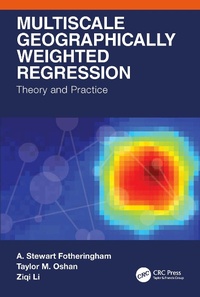
Multiscale Geographically Weighted Regression
Theory and Practice
1st Edition
Published on 15. November 2023
194 pages
978-1-000-98967-0 (ISBN)
Description

Multiscale geographically weighted regression (MGWR) is an important method that is used across many disciplines for exploring spatial heterogeneity and modeling local spatial processes. This book introduces the concepts behind local spatial modeling and explains how to model heterogeneous spatial processes within a regression framework. It starts with the basic ideas and fundamentals of local spatial modeling followed by a detailed discussion of scale issues and statistical inference related to MGWR. A comprehensive guide to free, user-friendly, software for MGWR is provided, as well as an example of the application of MGWR to understand voting behavior in the 2020 US Presidential election. Multiscale Geographically Weighted Regression: Theory and Practice is the definitive guide to local regression modeling and the analysis of spatially varying processes, a very cutting-edge, hands-on, and innovative resource.
Features
Provides a balance between conceptual and technical introduction to local models
Explains state-of-the-art spatial analysis technique for multiscale regression modeling
Describes best practices and provides a detailed walkthrough of freely available software, through examples and comparisons with other common spatial data modeling techniques
Includes a detailed case study to demonstrate methods and software
Takes a new and exciting angle on local spatial modeling using MGWR, an innovation to the previous local modeling 'bible' GWR
The book is ideal for senior undergraduate and graduate students in advanced spatial analysis and GIS courses taught in any spatial science discipline as well as for researchers, academics, and professionals who want to understand how location can affect human behavior through local regression modeling.
Features
Provides a balance between conceptual and technical introduction to local models
Explains state-of-the-art spatial analysis technique for multiscale regression modeling
Describes best practices and provides a detailed walkthrough of freely available software, through examples and comparisons with other common spatial data modeling techniques
Includes a detailed case study to demonstrate methods and software
Takes a new and exciting angle on local spatial modeling using MGWR, an innovation to the previous local modeling 'bible' GWR
The book is ideal for senior undergraduate and graduate students in advanced spatial analysis and GIS courses taught in any spatial science discipline as well as for researchers, academics, and professionals who want to understand how location can affect human behavior through local regression modeling.
More details
Edition
1. Auflage
Language
English
Place of publication
London
United Kingdom
Publishing group
Taylor & Francis Ltd
Target group
College/higher education
Professional and scholarly
Illustrations
1 Tables, color; 115 Tables, black and white; 25 Line drawings, black and white; 26 Halftones, color; 6 Halftones, black and white; 26 Illustrations, color; 31 Illustrations, black and white
ISBN-13
978-1-000-98967-0 (9781000989670)
Copyright in bibliographic data and cover images is held by Nielsen Book Services Limited or by the publishers or by their respective licensors: all rights reserved.
Schweitzer Classification
Other editions
Additional editions
A. Stewart Fotheringham | Taylor M. Oshan | Ziqi Li
Multiscale Geographically Weighted Regression
Theory and Practice
Book
approx. 06/2026
1st Edition
CRC Press
€69.00
Not yet published
A. Stewart Fotheringham | Taylor M. Oshan | Ziqi Li
Multiscale Geographically Weighted Regression
Theory and Practice
Book
11/2023
1st Edition
CRC Press
€155.50
Shipment within 10-20 days
Persons
A. Stewart Fotheringham is a Regents' Professor of Computational Spatial Science in the School of Geographical Sciences and Urban Planning at Arizona State University. He is also Director of the Spatial Analysis Research Center (SPARC) and a Distinguished Scientist in the Institute for Global Futures. He is a member of the US National Academy of Sciences and of Academia Europaea and a Fellow of both the UK's Academy of Social Sciences and the Association of American Geographers. He has been awarded over $15m in funding, published 12 books and over 250 research publications. He has over 36,000 citations according to Google Scholar as of March 2023. He is one of the top cited academics in the field of geography. He has been awarded the Lifetime Achievement Award by the Chinese Professional Association of GIS and the Distinguished Research Honors Award by the American Association of Geographers.
Taylor Oshan is an Assistant Professor in the Center for Geospatial Information Science in the Department of Geographical Sciences, University of Maryland, as well as an affiliate of the Social Data Science Center, the Maryland Population Research Center, and the Maryland Transportation Institute. His research focuses on developing and applying multiscale methods and local statistical models, particularly of human processes within urban environments, to understand how relationships change across different spatial contexts. He also leads projects to develop open source tools for spatial analysis, including the core algorithms for the Multiscale Geographically Weighted Regression software amongst others. He has published over 25 peer-reviewed manuscripts and has collaborated or lead funded projects totaling over $2.3m. He was elected as a board member in 2021 for the Spatial Analysis and Modeling specialty group of the American Association of Geographers and joined Applied Spatial Analysis and Policy as a co-editor-in-chief in 2023.
Ziqi Li is an Assistant Professor of Quantitative Geography in the Department of Geography at Florida State University. His research focuses on the methodological development of spatially explicit and explainable statistical and machine learning models, and he is one of the primary contributors to the field of Multiscale Geographically Weighted Regression. He has published over 20 peer-reviewed journal articles in these areas. He is a winner of multiple prestigious international awards including the Nystrom Award by the American Association of Geographers (AAG) in 2021 and the John Odland Award by the Spatial Analysis and Modeling Group of AAG in 2020.
Taylor Oshan is an Assistant Professor in the Center for Geospatial Information Science in the Department of Geographical Sciences, University of Maryland, as well as an affiliate of the Social Data Science Center, the Maryland Population Research Center, and the Maryland Transportation Institute. His research focuses on developing and applying multiscale methods and local statistical models, particularly of human processes within urban environments, to understand how relationships change across different spatial contexts. He also leads projects to develop open source tools for spatial analysis, including the core algorithms for the Multiscale Geographically Weighted Regression software amongst others. He has published over 25 peer-reviewed manuscripts and has collaborated or lead funded projects totaling over $2.3m. He was elected as a board member in 2021 for the Spatial Analysis and Modeling specialty group of the American Association of Geographers and joined Applied Spatial Analysis and Policy as a co-editor-in-chief in 2023.
Ziqi Li is an Assistant Professor of Quantitative Geography in the Department of Geography at Florida State University. His research focuses on the methodological development of spatially explicit and explainable statistical and machine learning models, and he is one of the primary contributors to the field of Multiscale Geographically Weighted Regression. He has published over 20 peer-reviewed journal articles in these areas. He is a winner of multiple prestigious international awards including the Nystrom Award by the American Association of Geographers (AAG) in 2021 and the John Odland Award by the Spatial Analysis and Modeling Group of AAG in 2020.
Content
1. Introduction to Local Modeling 2. MGWR: The Essentials 3. Inference 4. Spatial and Local Modeling 5. Software for MGWR 6. Caveat Emperor! 7. A Local Analysis of Voting Behavior 8. MGWR and Other Models Incorporating Spatial Contextual Effects 9. Epilogue
