

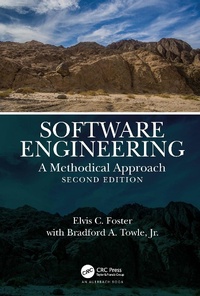
Software Engineering
A Methodical Approach, 2nd Edition
2nd Edition
Published on 19. July 2021
578 pages
978-1-000-39379-8 (ISBN)
Description

Software Engineering: A Methodical Approach (Second Edition) provides a comprehensive, but concise introduction to software engineering. It adopts a methodical approach to solving software engineering problems, proven over several years of teaching, with outstanding results. The book covers concepts, principles, design, construction, implementation, and management issues of software engineering. Each chapter is organized systematically into brief, reader-friendly sections, with itemization of the important points to be remembered. Diagrams and illustrations also sum up the salient points to enhance learning. Additionally, the book includes the author's original methodologies that add clarity and creativity to the software engineering experience.
New in the Second Edition are chapters on software engineering projects, management support systems, software engineering frameworks and patterns as a significant building block for the design and construction of contemporary software systems, and emerging software engineering frontiers. The text starts with an introduction of software engineering and the role of the software engineer. The following chapters examine in-depth software analysis, design, development, implementation, and management. Covering object-oriented methodologies and the principles of object-oriented information engineering, the book reinforces an object-oriented approach to the early phases of the software development life cycle. It covers various diagramming techniques and emphasizes object classification and object behavior. The text features comprehensive treatments of:
Project management aids that are commonly used in software engineering
An overview of the software design phase, including a discussion of the software design process, design strategies, architectural design, interface design, database design, and design and development standards
User interface design
Operations design
Design considerations including system catalog, product documentation, user message management, design for real-time software, design for reuse, system security, and the agile effect
Human resource management from a software engineering perspective
Software economics
Software implementation issues that range from operating environments to the marketing of software
Software maintenance, legacy systems, and re-engineering
This textbook can be used as a one-semester or two-semester course in software engineering, augmented with an appropriate CASE or RAD tool. It emphasizes a practical, methodical approach to software engineering, avoiding an overkill of theoretical calculations where possible. The primary objective is to help students gain a solid grasp of the activities in the software development life cycle to be confident about taking on new software engineering projects.
New in the Second Edition are chapters on software engineering projects, management support systems, software engineering frameworks and patterns as a significant building block for the design and construction of contemporary software systems, and emerging software engineering frontiers. The text starts with an introduction of software engineering and the role of the software engineer. The following chapters examine in-depth software analysis, design, development, implementation, and management. Covering object-oriented methodologies and the principles of object-oriented information engineering, the book reinforces an object-oriented approach to the early phases of the software development life cycle. It covers various diagramming techniques and emphasizes object classification and object behavior. The text features comprehensive treatments of:
Project management aids that are commonly used in software engineering
An overview of the software design phase, including a discussion of the software design process, design strategies, architectural design, interface design, database design, and design and development standards
User interface design
Operations design
Design considerations including system catalog, product documentation, user message management, design for real-time software, design for reuse, system security, and the agile effect
Human resource management from a software engineering perspective
Software economics
Software implementation issues that range from operating environments to the marketing of software
Software maintenance, legacy systems, and re-engineering
This textbook can be used as a one-semester or two-semester course in software engineering, augmented with an appropriate CASE or RAD tool. It emphasizes a practical, methodical approach to software engineering, avoiding an overkill of theoretical calculations where possible. The primary objective is to help students gain a solid grasp of the activities in the software development life cycle to be confident about taking on new software engineering projects.
More details
Edition
2nd edition
Language
English
Place of publication
London
United Kingdom
Publishing group
Taylor & Francis Ltd
Target group
Professional and scholarly
Illustrations
232 Line drawings, black and white; 232 Illustrations, black and white
ISBN-13
978-1-000-39379-8 (9781000393798)
Copyright in bibliographic data and cover images is held by Nielsen Book Services Limited or by the publishers or by their respective licensors: all rights reserved.
Schweitzer Classification
Other editions
Additional editions
Book
07/2021
2nd Edition
CRC Press
€186.20
Shipment within 15-20 days
Book
07/2021
2nd Edition
CRC Press
€94.20
Shipment within 15-20 days
Persons
Elvis C. Foster is Professor of Computer Science at Keene State College. He holds a Bachelor of Science (BS.) in Computer Science and Electronics, as well as a Doctor of Philosophy (PhD) in Computer Science (specializing in software engineering and database systems) from University of the West Indies, Mona Jamaica. His research interests include the development as well as evaluation of management support systems for contemporary organizations.
Bradford A. Towle, Jr. is an Assistant Professor of Computer Science at Florida Polytechnic University and is the interim-department chair. He holds a Bachelor of Science degree (BS) in Computer Engineering from Montana State University, Master of Science (MS), and Doctor of Philosophy (Ph.D.) in Computer Science and Engineering from the University of Nevada, Reno (specializing in artificial intelligence and robotics).
Bradford A. Towle, Jr. is an Assistant Professor of Computer Science at Florida Polytechnic University and is the interim-department chair. He holds a Bachelor of Science degree (BS) in Computer Engineering from Montana State University, Master of Science (MS), and Doctor of Philosophy (Ph.D.) in Computer Science and Engineering from the University of Nevada, Reno (specializing in artificial intelligence and robotics).
Content
Part A. Fundamentals. Chapter 1. Introduction to Software Engineering. Chapter 2. The Role of the Software Engineer. Part B. Software Investigation and Analysis. Chapter 3. Project Selection and Initial System Requirement. Chapter 4. Overview of Fundamental Object-Oriented Methodologies. Chapter 5. Object-Oriented Information Engineering. Chapter 6. The Requirements Specification. Chapter 7. Information Gathering. Chapter 8. Communication Via Diagrams. Chapter 9. More Diagramming. Chapter 10. Decision Models for System Logic. Chapter 11. Project Management Aids. Part C. Software Design. Chapter 12. Overview of Software Design. Chapter 13. Database Design. Chapter 14. User Interface Design. Chapter 15. Operations Design. Chapter 16. Other Design Considerations. Chapter 17. Putting the Pieces Together. Part D. Software Development. Chapter 18. Software Development Issues. Chapter 19. Human Resource Management. Chapter 20. Software Economics. Part E. Software Implementation and Management. Chapter 21. Software Implementation Issues. Chapter 22. Software Management. Chapter 23. Organizing for Effective Management. Part F. Advanced Software Engineering Concepts. Chapter 24.Using Database Systems to Anchor Management Support Systems. Chapter 25. Software Architectures, Frameworks, and Patterns. Chapter 26. New Frontiers in Software Engineering. Part G. Appendices. Appendix A. A Project Proposal for a Generic Inventory Management System. Appendix B. Requirements Specification for a Generic Inventory Management System. Appendix C. Design Specification for a Generic Inventory Management System.
