

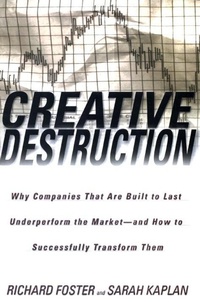
Creative Destruction
Why Companies That Are Built to Last Underperform the Market--And How to Successfully Transform Them
1st Edition
Published on 20. April 2011
384 pages
978-0-307-77931-1 (ISBN)
Description

Turning conventional wisdom on its head, a Senior Partner and an Innovation Specialist from McKinsey & Company debunk the myth that high-octane, built-to-last companies can continue to excel year after year and reveal the dynamic strategies of discontinuity and creative destruction these corporations must adopt in order to maintain excellence and remain competitive.
In striking contrast to such bibles of business literature as In Search of Excellence and Built to Last, Richard N. Foster and Sarah Kaplan draw on research they conducted at McKinsey & Company of more than one thousand corporations in fifteen industries over a thirty-six-year period. The industries they examined included old-economy industries such as pulp and paper and chemicals, and new-economy industries like semiconductors and software. Using this enormous fact base, Foster and Kaplan show that even the best-run and most widely admired companies included in their sample are unable to sustain their market-beating levels of performance for more than ten to fifteen years. Foster and Kaplan's long-term studies of corporate birth, survival, and death in America show that the corporate equivalent of El Dorado, the golden company that continually outperforms the market, has never existed. It is a myth.
Corporations operate with management philosophies based on the assumption of continuity; as a result, in the long term, they cannot change or create value at the pace and scale of the markets. Their control processes, the very processes that enable them to survive over the long haul, deaden them to the vital and constant need for change. Proposing a radical new business paradigm, Foster and Kaplan argue that redesigning the corporation to change at the pace and scale of the capital markets rather than merely operate well will require more than simple adjustments. They explain how companies like Johnson and Johnson , Enron, Corning, and GE are overcoming cultural "lock-in" by transforming rather than incrementally improving their companies. They are doing this by creating new businesses, selling off or closing down businesses or divisions whose growth is slowing down, as well as abandoning outdated, ingrown structures and rules and adopting new decision-making processes, control systems, and mental models. Corporations, they argue, must learn to be as dynamic and responsive as the market itself if they are to sustain superior returns and thrive over the long term.
In a book that is sure to shake the business world to its foundations, Creative Destruction, like Re-Engineering the Corporation before it, offers a new paradigm that will change the way we think about business.
In striking contrast to such bibles of business literature as In Search of Excellence and Built to Last, Richard N. Foster and Sarah Kaplan draw on research they conducted at McKinsey & Company of more than one thousand corporations in fifteen industries over a thirty-six-year period. The industries they examined included old-economy industries such as pulp and paper and chemicals, and new-economy industries like semiconductors and software. Using this enormous fact base, Foster and Kaplan show that even the best-run and most widely admired companies included in their sample are unable to sustain their market-beating levels of performance for more than ten to fifteen years. Foster and Kaplan's long-term studies of corporate birth, survival, and death in America show that the corporate equivalent of El Dorado, the golden company that continually outperforms the market, has never existed. It is a myth.
Corporations operate with management philosophies based on the assumption of continuity; as a result, in the long term, they cannot change or create value at the pace and scale of the markets. Their control processes, the very processes that enable them to survive over the long haul, deaden them to the vital and constant need for change. Proposing a radical new business paradigm, Foster and Kaplan argue that redesigning the corporation to change at the pace and scale of the capital markets rather than merely operate well will require more than simple adjustments. They explain how companies like Johnson and Johnson , Enron, Corning, and GE are overcoming cultural "lock-in" by transforming rather than incrementally improving their companies. They are doing this by creating new businesses, selling off or closing down businesses or divisions whose growth is slowing down, as well as abandoning outdated, ingrown structures and rules and adopting new decision-making processes, control systems, and mental models. Corporations, they argue, must learn to be as dynamic and responsive as the market itself if they are to sustain superior returns and thrive over the long term.
In a book that is sure to shake the business world to its foundations, Creative Destruction, like Re-Engineering the Corporation before it, offers a new paradigm that will change the way we think about business.
More details
Other editions
Additional editions
Richard Foster | Sarah Kaplan
Creative Destruction
Why Companies That Are Built to Last Underperform the Market--And How to Successfully Transform Them
Book
04/2001
Random House Inc
€24.50
Shipment within 10-20 days

Richard Foster | Sarah Kaplan
Creative Destruction
Why Companies That Are Built to Last Underperform the Market--And How to Successfully Transform Them
Book
04/2001
Broadway Business
€46.64
Article exhausted; check different version
Persons
Richard Foster is a senior partner and director at McKinsey & Company and the author of the bestselling Innovation: The Attacker's Advantage, named one of the best business books of the year by The Wall Street Journal.
Sarah Kaplan worked at McKinsey & Company for many years, specializing in innovation and technology management. Foster lives in New York City, and Kaplan in Boston.
Sarah Kaplan worked at McKinsey & Company for many years, specializing in innovation and technology management. Foster lives in New York City, and Kaplan in Boston.
Content
- Intro
- Title Page
- Copyright
- Dedication
- Contents
- Acknowledgments
- Introduction: The Game of Creative Destruction
- Chapter 1: Survival and Performance in the Era of Discontinuity
- Chapter 2: How Creative Destruction Works: The Fate of the East River Savings Bank
- Chapter 3: Cultural Lock-In
- Chapter 4: Operating vs. Creating: The Case of Storage Technology Corporation
- Chapter 5: The Gales of Destruction
- Chapter 6: Balancing Destruction and Creation
- Chapter 7: Designed to Change
- Chapter 8: Leading Creative Destruction
- Chapter 9: Increasing Creation by Tenfold
- Chapter 10: Control, Permission, and Risk
- Chapter 11: Setting the Pace and Scale of Change
- Chapter 12: The Ubiquity of Creative Destruction
- Appendix A: List of Companies
- Appendix B: Managerial Approach of Principal Investors
- Appendix C: Dynamic Performance Analysis (DPA)
- Notes
- Selected Sources
- About the Authors
