

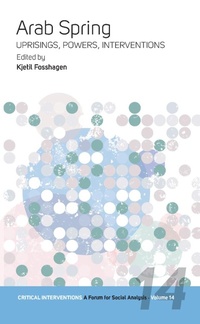
Arab Spring
Description

The events of the Arab Spring presented a dramatic reconstitution of politics and the public sphere through their aesthetic and performative uses of public space. Mass demonstrations have become a new global political form, grounded in the localization of globalizing processes, institutions, and relationships. This volume delves beneath the seemingly chaotic nature of events to explore the structural dynamics underpinning popular resistance and their support or suppression. It moves beyond what has usually been defined as Arab Spring nations to include critical views on Bahrain, the Palestinian territories, and Turkey. The research and analysis presented explores not just the immediate protests, but also the historical realization, appropriation, and even institutionalization of these critical voices, as well as the role of international criminal law and legal exceptionalism in authorizing humanitarian interventions. Above all, it questions whether the revolutions have since been hijacked and the broad popular uprisings already overrun, suppressed, or usurped by the upper classes.
More details
Other editions
Additional editions
Person
Kjetil Fosshagen teaches in the Department of Social Anthropology at the University of Bergen.
Content
Introduction: The Arab Spring: Revolutions or 1848 Reaction?
Kjetil Fosshagen
Chapter 1. Tahrir as Heterotopia: Spaces and Aesthetics of Egyptian Revolution
Paola Abenante
Chapter 2. Beyond the Arab Spring: The Aesthetics and Poetics of Popular Revolt and Protest, 2010-2012
Pnina Werbner, Martin Webb and Kathryn Spellman-Poots
Chapter 3. Emergency Law and Hypergovernance: Human Rights and Regime Change in the Arab Spring
Michael Humphrey
Chapter 4. The Promises and Limitations of Economic Protests in the West Bank
Sohbi Samour
Chapter 5. Stability or Democracy? The Failed Uprising in Bahrain and the Battle for the International Agenda
Thomas Fibiger
Chapter 6. The Turkish Model for the Arab Spring: The Corporate Moralist State
Kjetil Fosshagen
Notes on Contributors
