

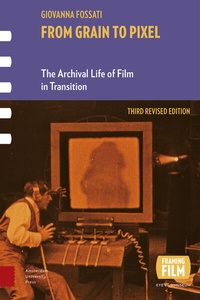
From Grain to Pixel
The Archival Life of Film in Transition, Third Revised Edition
Published on 15. November 2018
448 pages
978-90-485-4352-6 (ISBN)
Description

This book attempts to bridge the fields of film archiving and academic research by addressing the discourse on film's existence and analysing how it affects the important role of the film archive.
Reviews / Votes
"I have used the book extensively as teaching material for master's students specialising in film archiving and curating. [...]From Grain to Pixel is a vital tool for these students to understand the characteristics of analogue film from a material, technological, institutional, and social point of view. Moreover, thanks to its editorial arrangement, this third edition provides them with a sense of the diachronic historicity of film-archival practices: updates follow directly on the relevant original text, thus highlighting the changes of the last decade and offering direct comparison between state-of-the-art practices today with those of the 2000s." - Sonia Campanini, FIAF Journal of Film Preservation, April 2021"Ten years after its first publication, the relevance of Fossati's From Grain to Pixel remains untouched and its third revised edition is a precious opportunity to revisit her theories and test them against the passing of time in an era of frantic technological changes." - Sabrina Negri, Critical Inquiry, October 2019
"Giovanna Fossati's From Grain to Pixel has been an immensely valuable source for theories and practices of film digitization and restoration since its first publication in 2009. The new updated edition considers the changing requirements of this extremely dynamic, evolving field. Thanks to her double expertise as a film scholar and a curator, Fossati is able not only to provide deep insights into current approaches and advanced tools, but also to integrate them into her highly reflected theoretical framework thereby providing a state-of-the-art reference for research and teaching." - Barbara Flueckiger, Professor of Film Studies, University of Zurich
"When From Grain to Pixel appeared it was the first motion picture study to fully engage with both archival practice and film theory, setting a high standard for the emerging area of film heritage studies. After nearly a decade, Giovanna Fossati's book still stands alone-fascinating, visionary, and provocative. Remarkably, the updates in this revised edition make it even more essential today." - Jane M. Gaines, Professor of Film, Columbia University - author of Pink-Slipped: What Happened to Women in the Early Film Industries?
"Giovanna Fossati does more than simply give the most thoughtful, thorough and up-to-date account of the transformation in motion picture archiving over the last decades. She forces us to reconsider the nature of the moving image and prepare for a new era of communication and preservation." - Tom Gunning, Professor of Art History, Cinema and Media Studies, University of Chicago
"Scholarly research on film and media is profoundly influenced by the way in which moving images are preserved and made accessible for scrutiny. This fact alone should make Giovanna Fossati's book mandatory reading for all graduate courses in the field." - Paolo Cherchi Usai, Senior Curator, Moving Image Department, George Eastman Museum
More details
Series
Edition
Digital original
Language
English
Place of publication
Amsterdam
Netherlands
Target group
Professional and scholarly
US School Grade: College Graduate Student
Edition type
Digital original
Illustrations
11 s/w Abbildungen, 31 farbige Abbildungen
31 color plates, 25 halftones; 31 Illustrations, color; 11 Illustrations, black and white
File size
3,89 MB
ISBN-13
978-90-485-4352-6 (9789048543526)
Copyright in bibliographic data and cover images is held by Nielsen Book Services Limited or by the publishers or by their respective licensors: all rights reserved.
Schweitzer Classification
Other editions
Additional editions
Book
11/2018
3rd Edition
Amsterdam University Press
€62.50
Shipment within 15-20 days
Persons
Fossati Giovanna :
Giovanna Fossati is the chief curator of Eye Filmmuseum and professor of Film Heritage and Digital Film Culture at the University of Amsterdam.
Giovanna Fossati is the chief curator of Eye Filmmuseum and professor of Film Heritage and Digital Film Culture at the University of Amsterdam.
Content
Acknowledgements Introduction to the Third Revised Edition Framing Film (in Transition): an Introduction Part One: practice and theory of (archival) film 1 Film Practice in Transition 2 Theorizing Archival Film Part Two: theorizing (archival) practice 3 Film Archival Field in Transition 4 Restoration Case Studies: Theorizing Archival Practice A New Mindset for (Archival) Film in Transition: a Conclusion Conclusions to the Third Revised Edition Notes Notes to the Third Revised Edition Glossary of Technical Terms List of Illustrations Filmography Bibliography Index
