

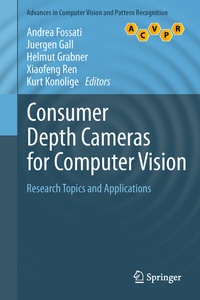
Consumer Depth Cameras for Computer Vision
Description

Reviews / Votes
From the reviews:
"Consumer Depth Cameras for Computer Vision is among the first few written from a research point of view. It is based on research published in the Workshop on Consumer Depth Cameras and includes some of the notable researchers in the field and the original team behind Kinect itself. It's an excellent resource for researchers working in computer vision and robotic vision or for students having knowledge of vision who wish to start working with Kinect. . highly recommend this book to any researcher of Kinect." (Owais Mehmood, IAPR Newsletter, Vol. 35 (3-2), July, 2013)More details
Other editions
Additional editions
Persons
Dr. Andrea Fossati and Dr. Helmut Grabner are post-doctoral researchers in the Computer Vision Laboratory at ETH Zurich, Switzerland.
Dr. Juergen Gall is a Senior Researcher at the Max Planck Institute for Intelligent Systems, Tübingen, Germany.
Dr. Xiaofeng Ren is a Research Scientist at the Intel Science and Technology Center for Pervasive Computing, Intel Labs, and an Affiliate Assistant Professor at the Department of Computer Science and Engineering of the University of Washington, Seattle, WA, USA.
Dr. Kurt Konolige is a Senior Researcher at Industrial Perception Inc., Palo Alto, CA, USA.
Content
Part I: 3D Registration and Reconstruction.-
3D with Kinect.- Real-Time RGB-D Mapping and 3-D Modeling on the GPU using the Random Ball Cover.- A Brute Force Approach to Depth Camera Odometry.-
Part II: Human Body Analysis.-
Key Developments in Human Pose Estimation for Kinect.- A Data-Driven Approach for Real-Time Full Body Pose Reconstruction from a Depth Camera.- Home 3D Body Scans from a Single Kinect.- Real-Time Hand Pose Estimation using Depth Sensors.-
Part III: RGB-D Datasets.-
A Category-Level 3D Object Dataset: Putting the Kinect to Work.- RGB-D Object Recognition: Features, Algorithms, and a Large Scale Benchmark.- RGBD-HuDaAct: A Color-Depth Video Database for Human Daily Activity Recognition.
