

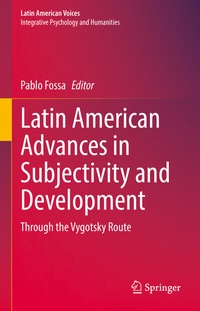
Latin American Advances in Subjectivity and Development
Through the Vygotsky Route
1st Edition
Published on 3. August 2021
XII, 280 pages
978-3-030-72953-0 (ISBN)
Description

This is the first book in English to show how the work of Lev Vygotsky gave rise to a prolific and original school of cultural-historical psychology in Latin America. In recent decades, Latin American researchers have expanded Vygotskyan conceptualizations and applied practical theory to psychological and educational research and practice, but until now this production remained virtually unknown for English speaking audiences since it has been mainly published in Spanish and Portuguese. This timely volume contributes to change this situation by presenting a panoramic picture of the state of the art of cultural-historical psychology in Latin America.
The book is divided in two parts. The first part shows how Latin American researchers used Vygotsky's work to develop new theoretical elaborations and empirical advances to deal with different political, social and cultural problems in the region. The second part presents an overview of the current stateof cultural-historical psychology in Latin America. Throughout its 15 chapters, the book shows how Latin American researchers contributed to the studies of different aspects of the cultural-historical theoretical conception of the development of higher psychological functions, such as concept formation, inner speech, zone of proximal development and imagination, and how these theoretical elaborations have been applied to research and practice in fields such as sociocultural psychology, developmental psychology, psychotherapy and education in Argentina, Brazil, Chile, Colombia, Cuba, Mexico, Peru and Puerto Rico.
Latin American Advances in Subjectivity and Development - Through the Vygotsky Route will be an invaluable resource to researchers, students and practitioners in the fields of psychology, education and other social sciences interested in discovering or learning more about the original Latin American school of cultural-historical psychology.
The book is divided in two parts. The first part shows how Latin American researchers used Vygotsky's work to develop new theoretical elaborations and empirical advances to deal with different political, social and cultural problems in the region. The second part presents an overview of the current stateof cultural-historical psychology in Latin America. Throughout its 15 chapters, the book shows how Latin American researchers contributed to the studies of different aspects of the cultural-historical theoretical conception of the development of higher psychological functions, such as concept formation, inner speech, zone of proximal development and imagination, and how these theoretical elaborations have been applied to research and practice in fields such as sociocultural psychology, developmental psychology, psychotherapy and education in Argentina, Brazil, Chile, Colombia, Cuba, Mexico, Peru and Puerto Rico.
Latin American Advances in Subjectivity and Development - Through the Vygotsky Route will be an invaluable resource to researchers, students and practitioners in the fields of psychology, education and other social sciences interested in discovering or learning more about the original Latin American school of cultural-historical psychology.
More details
Series
Language
English
Place of publication
Cham
Switzerland
Publishing group
Springer International Publishing
Target group
Professional and scholarly
Product notice
Reflowable
Illustrations
XII, 280 p. 33 illus., 19 illus. in color.
File size
4,85 MB
ISBN-13
978-3-030-72953-0 (9783030729530)
DOI
10.1007/978-3-030-72953-0
Schweitzer Classification
Other editions
Additional editions
Book
08/2021
Springer
€181.89
Shipment within 7-9 days
Person
Pablo Fossa is a professor and researcher at the School of Psychology of the Universidad del Desarrollo, Chile. He received his PhD degree from the Pontificia Universidad Católica de Chile. His dissertation was about the expressive dimension of the inner language in human experience. His research lines are related to the history of psychology, language and cognition, cultural psychology and relational processes. He is an active member of the Society for Historical Cultural Activity Research (ISCAR), International Society for Theoretical Psychology (ISTP) and the International Society for Dialogical Self (ISDS). Nowadays, he has a Postdoctoral Project about thought trajectories from a microgenetic perspective supported by the National Commission for Scientific and Technological Research (CONICYT) of Chile.
Content
1.Why follow the Vygotsky route?.- 2.What can gestures tell us about the Vygotsky´s Findings?.- 3.Contributions of the concept of Zone of Proximal Development to the Intersubjective understanding of internship supervision in Clinical Psychology.- 4.Exploring imaginative processes in adolescence - a case study following cultural-dialogical approach.- 5. Psychological Development as History: developing notions of Historicity and Temporality in Vygotsky's work and life.- 6.The development of subjectivity in community spaces of vulnerability: Perspectives from cultural-historical psychology.- 7.Game playing and rules management: A view at children´s development from Vygotsky's sociocultural theory.- 8. IMEIN And MEIN Methods: Psychoeducational resources for cognitive development in early childhood.- 9.Thinking Outside The Box: Externalization Of Psychological Functions And The Extended. - 10.Consciousness as a Key Construct in L.S. Vygotsky's Cultural-Historical Psychology and PauloFreire's Critical Pedagogy: A Latin American Perspective.- 11.The Quest for a Concrete Psychology: A New Vygotskyan Way in Argentina.- 12.Vygotsky in context and depth: proposals, legacy and continuity in Latin America.- 13.The Vygostkian Contribution to the Construction of a General Theory of Human.- 14.Cultural-historical psychology in Latin America: an interview with Fernando González.- 15.The future of Subjectivity and Development: Searching for the lost sense.
