

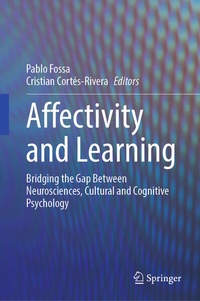
Affectivity and Learning
Description

This book presents an interdisciplinary approach to the study of affectivity and human learning by bridging the gap between neuroscience, cultural and cognitive psychology. It brings together studies that go beyond the focus on cognitive-intellectual variables involved in learning processes and incorporate the study of the role played by affectivity and emotions in learning not only at educational settings but in all processes of transformation and human development, thus presenting affectivity as a catalyst and mediator of all daily learning processes.
Chapters brought together in this contributed volume present both theoretical contributions and results of empirical research from different disciplines, such as neuroscience, cognitive psychology, cultural psychology, educational psychology, developmental psychology and philosophy, and are grouped into five thematic sections. The first part of the book brings together chapters discussing different aspects of the role played byaffectivity in learning processes from the perspectives of cultural, educational and developmental psychology. The second part is dedicated to the role of affectivity for teachers during their training as educators and during their pedagogical practice in diverse contexts. The third part focuses on the relationship between affectivity and learning from a neuroscientific point of view. The fourth part discusses affectivity and learning in therapeutic and clinical contexts. Finally, the fifth part brings together chapters about affectivity and learning in everyday life.
By bringing together this rich interdisciplinary collection of studies, Affectivity and Learning: Bridging the Gap Between Neurosciences, Cultural and Cognitive Psychology will be a valuable resource for researchers in the fields of psychology, neuroscience and education, as well as for educators and teachers interested in knowing more about the relationship between affectivity and human learning.
More details
Other editions
Additional editions
Persons
Pablo Fossa is Director of the Cognition & Culture Laboratory (C&C) of Instituto de Bienestar Socioemocional (IBEM) at the Faculty of Psychology, Universidad del Desarrollo, Chile. He received a PhD degree in Psychology from the Pontifical Catholic University of Chile. His doctoral thesis dealt with the expressive dimension of inner language in human experience. He did a postdoctoral fellowship financed by the National Commission for Scientific and Technological Research (CONICYT) of Chile, with a research project on thought trajectories from a microgenetic orientation. His lines of research are related to Cognition, Cultural Psychology and Phenomenology. He is an active member of the Society for Historical Cultural Activity Research (ISCAR), the International Society for Dialogical Self (ISDS), and the International Society for Theoretical Psychology (ISTP). He is the editor of the book Latin American Advances in Subjectivity and Development: Through Vygotsky Route (Springer, 2021), New Perspectives on Inner Speech (Springer, 2022), and the book Inner Speech, Culture & Education (Springer, 2022). Currently, he is PhD candidate in Philosophy at the University of Navarra, Spain.
Cristian Cortés-Rivera is Professor and researcher at The Neuropsychology and Cognitive Neurosciences Research Center (CINPSI Neurocog) at the Faculty of Health Sciences, Universidad Católica del Maule, Chile. He received a Ph.D. in Developmental Sciences and Psychopathology from the Universidad del Desarrollo, Chile. His doctoral thesis addressed the role of emotion in executive functioning, at behavioral and neurophysiological levels. His lines of research address the relationship between Cognition, Affectivity, and Learning. He is also a member of the Cognition & Culture Laboratory (C&C) and the Affective Neurosciences Laboratory of the Instituto de Bienestar Socioemotional (IBEM) at the Faculty of Psychology, Universidad del Desarrollo, Chile.
