

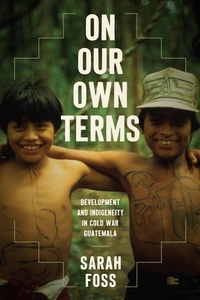
On Our Own Terms
Description

During the Cold War, U.S. intervention in Latin American politics, economics, and society grew in scope and complexity, with diplomatic legacies evident in today’s hemispheric policies. Development became a key form of intervention as government officials and experts from the United States and Latin America believed that development could foster hemispheric solidarity and security. In parts of Latin America, its implementation was especially intricate because recipients of these programs were diverse Indigenous peoples with their own politics, economics, and cultures. Contrary to project planners' expectations, Indigenous beneficiaries were not passive recipients but actively engaged with development interventions and, in the process, redefined racialized ideas about Indigeneity. Sarah Foss illustrates how this process transpired in Cold War Guatemala, spanning democratic revolution, military coups, and genocidal civil war. Drawing on previously unused sources such as oral histories, anthropologists' field notes, military records, municipal and personal archives, and a private photograph collection, Foss analyzes the uses and consequences of development and its relationship to ideas about race from multiple perspectives, emphasizing its historical significance as a form of intervention during the Cold War.
More details
Other editions
Additional editions
Person
Content
- Cover
- Contents
- List of Illustrations
- Acknowledgments
- Abbreviations in the Text
- Introduction. Until the Indian Is Made to Walk
- Chapter One. A Beautiful Laboratory: Pan-American Indigenismo and the Guatemalan Revolution, 1940-1945
- Chapter Two. Sons Like Juan Are the Pride of Guatemala: Creating the Permitted Indian, 1945-1951
- Chapter Three. Hen Houses and Hectares: Making Productive Citizens, 1951-1956
- Chapter Four. Indigenista Community Development and the Counterrevolution, 1954-1960
- Chapter Five. Operation Awaken: Guatemala's National Program of Community Development, 1960-1975
- Chapter Six. A Little Cuba in the Ixcán Jungle, 1968-1982
- Chapter Seven. Photographing Development: A Visual Analysis of War-Torn Guatemala, 1982-1996
- Conclusion. Protagonists in Guatemala's Development
- Notes
- Bibliography
- Index
- A
- B
- C
- D
- E
- F
- G
- H
- I
- J
- K
- L
- M
- N
- O
- P
- Q
- R
- S
- T
- U
- V
- W
- X
- Y
- Z
