

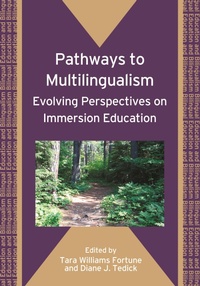
Pathways to Multilingualism
Evolving Perspectives on Immersion Education
1st Edition
Published on 11. January 2008
248 pages
978-1-84769-037-1 (ISBN)
Description

Immersion education serves as a highly successful pathway to multilingualism. This volume focuses on the evolution of perspectives and practices within language immersion education and showcases an international roster of scholars who offer theoretical perspectives, research reviews and empirical studies on teaching, learning and language development in immersion programs. This collection of studies and discussions represents three branches of immersion education, foreign language ("one-way"), bilingual ("two-way") and indigenous immersion programs. Each branch has its unique situational dynamics to address, and such dynamics must be carefully considered particularly in the interpretation of research findings. Nevertheless, the volume's co-editors argue that much can be learned from research and practices carried out in closely related immersion settings that experience similar challenges related to the delicate balance between language and content. This volume presents an opportunity for thoughtful cross-context dialogue and knowledge exchange.
Reviews / Votes
ms in the one volume, and this book provides just that. The book has also been extremely well edited, and forms a coherent, cross referenced whole, rather than a series of unlinked chapters. * Dr Michele de Courcy, University of Melbourne, Australia * Pathways to Multilingualism invokes powerful images - of diverse language communities with distinct sociolinguistic backgrounds, varied routes that teachers and program models can take, different approaches to research - all with the common goal of expanding understanding of immersion education. Essential reading for all interested in classroom and research-based perspectives on immersion education. * Professor Ann Snow, California State University, Los Angeles * This book is appropriate for a wide array of readers. Several chapters outline the history, core features, terminology, and issues related to the various dual language education models, and these will serve as a good introduction for newcomers to immersion education. However, the book also contains enough new research to interest readers who are already well-versed in the topic. The contributions are likewise relevant to both researchers and practitioners, as their focus ranges from classroom discourse analysis to pedagogical strategies and teaching tips. Moreover, the writing is uniformly clear and accessible. Susan Ballinger, McGill University, The Canadian Modern Language Review/La Revue canadienne des langues vivantes, * 66, 3 (March/mars), 465-478 *More details
Series
Language
English
Place of publication
Bristol
United Kingdom
Publishing group
Channel View Publications Ltd
Target group
Professional and scholarly
Edition type
Digital original
ISBN-13
978-1-84769-037-1 (9781847690371)
Copyright in bibliographic data and cover images is held by Nielsen Book Services Limited or by the publishers or by their respective licensors: all rights reserved.
Schweitzer Classification
Other editions
Additional editions
Tara Williams Fortune | Diane J. Tedick
Pathways to Multilingualism
Evolving Perspectives on Immersion Education
Book
01/2008
Multilingual Matters
€164.50
Article not available at the moment
Tara Williams Fortune | Diane J. Tedick
Pathways to Multilingualism
Evolving Perspectives on Immersion Education
Book
01/2008
Multilingual Matters
€48.20
Shipment within 10-20 days
Persons
Tara Williams Fortune is an Immersion Teaching Specialist and Coordinator of the Immersion Projects at the Center for Advanced Research on Language Acquisition at the University of Minnesota. She is founding editor of The American Council on Immersion Education (ACIE) Newsletter, a publication written for and by immersion practitioners that is currently in its 14th year of dissemination. Her professional and research interests focus on struggling immersion learners, K-8 oral proficiency development of immersion students, and language and literacy development in early total Chinese immersion programs.
Diane Tedick is Associate Professor of Second Languages and Cultures Education at the University of Minnesota. For over 20 years she has worked in the preparation of preservice teachers and ongoing professional development of inservice teachers representing a variety of language teaching contexts: immersion and bilingual programs, world languages, and ESL. Her professional and research interests focus on the pedagogy required for successful integration of language and content instruction, student oral language proficiency development in immersion programs, and language teacher development.
Diane Tedick is Associate Professor of Second Languages and Cultures Education at the University of Minnesota. For over 20 years she has worked in the preparation of preservice teachers and ongoing professional development of inservice teachers representing a variety of language teaching contexts: immersion and bilingual programs, world languages, and ESL. Her professional and research interests focus on the pedagogy required for successful integration of language and content instruction, student oral language proficiency development in immersion programs, and language teacher development.
Content
Foreword - Donna Christian
Acknowledgements
Introduction to the Volume - Tara Williams Fortune and Diane J. Tedick
1. One-Way, Two-Way and Indigenous Immersion: A Call for Cross-Fertilization - Tara Williams Fortune and Diane J. Tedick
2. Dual Language in the Global Village - Fred Genesee
Section I: Evolving Perspectives on Immersion Pedagogy
3. Paying Attention to Language: Literacy, Language, and Academic Achievement - Myriam Met
4. Integrated Language and Content Teaching: Insights from the Language Immersion Classroom - Tara Williams Fortune, Diane J. Tedick and Constance L. Walker
5. Diversity Up Close: Building Alternative Discourses in the Two-way Immersion Classroom - Deborah K. Palmer
Section II: Evolving Perspectives on Language Development in Immersion Classrooms
6. Lexical Learning Through a Multitask Activity: The Role of Repetition - Merrill Swain and Sharon Lapkin
7. Instructional Counterbalance in Immersion Pedagogy - Roy Lyster and Hirohide Mori
8. Teacher Strategies for Second Language Production in Immersion Kindergarten in Finland - Margareta Soedergard
Section III: Evolving Perspectives on Social Context and its Impact on Immersion Programs
9. Language Development and Academic Achievement in Two-Way Immersion Programs - Kathryn Lindholm-Leary and Elizabeth R. Howard
10. Developing a Critical Awareness of Language Diversity in Immersion - Diane Dagenais
11. Restoring Aboriginal Languages: Immersion and Intensive Language Program Models in Canada - Merle Richards and Barbara Burnaby
12. Late Immersion in Hong Kong: Still Stressed or Making Progress? - Philip Hoare and Stella Kong
Synthesis Chapter for the Volume
13. Concluding Thoughts: Does the Immersion Pathway Lead to Multilingualism? - G. Richard Tucker and Deborah Dubiner
Acknowledgements
Introduction to the Volume - Tara Williams Fortune and Diane J. Tedick
1. One-Way, Two-Way and Indigenous Immersion: A Call for Cross-Fertilization - Tara Williams Fortune and Diane J. Tedick
2. Dual Language in the Global Village - Fred Genesee
Section I: Evolving Perspectives on Immersion Pedagogy
3. Paying Attention to Language: Literacy, Language, and Academic Achievement - Myriam Met
4. Integrated Language and Content Teaching: Insights from the Language Immersion Classroom - Tara Williams Fortune, Diane J. Tedick and Constance L. Walker
5. Diversity Up Close: Building Alternative Discourses in the Two-way Immersion Classroom - Deborah K. Palmer
Section II: Evolving Perspectives on Language Development in Immersion Classrooms
6. Lexical Learning Through a Multitask Activity: The Role of Repetition - Merrill Swain and Sharon Lapkin
7. Instructional Counterbalance in Immersion Pedagogy - Roy Lyster and Hirohide Mori
8. Teacher Strategies for Second Language Production in Immersion Kindergarten in Finland - Margareta Soedergard
Section III: Evolving Perspectives on Social Context and its Impact on Immersion Programs
9. Language Development and Academic Achievement in Two-Way Immersion Programs - Kathryn Lindholm-Leary and Elizabeth R. Howard
10. Developing a Critical Awareness of Language Diversity in Immersion - Diane Dagenais
11. Restoring Aboriginal Languages: Immersion and Intensive Language Program Models in Canada - Merle Richards and Barbara Burnaby
12. Late Immersion in Hong Kong: Still Stressed or Making Progress? - Philip Hoare and Stella Kong
Synthesis Chapter for the Volume
13. Concluding Thoughts: Does the Immersion Pathway Lead to Multilingualism? - G. Richard Tucker and Deborah Dubiner
