

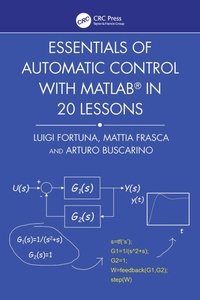
Essentials of Automatic Control with MATLAB in 20 Lessons
Published on 10. August 2025
286 pages
978-1-040-38998-0 (ISBN)
Description

This book is designed to explain the fundamental principles of automatic control through 20 lessons, each incorporating worked examples and MATLAB (R)-based exercises to help readers effectively understand and apply the proposed methods. It offers a concise and accessible resource for learning automatic control, blending simplicity with clarity. Drawing on decades of teaching experience, the authors aim to provide an approachable introduction to the core concepts of the discipline, encouraging further exploration through independent study.
Integrates MATLAB (R) within a 20-lesson framework
Enhances learning by supporting both theoretical understanding and practical problem-solving
Promotes critical thinking and problem-solving skills, essential competencies in today's AI-driven world.
Focuses on classical topics related to Single-Input Single-Output (SISO) linear continuous-time systems
Provides introductory material on topics such as Multiple-Input Multiple-Output (MIMO) and discrete-time systems, serving as a bridge to more advanced studies.
By establishing a strong foundation in these areas, the book prepares readers to tackle complex challenges in modern automatic control and excel in future academic and professional endeavors. Primarily intended for undergraduate engineering students, the book is also suitable for a wider audience. As automatic control is a foundational subject across numerous academic programs, this resource equips readers with essential analytical tools and introduces key problems, fostering deeper insights into the subject.
Integrates MATLAB (R) within a 20-lesson framework
Enhances learning by supporting both theoretical understanding and practical problem-solving
Promotes critical thinking and problem-solving skills, essential competencies in today's AI-driven world.
Focuses on classical topics related to Single-Input Single-Output (SISO) linear continuous-time systems
Provides introductory material on topics such as Multiple-Input Multiple-Output (MIMO) and discrete-time systems, serving as a bridge to more advanced studies.
By establishing a strong foundation in these areas, the book prepares readers to tackle complex challenges in modern automatic control and excel in future academic and professional endeavors. Primarily intended for undergraduate engineering students, the book is also suitable for a wider audience. As automatic control is a foundational subject across numerous academic programs, this resource equips readers with essential analytical tools and introduces key problems, fostering deeper insights into the subject.
More details
Language
English
Place of publication
London
United Kingdom
Publishing group
Taylor & Francis Ltd
Target group
College/higher education
Illustrations
24 Tables, black and white; 162 Line drawings, black and white; 162 Illustrations, black and white
File size
30,16 MB
ISBN-13
978-1-040-38998-0 (9781040389980)
Copyright in bibliographic data and cover images is held by Nielsen Book Services Limited or by the publishers or by their respective licensors: all rights reserved.
Schweitzer Classification
Other editions
Additional editions
Luigi Fortuna | Mattia Frasca | Arturo Buscarino
Essentials of Automatic Control with MATLAB in 20 Lessons
Book
08/2025
1st Edition
CRC Press
€145.90
Shipment within 10-20 days
Luigi Fortuna | Mattia Frasca | Arturo Buscarino
Essentials of Automatic Control with MATLAB in 20 Lessons
Book
08/2025
1st Edition
CRC Press
€76.80
Shipment within 10-20 days
Persons
Arturo Buscarino graduated in Computer Science Engineering in 2004 and received his Ph.D. in Electronics and Automation Engineering in 2008, at the University of Catania, Italy. Currently, he is a Technical Assistant at the University of Catania and teaches Modeling and Optimization at the Laura Magistrale in Management Engineering. He collaborates with the EUROFusion Consortium, ENEA Frascati, and JET Culham, UK. Dr. Buscarino has been a visiting researcher at the University of Wisconsin-Madison, US. His scientific interests include nonlinear circuits and systems, chaos and synchronization, complex networks, control systems, Cellular Nonlinear Networks, and plasma engineering. He is Associate Editor of Cogent Engineering. Dr. Buscarino has published one research monography on nonlinear circuits, and more than 60 papers on refereed international journals and international conference proceedings.
Luigi Fortuna received the degree of electrical engineering (cum laude) from the University of Catania, Italy, in 1977. He is a Full Professor of System Theory at the University of Catania. From 2005 to 2012, he was the Dean of the Engineering Faculty. He has been a visiting researcher at the Joint European Torus in Abingdon UK. He currently teaches complex adaptive systems and robust control. He has published 14 scientific books and 12 industrial patents. Dr. Fortuna has been a consultant of STMicroelectronics and other companies. He is the Editor in Chief of the SpringerBrief Series on Nonlinear Circuits. His scientific interests include robust control, Tokamak machine control, complex engineering, nonlinear circuits, chaos, cellular neural networks, robotics, and smart devices for control. Additionally, he is an IEEE Fellow.
Mattia Frasca graduated in Electronics Engineering in 2000 and received his Ph.D. in Electronics and Automation Engineering in 2003, at the University of Catania, Italy. Currently, he is a research associate at the University of Catania, where he also teaches process control. His scientific interests include nonlinear systems and chaos, complex networks, and bio-inspired robotics. He is Associate Editor of the International Journal of Bifurcations and Chaos, and Editor of Chaos, Solitons and Fractals. He is the general chair for the next edition of the European Conference on Circuits Theory and Design to be held in Catania. Additionally, he is co-author of one research monograph with Springer, three with World Scientific, and one book on Optimal and robust control with CRC Press. Dr. Frasca has published more than 250 papers on refereed international journals and international conference proceedings and is co-author of two international patents. He is an IEEE Senior and also a member of the Board of the Italian Society for Chaos and Complexity (SICC).
Luigi Fortuna received the degree of electrical engineering (cum laude) from the University of Catania, Italy, in 1977. He is a Full Professor of System Theory at the University of Catania. From 2005 to 2012, he was the Dean of the Engineering Faculty. He has been a visiting researcher at the Joint European Torus in Abingdon UK. He currently teaches complex adaptive systems and robust control. He has published 14 scientific books and 12 industrial patents. Dr. Fortuna has been a consultant of STMicroelectronics and other companies. He is the Editor in Chief of the SpringerBrief Series on Nonlinear Circuits. His scientific interests include robust control, Tokamak machine control, complex engineering, nonlinear circuits, chaos, cellular neural networks, robotics, and smart devices for control. Additionally, he is an IEEE Fellow.
Mattia Frasca graduated in Electronics Engineering in 2000 and received his Ph.D. in Electronics and Automation Engineering in 2003, at the University of Catania, Italy. Currently, he is a research associate at the University of Catania, where he also teaches process control. His scientific interests include nonlinear systems and chaos, complex networks, and bio-inspired robotics. He is Associate Editor of the International Journal of Bifurcations and Chaos, and Editor of Chaos, Solitons and Fractals. He is the general chair for the next edition of the European Conference on Circuits Theory and Design to be held in Catania. Additionally, he is co-author of one research monograph with Springer, three with World Scientific, and one book on Optimal and robust control with CRC Press. Dr. Frasca has published more than 250 papers on refereed international journals and international conference proceedings and is co-author of two international patents. He is an IEEE Senior and also a member of the Board of the Italian Society for Chaos and Complexity (SICC).
Content
1. Lecture 1 - Automatic control 2. Lecture 2 - Mathematical models 3. Lecture 3 - Brief introduction to MATLABr 4. Lecture 4 - Laplace transform 5. Lecture 5 - Continuous-time linear systems 6. Lecture 6 - Equilibrium points and stability of continuous
LTI systems 7. Lecture 7 - The transfer function 8. Lecture 8 - System aggregates 9. Lecture 9 - Reachability and observability of continuous time linear systems 10. Lecture 10 - Time-domain speci?cations 11. Lecture 11 - Frequency response and Bode diagrams 12. Lecture 12 - Closed-loop stability 13. Lecture 13 - Discrete-time systems: time-domain analysis 14. Lecture 14 - The z-transform and the design of discrete-time control systems 15. Lecture 15 - Controller design: steady-state performance 16. Lecture 16 - Controller design: transient performance 17. Lecture 17 - Controller design: complete procedure and examples 18. Lecture 18 - PID controllers 19. Lecture 19 - Linear state regulator and linear observer 20. Lecture 20 - Concluding remarks A. Appendix A - Examination test
LTI systems 7. Lecture 7 - The transfer function 8. Lecture 8 - System aggregates 9. Lecture 9 - Reachability and observability of continuous time linear systems 10. Lecture 10 - Time-domain speci?cations 11. Lecture 11 - Frequency response and Bode diagrams 12. Lecture 12 - Closed-loop stability 13. Lecture 13 - Discrete-time systems: time-domain analysis 14. Lecture 14 - The z-transform and the design of discrete-time control systems 15. Lecture 15 - Controller design: steady-state performance 16. Lecture 16 - Controller design: transient performance 17. Lecture 17 - Controller design: complete procedure and examples 18. Lecture 18 - PID controllers 19. Lecture 19 - Linear state regulator and linear observer 20. Lecture 20 - Concluding remarks A. Appendix A - Examination test
