

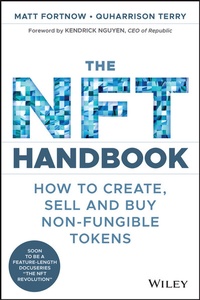
The NFT Handbook
Description

The NFT Handbook is a detailed guide on how to create, sell and buy non-fungible tokens without the need for a technical background. Learn exactly what NFTs are, how they evolved, and why they have value.
We'll delve into the different types and aspects of NFTs and discuss the different NFT marketplaces and the pros and cons of each.
* Create Your Own NFTs: Step by step instructions on all aspects of NFT creation, including what types of content to use, where to source content, adding artistic design, writing the NFT's description, adding optional unlockable content and setting an optional ongoing royalty.
* Mint Your NFTs: You'll learn the process of how to get your NFTs on the blockchain.
* Sell Your NFTs: We'll go through the whole process including creating a collection, and the different options such as setting a price or starting an auction.
* Buy NFTs: What you'll need to bid on and purchase NFTs, and how to avoid getting scammed.
* You'll also get a primer on blockchain, particularly the Ethereum cryptocurrency and "gas" fees. You'll also be shown step by step how to create, secure and fund your own cryptocurrency wallet, where you'll store your NFTs and cryptocurrency.
Whether you're experienced with the blockchain and crypto or a complete noob (beginner), The NFT Handbook will guide you in the process of creating, minting, selling and buying NFTs.
More details
Other editions
Additional editions
Persons
7th edition of This Business of Music then co-founded the web's first fantasy sports service, which he sold to CBS Sports. The past several years Matt dove into blockchain technology, cryptocurrencies, and non-fungible tokens.
QUHARRISON TERRY is a growth marketer and entrepreneur. Co-Founder of 23VIVI, the world's first digital art marketplace powered by the Bitcoin blockchain, he is a 4x recipient of LinkedIn's Top Voices in Technology Award. He currently leads Growth Marketing at Mark
Cuban Companies.
Content
About the Technical Editor ix
Acknowledgments x
Foreword xvii
Chapter 1 Introduction to NFTs 1
Chapter 2 What Are NFTs? 7
Why People Collect 7
What Exactly Are NFTs? 10
Types of NFTs 16
Aspects of NFTs 32
Extrinsic Elements of NFTs 44
Chapter 3 Why NFTs Have Value 49
Why Do Collectibles Have Value? 50
The Problems with Traditional Art 53
The Problems with Collectibles and Memorabilia 57
Digital Art Before NFTs 60
The True Advantage of NFTs 61
NFTs Aren't Perfect 74
External Forces That Drive Value 89
Chapter 4 History of NFTs 93
Andy Warhol Presents Pop Art 94
Beeple's Cyberpunk World Meets NFTs 99
The Story of Digital Art 104
Chapter 5 NFT Marketplaces 115
OpenSea 116
Rarible 117
Nifty Gateway 118
SuperRare 118
Wax (Atomic Hub) 119
Foundation 120
NBA Top Shot 121
VeVe 122
Known Origin 122
Myth Market 123
Wrap-Up 124
Chapter 6 Creating and Minting NFTs 125
Creating the Aspects of Your NFT 126
Creating a Cryptocurrency Wallet 134
Creating an OpenSea Account 144
Creating a Collection 147
Minting an NFT 157
Chapter 7 Selling NFTs 161
Your Exchange Account 161
Buying Cryptocurrency 167
Funding Your MetaMask Wallet 170
Selling Your NFTs 172
Marketing Your NFTs 181
Chapter 8 Buying NFTs 195
Why Buy NFTs? 195
Buying NFTs 199
Building an NFT Collection 206
Chapter 9 Legal Aspects of NFTs 213
Are NFTs Securities? 214
Intellectual Property Rights 218
Right of Publicity 225
Right of Privacy 231
Contracts 232
Taxes 235
Chapter 10 The Future of NFTs 239
The Metaverse 240
Non-bankable Assets 246
Digital Wallets 251
The Unwritten Future of NFTs 254
Index 255
CHAPTER 2
What Are NFTs?
Even before you think about non-fungible tokens (NFTs), which in their most basic form are unique digital collectibles secured by the blockchain, you must understand how collectibles work. Perhaps the following eclectic Beanie Babies parable will clarify the erratic and eccentric psychology behind why we collect.
Why People Collect
Before NFTs, there were Beanie Babies.
From stamps to Civil War weapons to sneakers, people collect many different objects in various formats. So, it should come as no surprise that there is a market for collectibles in a digital form. Conceptually, it's confusing. But on the sheer basis of wanting to own a unique item that others do not have, digital collectibles vary little from their physical counterparts. Therefore, to understand why people collect NFTs, we'll draw a comparison to a physical collectible that took the world by storm in the 1990s: Beanie Babies.
From its inception in 1993, Ty Warner, the founder of Beanie Babies, built scarcity into his product. The plush toys were distributed in small quantities to small retailers, avoiding chain retailers and large orders altogether. Ty didn't want people to be able to find or buy every Beanie Baby they wanted.
The company kept the number of Beanie Babies in circulation secret. It "retired" the production of certain Beanie Babies to create more exclusivity. It intentionally let misprints and faulty Beanie Babies through the cracks, which would become extra rare editions of the toys.
Around the same time as the Beanie Babies' rise in the public consciousness, eBay emerged and positioned itself as the online marketplace for buying and selling collectibles worldwide. It was a synergistic relationship that ballooned the resale value of Beanie Babies and validated eBay as a valuable tool for speculators in all collectibles markets.
Those lucky enough to get their hands on one of the retired $5 plushies could, at minimum, see a two- or three-fold return by listing it on eBay. Some rarer misprints, such as the "Pinchers the Lobster" misprint as "Punchers the Lobster," yielded one collector more than $10,000.
The Beanie Babies craze was in full swing toward the end of the 1990s. Robberies and even murders ensued over the pursuit of the plush toys. For example, at a Hallmark store in West Virginia in 1999, a security guard was shot and killed when tensions were high due to a late shipment of Beanie Babies.
Sane adults searched far and wide for the chance to get a single life-changing Beanie Baby. One set of divorcees battled over who got the Beanie Babies collection, believing it was the most valuable asset that the two had to divvy up.
Then in 1997, McDonald's got in on the craze with Ty Inc. Together they launched the Teenie Beanies product line in McDonald's Happy Meals and proceeded to sell 100 million of the mini plush toys in just 10 days.
Magazines, such as Mary Beth's Beanie World, which sold 650,000 copies a month at its height, published entire spreads on Beanie Babies, discussing their value as a speculative investment, which, with the right strategy, could yield more than enough to send a kid to college.
Just when Beanie Babies seemed to be a collectible that would carry on for decades, it all came crashing down. Talk of their overvaluation sparked an avalanche of Beanie Babies hoarders to list their toys on eBay, causing a significant oversupply. In turn, the price of Beanie Babies plummeted.
Seemingly overnight, people's collections of presumed valuable Beanie Babies became nearly worthless. The story of Chris Robinson Sr.-the man who spent more than $100,000 on Beanie Babies for the speculative investment-became the symbol for the crushing defeat that this collectible market experienced.
The Financial Times aptly called Beanie Babies "the dot-com stock of the soccer mom world in the second half of the 1990s." We don't draw this comparison to say that NFTs are doomed to the same fate as Beanie Babies, that is, a collectible bubble bound to burst. Instead, Beanie Babies provide an excellent look into the dynamics of why people collect.
The same basic principle that drove people to collect Beanie Babies drives people to collect NFTs: scarcity. Although other factors drive collectors to collect, such as investment, speculation, emotional connection, the fear of missing out (FOMO), and "the thrill of the hunt," at the core of collecting is scarcity. No matter what we collect, we do so because there are a limited number of those things.
Could the NFT market crash? Anything is possible. But unlike Beanie Babies, NFTs provide real-world solutions to problems plaguing the art and collectibles markets, as we discuss in Chapter 3, "Why NFTs Have Value."
Now that we've addressed why people collect, whether it's physical or digital collectibles, let's dive into the topic at hand: NFTs.
What Exactly Are NFTs?
NFTs are generally known as a particular type of digital collectible, such as digital art from Beeple, a digital trading card from Rob Gronkowski, a short video from Saturday Night Live, a picture of fortune-telling Curly of The Three Stooges with an unlockable Curly-esque fortune, or one of the CryptoKitties. But what exactly are NFTs?
NFTs are unique items verified and secured by a blockchain, the same technology used for cryptocurrencies. An NFT provides authenticity of origin, ownership, uniqueness (scarcity), and permanence for any particular item. Let's break the term non-fungible token down a piece at a time.
Tokens
Let's start with the word token. According to Dictionary.com, one of the definitions of token is "a memento; souvenir; keepsake." Since NFTs are commonly known as digital collectibles, one might think the token in NFT is derived from this definition. Although it may apply (somewhat), the token in NFT is derived from something entirely different: the blockchain.
Some of you may be fretting, "Oh no, here comes the technical part. I just want to know what an NFT is." To understand completely what an NFT is, you need to learn a little about blockchain. We promise not to make it too complicated.
You've probably heard of Bitcoin and perhaps some other cryptocurrencies. According to Investopedia, a cryptocurrency is "a digital or virtual currency that is secured by cryptography." Just know that cryptocurrencies are digital currencies that exist on the Internet. You can buy and sell them for investment purposes, buy things with them, or even stake them (essentially lending them to earn interest).
Whenever someone transacts with a cryptocurrency, whether buying, selling, transferring, staking, or purchasing something with cryptocurrency, that transaction must be verified. The verification process determines whether the sender has the amount of cryptocurrency being sent. This is what keeps a cryptocurrency secure and reliable.
When cryptocurrency transactions are verified, for example, with Bitcoin, the verification is conducted on a group of transactions, not a single transaction. This batch of cryptocurrency transactions is known as a block. Each block has a certain storage capacity. After the block is filled and the transactions have been confirmed, the block of transactions is then appended to the previously verified block, creating an ever-growing chain of blocks: a blockchain. The process repeats, and the blockchain grows longer and longer (see Figure 2.1).
So, the blockchain of a cryptocurrency is a list of all transactions (every single one) of that currency, going all the way back to the beginning of that cryptocurrency.
Every time someone buys or sells Bitcoin, buys something with Bitcoin, exchanges Bitcoin, or transfers Bitcoin, that transaction is listed on the Bitcoin blockchain. The number of daily Bitcoin transactions reached around 400,000 in January 2021, and Ethereum (the second largest cryptocurrency) was processed more than 1.1 million times per day (Statista.com). Think of a blockchain as an extremely long accounting ledger.
FIGURE 2.1 A blockchain
Coin vs. Token.
When speaking about certain cryptocurrencies, people often use the terms coin and token interchangeably. But that would be wrong because there is an important distinction.
Cryptocurrencies that are coins, such as Bitcoin, Litecoin, Dogecoin, and Ethereum, have their own respective blockchains. In contrast, tokens are cryptocurrencies that don't have their own blockchains. Instead, tokens utilize another coin's blockchain. For example, GameCredits (GAME) and SushiToken (SUSHI), among thousands of others, are tokens that use the Ethereum blockchain. Cryptocurrency tokens that exist on the Ethereum blockchain are also known as ERC20 tokens. ERC20 is the Ethereum standard for creating cryptocurrency tokens.
GameCredits is an interesting case because it was initially a coin with its own blockchain. But to take advantage of the greater functionality that the Ethereum network offers, it switched to become an ERC20 token. So, now all GameCredits transactions (and all other ERC20 token...
