

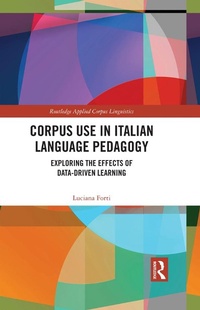
Corpus Use in Italian Language Pedagogy
Exploring the Effects of Data-Driven Learning
1st Edition
Published on 31. March 2023
266 pages
978-1-000-84602-7 (ISBN)
Description

Corpus Use in Italian Language Pedagogy: Exploring the Effects of Data-Driven Learning provides a comprehensive overview of corpus use in Italian L2 Pedagogy. The author addresses Italian language corpus resources, their potential uses in pedagogical settings, and the range of research methods available to evaluate their effectiveness. Overall, the book:
provides a comprehensive account of Italian corpora and corpus-based research on Italian that can inform the design, implementation and evaluation of DDL practices in Italian learning and teaching contexts
traces the history of DDL, by describing its origins and discussing its theoretical underpinnings, in relation to both linguistics and pedagogy
examines the state-of-the-art in DDL research, in light of the available empirical evidence on both etic and emic dimensions, while placing particular emphasis on the methodological gaps
illustrates the main methodological challenges in researching DDL, from corpus resource selection to empirical evaluation of its pedagogical effectiveness, and describes how they can be overcome
demonstrates, by means of an in-depth case study, how the guidelines provided above can be applied when researching DDL effects in a specific second language learning and teaching context
discusses the overall challenges the field faces today, while outlining some desirable avenues for future research and pedagogical practice
This book will not only be of interest to those conducting research in corpus linguistics and teaching in the Italian domain, but also to those working with other languages.
provides a comprehensive account of Italian corpora and corpus-based research on Italian that can inform the design, implementation and evaluation of DDL practices in Italian learning and teaching contexts
traces the history of DDL, by describing its origins and discussing its theoretical underpinnings, in relation to both linguistics and pedagogy
examines the state-of-the-art in DDL research, in light of the available empirical evidence on both etic and emic dimensions, while placing particular emphasis on the methodological gaps
illustrates the main methodological challenges in researching DDL, from corpus resource selection to empirical evaluation of its pedagogical effectiveness, and describes how they can be overcome
demonstrates, by means of an in-depth case study, how the guidelines provided above can be applied when researching DDL effects in a specific second language learning and teaching context
discusses the overall challenges the field faces today, while outlining some desirable avenues for future research and pedagogical practice
This book will not only be of interest to those conducting research in corpus linguistics and teaching in the Italian domain, but also to those working with other languages.
Reviews / Votes
'This book is the first comprehensive synthesis of resources, teaching applications, and empirical research devoted to data-driven learning of Italian. Deeply rooted in the field's history, supplemented with detailed theoretical and methodological considerations, and exemplified by a longitudinal empirical study, Luciana Forti's book is an invaluable reference resource, model, and inspiration for expanding corpus-based research and teaching beyond English.'Nina Vyatkina, University of Kansas, USA
'This book represents an invaluable contribution to the data-driven learning approach for Italian: researchers, teachers and students will find much to inform their work with Italian and other less-represented languages. Luciana Forti confirms her role as an important researcher in data-driven learning, especially for Italian as a foreign language. The author shows a solid understanding of research methodology in the field and an ability to transmit this via practical examples of her own research, whether qualitative or quantitative, emic or etic. The book recognises the challenges of dealing with DDL for languages that are under-researched and currently under-resourced, but provides a wealth of suggestions to meet that challenge.'
Alex Boulton, CNRS & University of Lorraine, France
More details
Series
Edition
1. Auflage
Language
English
Place of publication
London
United Kingdom
Publishing group
Taylor & Francis Ltd
Target group
Professional and scholarly
Illustrations
33 Tables, black and white; 18 Line drawings, black and white; 18 Illustrations, black and white
ISBN-13
978-1-000-84602-7 (9781000846027)
Copyright in bibliographic data and cover images is held by Nielsen Book Services Limited or by the publishers or by their respective licensors: all rights reserved.
Schweitzer Classification
Other editions
Additional editions
Book
10/2024
1st Edition
Routledge
€63.20
Shipment within 15-20 days
Book
03/2023
1st Edition
Routledge
€186.30
Shipment within 15-20 days
Person
Luciana Forti is a researcher and lecturer in Applied Linguistics at the University for Foreigners of Perugia, Italy.
Content
1. Introduction; 2. Data-driven learning: Origins, theoretical underpinnings and development through time; 3. Delving into the research evidence on data-driven learning effects; 4. Methods in researching data-driven learning effects; 5. Italian L2: Corpus resources and language learning research; 6. Language gains and learner attitudes in data-driven learning: Study design; 7. How data-driven learning impacts language gains; 8. How learners react to data-driven learning; 9. Conclusions and future prospects; Appendix A. Sample experimental lesson plan and activities (week 4); Appendix B. Sample control lesson plan and activities (week 4); Appendix C. Phraseological competence test; Appendix D. End-of-course student questionnaire (DDL group); Appendix E. End-of-course student questionnaire (non-DDL group); Index
