

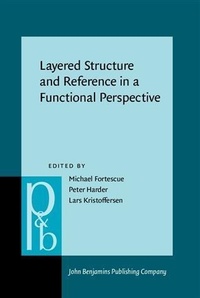
Layered Structure and Reference in a Functional Perspective
Papers from the Functional Grammar Conference, Copenhagen, 1990
1st Edition
Published on 1. July 1992
XIII, 444 pages
978-90-272-8290-3 (ISBN)
Description

This volume contains revised and expanded versions of those papers from the 1990 Functional Grammar Conference in Copenhagen that contributed specifically to the current investigation of clause structure in terms of semantic layers. One of the key concepts in this discussion is 'reference'. Some papers discuss ways in which previous accounts of reference need to be expanded and differentiated to provide a consistent picture of referential properties. The power of layered analysis to bring out fundamental similarities between languages of very different types is the theme of another group of papers, again with the referential properties of constituents playing a central role. By some contributors layered analysis is challenged, and the question is raised as to how it might fit into a dynamic and pragmatic picture of language. The book is rounded off by a comparison between layered structure in Functional Grammar and in Government and Binding Theory.
More details
Other editions
Additional editions
Michael Fortescue | Peter Harder | Lars Kristoffersen
Layered Structure and Reference in a Functional Perspective
Papers from the Functional Grammar Conference, Copenhagen, 1990
Book
07/1992
John Benjamins Publishing Co
€137.80
Shipment within 10-15 days
Content
- LAYERED STRUCTURE AND REFERENCE IN A FUNCTIONAL PERSPECTIVE
- Editorial page
- Title page
- Copyright page
- Table of contents
- List of Contributors
- Preface
- References
- Predicates as Referring Expressions
- 0. Introduction
- 1. Predicates as referring expressions
- 2. On (non-) referentiality
- 3. Consequences for copular sentences
- 4. The representation of identifying constructions
- 5. Implications for Topic assignment
- 6. Conclusion
- Notes
- References
- Parts of Speech
- 0. Introduction
- 1. Variables for predicates
- 2. New definitions for four parts of speech
- 3. Parts-of-speech systems
- 4. Conclusion
- Notes
- References
- Predication, Aspect, and Negation
- 0. Introduction
- 1. Aktionsart
- 2. Perfective and Imperfective Aspect
- 3. Composed Past and Pluperfect
- 4. Negation
- 5. Conclusion
- Notes
- References
- Subjective vs. Objective Modality: What Is the Difference?
- 0. Introduction
- 1. The distinction
- 2. Some problematic facts
- 3. A re-consideration of the distinction
- 4. Consequences for a layered representation of utterances
- Notes
- References
- Aspect and Superaspect in Koyukon: An Application of the Functional Grammar Model toa Polysynthetic Language
- 1. Introduction
- 2. The nature of aspect and aspectual derivation in Koyukon
- 3. Illustrative derivations
- 4. The expression rules
- 5. Discussion
- Notes
- References
- Derivation and Inflection in a Functional Grammarof West Greenlandic
- 0. Introduction
- 1. West Greenlandic morphology
- 2. Morphology in FG
- 3. Verbalizing affixation
- 4. Verbal expansion
- 5. Verbal modification
- 6. Sentential affixation
- 7. Discussion and conclusion
- Notes
- References
- Unit Accentuation as an Expression Device forPredicate Formation. The Case of Syntactic NounIncorporation in Danish
- 0. The structure of the paper
- 1. Introduction: the nature of the phenomenon
- 2. The syntax of the syntactic Noun Incorporation construction: predicate formation
- 3. Factors determining NI/UA
- 4. The phonology of the syntactic Noun Incorporation construction: Unit Accentuation
- 5. The lexicon and the fund - and beyond
- 6. Empirical matters: some quantitative results
- 7. Further prospects
- APPENDIX I: The range of distributions of Noun Incorporation/Unit Accentuation
- APPENDIX II: Some problems posed for FG by IN's in Danish - and some possible solutions.
- APPENDIX III: A sample derivation
- Acknowledgements
- Notes
- References
- The Treatment of Turkish Nominal Compounds in FG
- 0. Introduction
- 1. Nominal compounds
- 2 Terms as Input?
- 3. Evaluation
- 4. Compounding and Derivation
- 5. On Lexicalization
- 6. Summary and Conclusions
- Notes
- References
- Places and Things
- 0. Introduction
- 1. Places are not entities
- 2. Entities and places in Functional Grammar
- 3. Entities and places in English
- 4. Consequences for FG
- 5. Non-locational p-terms with nominal restrictor
- 6. Non-locational p-terms with predicational restrictor
- 7. 'Place': variable or lexeme?
- 8. Locational p-terms
- 9. Non-locational p-terms with adpositional predicate
- 10. Conclusion
- Notes
- References
- Classifiers in a Functional Perspective
- 1. Classifiers in Dik's Functional Grammar
- 2. A morpho-syntactic typology of classifiers
- 3. Some arguments in support of the classifier typology
- 4. Back to classifiers in Functional Grammar
- References
- Semantic Content and Linguistic Structure inFunctional Grammar. On the Semantics of 'Nounhood'
- 1. Semantics and underlying structure
- 2. Meaning as input to interpretation
- 3. Terms and predicates
- 4. Term semantics: the FG apparatus and the instructional alternative
- 5. Word classes
- 6. Reference
- 7. A reinterpretation of some examples
- 8. Conclusion
- Notes
- References
- Free Relatives
- 1. Introduction
- 2. Layering
- 3. Restrictives and appositives
- 4. Free relatives
- 5. Free appositives
- 6. Conclusion
- Notes
- References
- Number, Gender and Countability in Danish: An FG Approach
- 0. Introduction
- 1. Number and countability
- 2. Number and countability in FG
- 3. Gender in Danish
- 4. Gender in FG
- 5. Underlying structure, content syntax and expression syntax
- 6. A brief summary
- Notes
- References
- Conditionals in the Layered Structure of Functional Grammar
- 1. Introduction
- 2. Propositional conditionals and the layered typology of satellites
- 3. The underlying structure of propositional conditionals
- 4. The underlying structure of illocutionary and non-restrictive propositionalconditionals: remaining problems
- 5. Conclusion
- Notes
- References
- Limits to Layering: Locatability and Other Problems
- 0. Introduction
- 1. Some inconsistencies
- 2. ILL and converted ILL
- 3. The problem of extra-clausal constituents
- 4. Some problems for the layered structure
- 5. Concluding remarks
- Notes
- References
- Layers in FG and GB
- 1. Introduction
- 2. Hierarchical structure in FG
- 3. X-bar hierarchical constituency structure
- 4. Comparing the hierarchical structures
- 5. Hierarchical structure and clausal complementation
- 6. Some final remarks
- Notes
- References
- Subject Index
- Index of Names
