

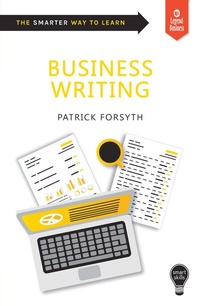
Smart Skills: Business Writing
Published on 30. April 2018
130 pages
978-1-78719-821-0 (ISBN)
Description

Book 3 of the Smart Skills series: practical guides to mastering vital business skills and techniques. Using proven strategies from business experts, these essential smart skills can empower anyone with the tools to get ahead.
Gain a competitive edge at work with your business writing skills.
Effective business writing skills can help you win that million-pound contract, earn a promotion, resolve a dispute or generate a significant increase in business leads. Our Smart Skills book offers proven, practical advice on how to put over a clear and impressive message in a style that's deceptively simple and even enjoyable to read. These guidelines will teach you how to: - Write and format business reports, proposals or presentations
- Recognise the dangers of poor writing
- Write effectively under time pressure
- Use persuasive techniques and structures
- Deal with all types of documentation from a "simple" email to a long report
Accessibly written, it includes checklists, templates and exercises to help you work through even the most basic building blocks of good writing. Business Writing provides an antidote to the dangers of 'gobbledegook' and 'business-speak' and allows you to generate any kind of document with confidence. After reading this guide, your writing will be effective, engaging and memorable- a vital skill for all professionals.
Gain a competitive edge at work with your business writing skills.
Effective business writing skills can help you win that million-pound contract, earn a promotion, resolve a dispute or generate a significant increase in business leads. Our Smart Skills book offers proven, practical advice on how to put over a clear and impressive message in a style that's deceptively simple and even enjoyable to read. These guidelines will teach you how to: - Write and format business reports, proposals or presentations
- Recognise the dangers of poor writing
- Write effectively under time pressure
- Use persuasive techniques and structures
- Deal with all types of documentation from a "simple" email to a long report
Accessibly written, it includes checklists, templates and exercises to help you work through even the most basic building blocks of good writing. Business Writing provides an antidote to the dangers of 'gobbledegook' and 'business-speak' and allows you to generate any kind of document with confidence. After reading this guide, your writing will be effective, engaging and memorable- a vital skill for all professionals.
More details
Language
English
Place of publication
London
United Kingdom
Publishing group
Legend Press Ltd
Target group
College/higher education
Professional and scholarly
File size
0,49 MB
ISBN-13
978-1-78719-821-0 (9781787198210)
Copyright in bibliographic data and cover images is held by Nielsen Book Services Limited or by the publishers or by their respective licensors: all rights reserved.
Schweitzer Classification
Other editions
Additional editions
Patrick Forsyth
Smart Skills: Business Writing
Book
04/2018
Legend Business
€14.50
Shipment within 3-4 weeks
Person
Patrick Forsyth began his career in publishing and has run Touchstone Training & Consultancy since 1990; this specialises in the improvement of marketing, management and communications skills. He is an experienced conference speaker and writes extensively on business matters. He is the author of many successful books on aspects of business, management and careers, including How to Write Reports and Proposals (Kogan Page) and Marketing: a guide to the fundamentals (The Economist). One reviewer says of his work: Patrick has a lucid and elegant style of writing which allows him to present information in a way that is organised, focused and easy to apply.
Content
- Cover
- Title
- Copyright
- Contents
- Preface The rationale: dangers of poor writing and opportunities of good
- 1. Introduction Good writing is the business equivalent of an open goal
- 2. Getting it down right
- 3. Making language work for you
- 4. Making it persuasive
- 5. Horses for courses: linking style to method
- 6. The brief, the very brief and the ubiquitous email
- 7. At length: reports and prososals
- Postscript
- About the author
PREFACE
THE RATIONALE: DANGERS OF POOR WRITING AND OPPORTUNITIES OF GOOD
What is written without effort is in general read without pleasure. Samuel Johnson
Communications is an inherent part of business. Yet successful communication can be difficult. Poor communication can cause problems. This may involve a momentary hiatus as two people try to sort out exactly what is meant. Or it may cause a major misunderstanding that causes a project of some sort to be stopped in its tracks. Why is this? There are many reasons, but one is certainly an assumption that what is being done is not difficult, coupled with a subsequent unwillingness to check out the principles on which success might be based. Perhaps that is actually two reasons already, and more are investigated later.
Furthermore some kinds of communication are inherently more difficult than others. The intentions of communication may vary. It may need to inform, explain, motivate, challenge, prompt a debate or more; and such intentions are not mutually exclusive, one communication may need to do several of these things at once. Communications designed with a specific purpose, say to be persuasive, adds another layer and putting something in writing can add further complications. I once stayed in a hotel with a sign inside the bedroom door saying: In the interests of security please ensure your bedroom door is firmly shut before entering or leaving the room. It would be a good trick if you can do it. And that is just one sentence - someone wrote it, printed it and posted it around the hotel and still no one noticed it was rubbish!
On paper
There is a further problem, and that is that most people are better at communicating face to face than in other ways. Other methods all have their disadvantages. The telephone is good, immediate, maybe quick and easy, but try describing to someone over the telephone how to, say, tie a shoelace. Think about it for a second. You know how to do it, you could easily show someone else - but using only your voice, it is somehow more of a problem.
One method that seems consistently to render people less articulate is when they have to put something in writing. Your manager wants a note about something, the Board need a report or proposal, and my editor wants a book (and there are still many thousands of words to go). Business writing almost seems to hinder good communication. People who can talk about something and usually get their message over successfully, find themselves descending into a muddle of business-speak and gobbledegook, writing something over formal, over long and - at worst - forgetting somewhere along the way exactly what their objectives were in the first place.
Of course, putting something into written form can be a chore, and its being so can extend the task as agonising over the best form of words to make permanent takes time. Hence this book: the intention here is clear. It is to assist the process of communicating successfully when it must be done in writing. This may mean a letter (or e-mail), or it may mean a report or a proposal and various kinds of letter and document in between. It might also mean copy for a brochure or a newsletter. A message may be sent internally: to a group of staff or an individual member of your team - or upwards, perhaps to your manager. It may be sent externally: to a supplier, a customer or to many customers (this latter may include direct mail letters). The circumstances can vary. But the intention is always the same: to make things clear and achieve your objectives to inform, persuade or whatever.
Whatever your circumstances, this book is designed to help you see more clearly how to go about writing clearly and powerfully. There is no one magic formula, as so often what makes a business technique work is, though it may be based on certain fundamental approaches, a matter of attention to a number of details. Certainly that is the case here.
It is, however, possible. You can write with clarity if you go about it in the right way and, if you do that, you will also begin to do it faster as well. In a busy life that is something worthwhile too. In the coming pages we will see how all this can be done, starting with a look at some of the difficulties of communication and how to avoid them.
THE RATIONALE: DANGERS OF POOR WRITING AND OPPORTUNITIES OF GOOD
What is written without effort is in general read without pleasure. Samuel Johnson
Communications is an inherent part of business. Yet successful communication can be difficult. Poor communication can cause problems. This may involve a momentary hiatus as two people try to sort out exactly what is meant. Or it may cause a major misunderstanding that causes a project of some sort to be stopped in its tracks. Why is this? There are many reasons, but one is certainly an assumption that what is being done is not difficult, coupled with a subsequent unwillingness to check out the principles on which success might be based. Perhaps that is actually two reasons already, and more are investigated later.
Furthermore some kinds of communication are inherently more difficult than others. The intentions of communication may vary. It may need to inform, explain, motivate, challenge, prompt a debate or more; and such intentions are not mutually exclusive, one communication may need to do several of these things at once. Communications designed with a specific purpose, say to be persuasive, adds another layer and putting something in writing can add further complications. I once stayed in a hotel with a sign inside the bedroom door saying: In the interests of security please ensure your bedroom door is firmly shut before entering or leaving the room. It would be a good trick if you can do it. And that is just one sentence - someone wrote it, printed it and posted it around the hotel and still no one noticed it was rubbish!
On paper
There is a further problem, and that is that most people are better at communicating face to face than in other ways. Other methods all have their disadvantages. The telephone is good, immediate, maybe quick and easy, but try describing to someone over the telephone how to, say, tie a shoelace. Think about it for a second. You know how to do it, you could easily show someone else - but using only your voice, it is somehow more of a problem.
One method that seems consistently to render people less articulate is when they have to put something in writing. Your manager wants a note about something, the Board need a report or proposal, and my editor wants a book (and there are still many thousands of words to go). Business writing almost seems to hinder good communication. People who can talk about something and usually get their message over successfully, find themselves descending into a muddle of business-speak and gobbledegook, writing something over formal, over long and - at worst - forgetting somewhere along the way exactly what their objectives were in the first place.
Of course, putting something into written form can be a chore, and its being so can extend the task as agonising over the best form of words to make permanent takes time. Hence this book: the intention here is clear. It is to assist the process of communicating successfully when it must be done in writing. This may mean a letter (or e-mail), or it may mean a report or a proposal and various kinds of letter and document in between. It might also mean copy for a brochure or a newsletter. A message may be sent internally: to a group of staff or an individual member of your team - or upwards, perhaps to your manager. It may be sent externally: to a supplier, a customer or to many customers (this latter may include direct mail letters). The circumstances can vary. But the intention is always the same: to make things clear and achieve your objectives to inform, persuade or whatever.
Whatever your circumstances, this book is designed to help you see more clearly how to go about writing clearly and powerfully. There is no one magic formula, as so often what makes a business technique work is, though it may be based on certain fundamental approaches, a matter of attention to a number of details. Certainly that is the case here.
It is, however, possible. You can write with clarity if you go about it in the right way and, if you do that, you will also begin to do it faster as well. In a busy life that is something worthwhile too. In the coming pages we will see how all this can be done, starting with a look at some of the difficulties of communication and how to avoid them.
