

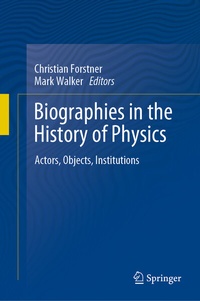
Biographies in the History of Physics
Description

This book sheds new light on the biographical approach in the history of physics by including the biographies of scientific objects, institutions, and concepts. What is a biography? Can biographies also be written for non-human subjects like scientific instruments, institutions or concepts? The respective chapters of this book discuss these controversial questions using examples from the history of physics. By approaching biography as metaphor, it transcends the boundaries between various perspectives on the history of physics, and enriches our grasp of the past.
More details
Other editions
Additional editions
Persons
Christian Forstner is a Heisenberg-Fellow at the Friedrich Schiller University in Jena, Germany. Graduated in physics, he started a career in the history of science. His research focuses on the history of quantum mechanics and nuclear physics, science and society, and the material culture of physics. He was vice-president of the international Commission for the History of Modern Physics and serves as chairman of the Division for the History of Physics of the German Physical Society.
Mark Walker is the John Bigelow Professor of History at Union College in Schenectady, NY, USA, where he teaches modern European history and the history of science and technology. His research focuses on the history of science, medicine, technology, and National Socialism from the First World War to the postwar Cold War era, including comparative perspectives.
Content
Preface (Christian Forstner, Dieter Hoffmann, Mark Walker).- Biography of what? Biographies and the History of Physics (Christian Forstner).- Autobiography as history, curriculum vitae, or ars moriendi? (Thomas Söderqvist).- Bridging Personal and Professional: Margaret Maltby's Life in Early Twentieth Century Physics (Joanna Behrman).- The Monastic Natural Philosopher - An Eighteenth Century Scientific Persona (Julia Bloemer).- Ludwig Prandtl -- Pioneer of Fluid Mechanics and Science Manager (Michael Eckert).- Rudolf Tomaschek: An exponent of the 'Deutsche Physik' movement (Vanessa Osganian).- Erwin Schrödinger in Spain (Enric Pérez).- Whose Biography Is It Anyway?: The Intersection of Biographies of Institutions, Leaders, and Instruments (Catherine Westfall).- Institutionalizing Einstein's Theory During the Cold War: Toward a Biography of the International Society on General Relativity and Gravitation(Roberto Lalli).- Marxism-Leninism and Relativity: Science and Ideology in Hans-Jürgen Treder's early academic career (Raphael Schlattmann).- A "Biography of the Max Planck Society:" The development of research clusters (Carsten Reinhardt).- Institutional biographies in time and frequency metrology: the case of the French Laboratoire National de Radioélectricité (Eckhard Wallis).- A biographical sketch of the last days of the ether (Jaume Navarro).- The Biography of a Concept - The "Birth" of Virtual Particles as a Case Study (Markus Ehberger).- The Biography of the German Atomic Bomb (Mark Walker).- The colour top and the distinction between additive and subtractive colour mixing (Valentina Roberti).- Scientific instruments turning into toys. From Franklin's palm glass to dipping birds. (Takis Lazos).- The transformation of research experiments into teaching devices (Peter Heering).- Lost in the production of time and space: the transformation of the Airy Transit Circle from a working telescope to a museum object (Daniel Belteki).
