

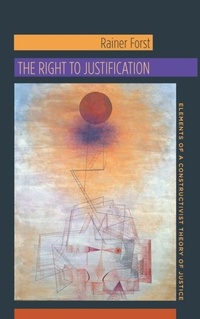
The Right to Justification
Description

Contemporary philosophical pluralism recognizes the inevitability and legitimacy of multiple ethical perspectives and values, making it difficult to isolate the higher-order principles on which to base a theory of justice. Rising up to meet this challenge, Rainer Forst, a leading member of the Frankfurt School's newest generation of philosophers, conceives of an "autonomous" construction of justice founded on what he calls the basic moral right to justification.
Forst begins by identifying this right from the perspective of moral philosophy. Then, through an innovative, detailed critical analysis, he ties together the central components of social and political justice¿freedom, democracy, equality, and toleration¿and joins them to the right to justification. The resulting theory treats "justificatory power" as the central question of justice, and by adopting this approach, Forst argues, we can discursively work out, or "construct," principles of justice, especially with respect to transnational justice and human rights issues.
As he builds his theory, Forst engages with the work of Anglo-American philosophers such as John Rawls, Ronald Dworkin, and Amartya Sen, and critical theorists such as Jürgen Habermas, Nancy Fraser, and Axel Honneth. Straddling multiple subjects, from politics and law to social protest and philosophical conceptions of practical reason, Forst brilliantly gathers contesting claims around a single, elastic theory of justice.
All prices
More details
Other editions
Additional editions
Persons
Jeffrey Flynn is assistant professor of philosophy at Fordham University.
Content
Translator's Note
Introduction: The Foundation of Justice
Part 1: Foundations: Practical Reason, Morality, and Justice
1. Practical Reason and Justifying Reasons: On the Foundation of Morality
2. Moral Autonomy and the Autonomy of Morality: Toward a Theory of Normativity After Kant
3. Ethics and Morality
4. The Justification of Justice: Rawls's Political Liberalism and Habermas's Discourse Theory in Dialogue
Part 2: Political and Social Justice
5. Political Liberty: Integrating Five Conceptions of Autonomy
6. A Critical Theory of Multicultural Toleration
7. The Rule of Reasons: Three Models of Deliberative Democracy
8. Social Justice, Justification, and Power
Part 3: Human Rights and Transnational Justice
9. The Basic Right to Justification: Toward a Constructivist Conception of Human Rights
10. Constructions of Transnational Justice: Comparing John Rawls's The Law of Peoples and Otfried Höffe's Democracy in an Age of Globalisation
11. Justice, Morality, and Power in the Global Context
12. Toward a Critical Theory of Transnational Justice
Notes
Bibliography
