

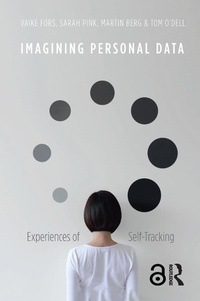
Imagining Personal Data
Experiences of Self-Tracking
Published on 4. May 2020
176 pages
978-1-000-18529-4 (ISBN)
Description

Digital self-tracking devices and data have become normal elements of everyday life. Imagining Personal Data examines the implications of the rise of body monitoring and digital self-tracking for how we inhabit, experience and imagine our everyday worlds and futures. Through a focus on how it feels to live in environments where data is emergent, present and characterized by a sense of uncertainty, the authors argue for a new interdisciplinary approach to understanding the implications of self-tracking, which attends to its past, present and possible future. Building on social science approaches, the book accounts for the concerns of scholars working in design, philosophy and human-computer interaction. It problematizes the body and senses in relation to data and tracking devices, presents an accessible analytical account of the sensory and affective experiences of self-tracking, and questions the status of big data. In doing so it proposes an agenda for future research and design that puts people at its centre.
Reviews / Votes
This is a very welcome and timely contribution. Rather than evaluating self- tracking as either empowering or not, it goes into a more nuanced, complex and engaging account of the temporalities of self-tracking technologies. How they are entangled with everyday life, how they participate in different human futures, and how they serve as a tool for learning about ourselves as human beings. Highly needed and highly recommendable! - Dorthe Brogard Kristensen, University of Southern DenmarkMore details
Language
English
Place of publication
London
United Kingdom
Publishing group
Taylor & Francis Ltd
Target group
College/higher education
File size
2,82 MB
ISBN-13
978-1-000-18529-4 (9781000185294)
Copyright in bibliographic data and cover images is held by Nielsen Book Services Limited or by the publishers or by their respective licensors: all rights reserved.
Schweitzer Classification
Other editions
Additional editions

Book
08/2021
1st Edition
Routledge
€67.20
Shipment within 10-20 days
Book
12/2019
1st Edition
Bloomsbury Academic
€131.90
Shipment within 15-20 days
Persons
Vaike Fors is Associate Professor of Pedagogy at Halmstad University, Sweden.
Sarah Pink is Professor and Director of the Emerging Technologies Research Lab at Monash University, Australia.
Martin Berg is Associate Professor of Sociology and Media Technology at Malmoe University, Sweden.
Tom O'Dell is Professor in the Department of Arts and Cultural Sciences at Lund University, Sweden.
Sarah Pink is Professor and Director of the Emerging Technologies Research Lab at Monash University, Australia.
Martin Berg is Associate Professor of Sociology and Media Technology at Malmoe University, Sweden.
Tom O'Dell is Professor in the Department of Arts and Cultural Sciences at Lund University, Sweden.
Content
List of Figures Acknowledgements Prologue 1. Self-Tracking in the World 2. Encountering the Temporalities and Imaginaries of Personal Data 3. Ubiquitous Monitoring Technologies in Historical Perspective 4. Algorithmic Imaginations 5. Traces through the Present 6. Anticipatory Data Worlds 7. Personal Data Futures Notes Bibliography Index
