

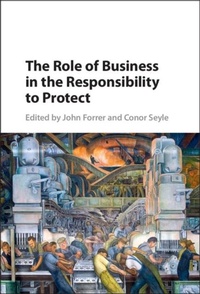
The Role of Business in the Responsibility to Protect
Published on 26. July 2017
978-1-316-77767-1 (ISBN)
Description

The Role of Business in the Responsibility to Protect closes the gap between research on the Responsibility to Protect and the private sector, as previous research has focused only on state responsibilities and state actors. This book examines in detail the developing research on the significant role that private sector actors can play in promoting peace and stability. Contributors to this volume explore the key arguments for where, why, and how private sector actors can contribute to the prevention and cessation of mass atrocity crimes; and how this can inform and extend the UN policy discussion around Responsibility to Protect. The contributors include lead voices in the Responsibility to Protect discourse as well as central voices in business and peace literature.
Reviews / Votes
'In the past, predatory business practices have sometimes enabled crimes against humanity. This book identifies how some businesses have profited from human misery while also providing welcome examples of how the private sector can play a crucial role in undermining the politics of the machete and the mass grave. In doing so, this book broadens our understanding of the international community, of our collective responsibility to protect, and of how the private sector - whose wealth, resources and capacity can easily exceed those of failing or fragile states - can play a vital role in the prevention of mass atrocities.' Simon Adams, Global Centre for the Responsibility to Protect, The Graduate Center, City University of New York 'That business can be an instrument in building peace has now been firmly recognized. Including the business sector in the Responsibility to Protect (R2P) debate seems only natural, having in mind the capacity of the business community to influence societal attitudes and structures. In this new book professor John Forrer and Conor Seyle make an important effort in putting this agenda forward.' Per L. Saxegaard, Founder and Chairman, Business for Peace Foundation 'The private sector is an increasingly influential actor in global governance - the network of arrangements that ensure order, stability and predictability even in the absence of world government. Business can sustain and profiteer from group violence. But it also has important roles to play before, in and after armed conflicts in underwriting peace, stability and prosperity as the pathway to sustainable profits. One important role is to partner with other key actors in implementing the responsibility to protect populations at risk of mass atrocities. This invaluable collection of essays by leading experts systematically explains why, how and with what prospects.' Ramesh Thakur, Australian National University, Canberra, International Commission on Intervention and State Sovereignty (ICISS) Commissioner and Editor-in-Chief, Global Governance 'This volume fills an important lacuna in the literature on how business relates to the responsibility to protect. The contributing authors offer practical and theoretical insights and examples that will be of interest to many on the ways the private sector can support (or undermine) the goals of the responsibility to protect.' Abi Williams, President, The Hague Institute for Global Justice 'This book, with its focus on how business actors may contribute to the global Responsibility to Protect Agenda (R2P), pioneers a whole new agenda for research and policy formulation. In the process, the authors challenge our standard conceptions of both business and R2P.' Kristian Berg Harpviken, Director, Peace Research Institute Oslo (PRIO)More details
Language
English
Place of publication
Cambridge
United Kingdom
Publishing group
Cambridge University Press
Target group
Professional and scholarly
File size
19,73 MB
ISBN-13
978-1-316-77767-1 (9781316777671)
Copyright in bibliographic data and cover images is held by Nielsen Book Services Limited or by the publishers or by their respective licensors: all rights reserved.
Schweitzer Classification
Other editions
Additional editions
John Forrer | Conor Seyle
The Role of Business in the Responsibility to Protect
Book
09/2016
Cambridge University Press
€133.10
Shipment within 15-20 days
Persons
John J. Forrer is Director of the Institute of Corporate Responsibility, Associate Research Professor of Strategic Management and Public Policy, and Associate Faculty at George Washington University, Washington DC. He has researched, taught, and written on cross-sector collaborations and public-private partnerships for fifteen years, in particular emphasizing the role the private-sector can play in advancing public policy goals. Other research areas focus on business and peace, global governance and sustainable global supply chains. He has co-authored books on economic sanctions and cross-sector collaboration and published more than twenty book chapters and journal articles. Conor Seyle is Deputy Director of Research and Development at the One Earth Future Foundation, an international research and operating foundation focused on supporting good global governance in the interest of peace. He is a political psychologist with research interests in international governance, deliberative democracy, and the long-term impact of violence and traumatic events. He is the author or co-author of more than twenty-six academic and NGO publications.
Content
Overview: the role of business in R2P John Forrer and Conor Seyle; Introduction: the private sector, the United Nations, and the Responsibility to Protect Edward Luck; 1. Selling R2P: time for action Victor MacDiarmid and Tina Park; 2. Why not business? Tim Fort and Michelle Westermann-Behaylo; 3. Responsibility to protect trumps business as usual: how corporate leaders build heroism to face atrocities Alain Lemperuer and Rebecca Herrington; 4. The Responsibility to Protect, Inc. Jonas Claes; 5. The Kenyan private sector's role in mass atrocity prevention, cessation and recovery Patrick Obath and Victor Owuor; 6. R2P and the extractive industries Jill Shankleman; 7. Information technology, private actors, and the Responsibility to Protect Kirsten Martin; 8. Corporate responsibility to protect populations from mass atrocities Vesselin Popovski; 9. The private sector and atrocities prevention Alex Bellamy; 10. The way forward: discovering the shared interests between business and R2P John Forrer and Conor Seyle.
