

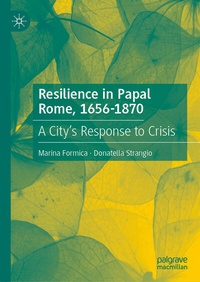
Resilience in Papal Rome, 1656-1870
Description

This book analyses the evolution of the city of Rome, in particular, papal Rome, from the plague of 1656 until 1870 when it became the capital of the Kingdom of Italy. The authors explore papal Rome as a resilient city that had to cope with numerous crises during this period. By focusing on a selection of different crises in Rome, the book combines cultural, political, and economic history to examine key turning points in the city's history. The book is split into chapters exploring themes such as diplomacy and international relations, disease, environmental disasters, famine, public debt, and unravels the political, economic, and social consequences of these transformative events. All the chapters are based on untapped original sources, chiefly from the State Archive in Rome, the Vatican Archives, the Rome Municipal Archives, the École Française Library, the National Library, and the Capitoline Library.
More details
Other editions
Additional editions
Persons
Marina Formica is Full Professor of Modern History at the University of Rome Tor Vergata, Italy, and President of the Italian Society of Studies on the Eighteenth Century (SISSD). Additionally, she is on the Executive Board of the National Institute of Roman Studies and is a member of the Committee for Addresses of the Rome Foundation and the Camillo Caetani Foundation. Recently, she was the scientific organiser of the World Conference, Antiquity and the Shape of the Future in the Age of the Enlightenment.
Donatella Strangio is Full Professor of Economic History at Sapienza University of Rome, Italy, where she is affiliated with the Department of Methods and Models for Economics, Land, and Finance. She is an Ordinary Member of the National Institute of Roman Studies; a Member of the Italian Society of Studies on the Eighteenth Century (SISSD); a Delegate of the Rector of Sapienza University of Rome for Brazil and Chile; and a Lecturerof the UNESCO Chair in 'Economic Systems and Human Rights' of the National University of La Plata.
Content
Chapter 1: Papal Rome: Between Crisis and Resilience.- Chapter 2: Political Crises .- Chapter 3: Health Crises.- Chapter 4: Environmental Crises.- Chapter 5: Food Crises.- Chapter 6: Financial Crises.- Chapter 7: Identity Crises.
