

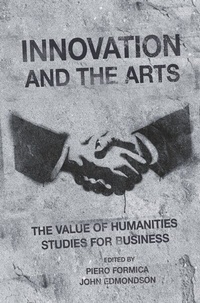
Innovation and the Arts
The Value of Humanities Studies for Business
1st Edition
Published on 19. February 2020
248 pages
978-1-78973-885-8 (ISBN)
Description

We live in the Age of Knowledge but we are heading towards the Age of Imagination. However, our current education systems still divide arts and business, juxtaposing them as different worlds, apparently ignoring the essential truth that imagination is the springboard of innovation. For business to continue to evolve, the barriers to creativity and innovation must be lowered.
In Innovation and the Arts: The Value of Humanities Studies for Business, editors Piero Formica and John Edmondson bring together a cast of expert contributors to explore how arts education can transform future business and social endeavours by developing empathy and enhancing skills frequently identified as lacking in graduates entering the workplace. Looking at arts and humanities across the broad spectrum of business and social innovation, and in the context of business education, examples of entrepreneurial and innovative developments, and the nature of the innovative mind, the contributors show how underdeveloped empathy and creativity constrain innovation. Art is disruptive, and innovation requires disruption to thrive.
By dwelling on the need for the convergence of business, innovation and the arts, Innovation and the Arts highlights the inestimable value of lowering the psychological, organizational and institutional barriers that keep them apart. For educators and practitioners, this is an in-depth discussion designed to stimulate awareness of the issues facing business education.
In Innovation and the Arts: The Value of Humanities Studies for Business, editors Piero Formica and John Edmondson bring together a cast of expert contributors to explore how arts education can transform future business and social endeavours by developing empathy and enhancing skills frequently identified as lacking in graduates entering the workplace. Looking at arts and humanities across the broad spectrum of business and social innovation, and in the context of business education, examples of entrepreneurial and innovative developments, and the nature of the innovative mind, the contributors show how underdeveloped empathy and creativity constrain innovation. Art is disruptive, and innovation requires disruption to thrive.
By dwelling on the need for the convergence of business, innovation and the arts, Innovation and the Arts highlights the inestimable value of lowering the psychological, organizational and institutional barriers that keep them apart. For educators and practitioners, this is an in-depth discussion designed to stimulate awareness of the issues facing business education.
More details
Language
English
Place of publication
Bingley
United Kingdom
Target group
Professional and scholarly
File size
9,53 MB
ISBN-13
978-1-78973-885-8 (9781789738858)
Copyright in bibliographic data and cover images is held by Nielsen Book Services Limited or by the publishers or by their respective licensors: all rights reserved.
Schweitzer Classification
Other editions
Additional editions
Book
02/2020
Emerald Publishing Limited
€121.80
Shipment within 10-20 days
Persons
Piero Formica is currently a Senior Research Fellow of the Innovation Value Institute at Maynooth University in Ireland. Professor Formica received the Innovation Luminary Award in 2017 from the EU's Open Innovation Science and Policy Group for his work on modern innovation policy. Previous publications with Emerald include Grand Transformation Towards an Entrepreneurial Economy: Exploring the Void, 2015, and Exploring the Culture of Open Innovation: Towards an Altruistic Model of Economy, 2018.
John Edmondson is an editor, writer and publishing consultant and an independent scholar in Victorian Studies. He is Editor of the bimonthly journal Industry and Higher Education. His previous books include Entrepreneurship and Knowledge Exchange, co-edited with Jay Mitra, 2015; Dickens on France, 2006 and Traveller's Literary Companion to France, 1996.
John Edmondson is an editor, writer and publishing consultant and an independent scholar in Victorian Studies. He is Editor of the bimonthly journal Industry and Higher Education. His previous books include Entrepreneurship and Knowledge Exchange, co-edited with Jay Mitra, 2015; Dickens on France, 2006 and Traveller's Literary Companion to France, 1996.
Content
Foreword; Brian Donnellan
1. Business, innovation and the arts: The golden encounter; Piero Formica
2. The golden path toward the arts in/with business; Tatiana Chemi
3. Teaching intangibles - uncertainty and imperfection and the institutional challenge of the unmeasurable; John Edmondson
4. On regarding the value of aesthetics for entrepreneurship; Jay Mitra
5. The true value of 'doing well' economically; Morten Tonnessen
6. Beyond the 'great derangement': Will the humanities lead ecological transition?; Fabio Montagnino
7. Move slow and nurture things: Wise creativity and human-centred values in a world that idolizes disruption; Danah Henriksen and Punya Mishra
8. How businesses can benefit from collaborating with the arts; Peter Robbins
9. The arts as an economic driver in an era of exponential technologies: A Silicon Valley entrepreneur's
perspective; Sheridan Tatsuno
10. Leadership in business, innovation and art: Lessons learnt from an orchestra conductor; Edna Pasher, Roni Porat, Yaara Turjeman-Levi, Mor Harir and Yael Caspi
1. Business, innovation and the arts: The golden encounter; Piero Formica
2. The golden path toward the arts in/with business; Tatiana Chemi
3. Teaching intangibles - uncertainty and imperfection and the institutional challenge of the unmeasurable; John Edmondson
4. On regarding the value of aesthetics for entrepreneurship; Jay Mitra
5. The true value of 'doing well' economically; Morten Tonnessen
6. Beyond the 'great derangement': Will the humanities lead ecological transition?; Fabio Montagnino
7. Move slow and nurture things: Wise creativity and human-centred values in a world that idolizes disruption; Danah Henriksen and Punya Mishra
8. How businesses can benefit from collaborating with the arts; Peter Robbins
9. The arts as an economic driver in an era of exponential technologies: A Silicon Valley entrepreneur's
perspective; Sheridan Tatsuno
10. Leadership in business, innovation and art: Lessons learnt from an orchestra conductor; Edna Pasher, Roni Porat, Yaara Turjeman-Levi, Mor Harir and Yael Caspi
