

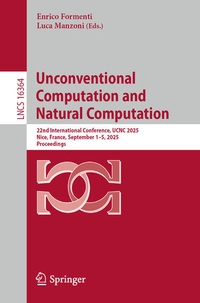
Unconventional Computation and Natural Computation
Description

This book constitutes the proceedings of the 22nd International Conference on Unconventional Computation and Natural Computation, UCNC 2025, held in Nice, France, during September 1-5, 2025.
The 24 full papers and 5 short papers presented in this volume were carefully reviewed and selected from 43 submissions.
They focus on current important theoretical and experimental results in Molecular computing, Quantum computing, Optical computing, Chaos computing, Physarum computing, Collision-based computing, Self-assembling and self-organizing systems, Super-Turing computation, Cellular automata, Neural computation, Evolutionary computation, Swarm intelligence, Ant algorithms, Artificial immune systems, Artificial life, Membrane computing, Amorphous computing, Computational systems biology, Computational neuroscience, Synthetic biology, Cellular (in-vivo) computing, and other unconventional and natural models of computation with no limitations on their inspiration and origin.
More details
Other editions
Additional editions
Content
.- Invited Talks.
.- Toward non abelian scenarios for Additive Cellular Automata on finite groups.
.- Regular Papers.
.- Reversibility, balance and expansitivity of non uniform cellular automata.
.- Simulating Virtual Players for UNO without Computers.
.- Entropy Guarantees for Quantum Boolean Functions.
.- Balance-Based Cryptography: Physically Computing Any Boolean Function.
.- Benchmarking the ORCA PT-1 Boson Sampler in Simulation.
.- Short and useful quantum proofs for sublogarithmic-space verifiers.
.- Probabilistic Spiking Neural Networks: Formal Verification and Simulation.
.- The domino problem is decidable for robust tilesets.
.- Creation of fixed points in block-parallel Boolean automata networks.
.- Identification of Cellular Automata on Bernoulli Probability Measures.
.- Symport/Antiport P Systems with Membrane Separation Characterize P^(#P).
.- Cellular Automata on Spaces of Probability Measures.
.- The Morita Gate is Universal.
.- Bridging Chaos Game Representations and k-mer Frequencies of DNA Sequences.
.- Machine Learning by Adiabatic Evolutionary Quantum Systems.
.- On Time-Varying Insertion-Deletion Systems.
.- Evaluating ESNs against Lagged Input Regression Computation.
.- Determining Isomorphic Crystal Structures.
.- Enhancing MFCC Feature Extraction Through Reservoir Computing.
.- Efficient Algorithms for Quantum Hashing.
.- Reachability in Interactive Chemical Reaction Networks.
.- Gakmoro: An Application of Physical Secure Computation to Card Game.
.- Pattern Graphs of Cellular Automata and Reaction Systems.
.- Polynomial Simulations of CRN Models with Trimolecular Void Step-Cycle CRNs.
.- Short Papers.
.- A Selective Dual-Railing Technique for General-Purpose Analog Computers.
.- Partial Information Decomposition of the Radical Pair Spin Dynamics in Avian Magnetoreception Mechanism.
.- On the Composition of Cellular Automata.
.- A Comparison of Polynomial-Based Tree Clustering Methods.
.- Analog-Hybrid Implementation for Reconfigurable CPGs.
