

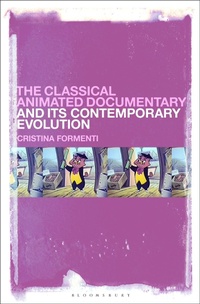
The Classical Animated Documentary and Its Contemporary Evolution
1st Edition
Published on 24. March 2022
328 pages
978-1-5013-4648-4 (ISBN)
Description

The Classical Animated Documentary and Its Contemporary Evolution is the first book to provide an historical insight into the animated documentary.
Drawing on archival research and textual analysis, it shows how this form, usually believed to be strictly contemporaneous, instead took shape in the 1940s. Cristina Formenti integrates a theoretical and a historical approach in order to shed new light on the animated documentary as a form as well as on the work of renowned studios such as The Walt Disney Studios, Halas & Batchelor, National Film Board of Canada and never before addressed ones, such as Corona Cinematografica. She also highlights the differences and the similarities existing among the animated documentaries created between the 1940s and the mid-1980s and those produced today so as to demonstrate how the latter do not represent a complete otherness in respect to the former, but rather an evolution.
Drawing on archival research and textual analysis, it shows how this form, usually believed to be strictly contemporaneous, instead took shape in the 1940s. Cristina Formenti integrates a theoretical and a historical approach in order to shed new light on the animated documentary as a form as well as on the work of renowned studios such as The Walt Disney Studios, Halas & Batchelor, National Film Board of Canada and never before addressed ones, such as Corona Cinematografica. She also highlights the differences and the similarities existing among the animated documentaries created between the 1940s and the mid-1980s and those produced today so as to demonstrate how the latter do not represent a complete otherness in respect to the former, but rather an evolution.
Reviews / Votes
This is a valuable addition to debates around the under-theorised subgenre of animated documentary. It traces the historical emergence of a graphic (and aural) vocabulary for this subgenre, dating from the early twentieth century within a variety of national and institutional contexts. It convincingly demonstrates the deep historical roots of the range of animation within newer online, interactive and immersive forms of documentary. * Craig Hight, Associate Professor in Creative Industries, University of Newcastle, Australia * A "tour de force" through the wide history of the animated documentary. This is the book I have been waiting for! * Gunnar Strom, Professor emeritus, Volda University College, Norway and author of 'The Animated Documentary' (Animation Journal 2003) * Formenti's The Classical Animated Documentary and its Contemporary Evolution is an essential point of reference and is surely destined to be a seminal text for many years to come. For anyone wanting to understand animated documentary, Formenti's words guide the reader expertly through the often-uncharted realm of animated documentary, providing crisp insights regarding the history of the form, conceptual debates and stylistic evolution, as well as hinting at what the future may hold for animated documentary. * Chris Pallant, Reader in Screen Culture, Canterbury Christ Church University, UK * Formenti's research is extensive and she captures the evolution of how the animated documentary has developed in its classic and contemporary forms, thus managing to focus on topics, texts and authors in a coherent and profound way ... this is an original text of great cultural and historical value, rich in content and perspectives. * Cinergie (Bloomsbury Translation) *More details
Edition
1. Auflage
Language
English
Place of publication
New York
United States
Publishing group
Bloomsbury Publishing PLC (Digital)
Target group
Professional and scholarly
Illustrations
47 bw illus
ISBN-13
978-1-5013-4648-4 (9781501346484)
Copyright in bibliographic data and cover images is held by Nielsen Book Services Limited or by the publishers or by their respective licensors: all rights reserved.
Schweitzer Classification
Other editions
Additional editions
Cristina Formenti
The Classical Animated Documentary and Its Contemporary Evolution
Book
11/2023
Bloomsbury Academic USA
€45.00
Shipment within 15-20 days
Person
Cristina Formenti is Assistant Professor in Film Studies at University of Udine, Italy. She is author of Il mockumentary: la fiction si maschera da documentario (2013), and editor of Mariangela Melato tra cinema, teatro e televisione (2016) and Valentina Cortese: un'attrice intermediale (2019). Her work has appeared in various national and international journals, such as Studies in Documentary Film, Alphaville, and Horror Studies. Dr. Formenti is also the co-editor of the journal Animation Studies and currently serves on the Board of the Society for Animation Studies.
Content
List of Figures
Acknowledgements
List of Abbreviations
Introduction
Part I: Theoretical and Historical Issues
1. Reality's Two Animated Faces
2. The Sincerest Form of Docudrama
3. A New Periodization for an Old Form
Part II: The Rise and Affirmation of an Audiovisual Form
4. The Age of the Origins, 1909-39
5. The Classical Age, 1940-85
6. The United States
7. Great Britain
8. Canada
9. Italy
Part III: The Contemporary Production, 1986 and Beyond
10. Private Truths and Inner Realities
11. The Persistence of the Classical Animated Documentary
Conclusion: Towards a Post-Animated Documentary Age?
Notes
References
Index
Acknowledgements
List of Abbreviations
Introduction
Part I: Theoretical and Historical Issues
1. Reality's Two Animated Faces
2. The Sincerest Form of Docudrama
3. A New Periodization for an Old Form
Part II: The Rise and Affirmation of an Audiovisual Form
4. The Age of the Origins, 1909-39
5. The Classical Age, 1940-85
6. The United States
7. Great Britain
8. Canada
9. Italy
Part III: The Contemporary Production, 1986 and Beyond
10. Private Truths and Inner Realities
11. The Persistence of the Classical Animated Documentary
Conclusion: Towards a Post-Animated Documentary Age?
Notes
References
Index
