

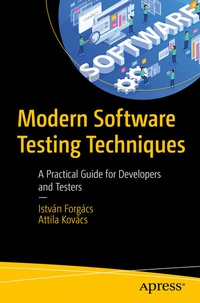
Modern Software Testing Techniques
Description

Many books have been written about software testing, but most of them discuss the general framework of testing from a traditional perspective. Unfortunately, traditional test design techniques are often ineffective and unreliable for revealing the various kinds of faults that may occur. This book introduces three new software testing techniques: Two-Phase Model-Based Testing, the Action-State Testing, and the General Predicate Testing, all of which work best when applied with efficient fault revealing capabilities.
You'll start with a short recap of software testing, focusing on why risk analysis is obligatory, how to classify bugs practically, and how fault-based testing can be used for improving test design. You'll then see how action-state testing merges the benefits of state transition testing and use case testing into a unified approach. Moving on you'll look at general predicate testing and how it serves as an extension of boundary value analysis, encompassing morecomplex predicates.
Two-phase model-based testing represents an advanced approach where the model does not necessarily need to be machine-readable; human readability suffices. The first phase involves a high-level model from which abstract tests are generated. Upon manual execution of these tests, the test code is generated. Rather than calculating output values, they are merely checked for conformity. The last part of this book contains a chapter on how developers and testers can help each other and work as a collaborative team.What You'll Learn
- Apply efficient test design techniques for detecting domain faults
- Work with modeling techniques that combine all the advantages of state transition testing and uses case testing
- Grasp the two-phase model-based testing technique
- Use test design efficiently to find almost all the bugs in an application
Who This Book Is For
Software developers, QA engineers, and, business analysts
More details
Other editions
Additional editions
Persons
István Forgács, Ph.D. , was originally a researcher at the Hungarian Academy of Sciences. He has had more than 25 scientific articles published in leading international journals and conference proceedings. He is the co-author of three books. His research interests include test design, test automation, agile testing, model-based testing, debugging, code comprehension, and static and dynamic analysis. He left his academic life in 1998 to be a founder of Y2KO, the startup company that offered an efficient solution to the Y2K project. He is the founder and Chief Executive Officer of 4Test-Plus and is a former CEO of 4D Soft. He is a member of the TA WG and a former member of the Agile WG of ISTQB. He is the creator and key contributor to the two-phase model-based testing tool harmony.
Attila Kovács holds the position of a full professor at the Faculty of Informatics at Eötvös Loránd University, Budapest. His professional expertiselies in the fields of mathematics, software engineering, and computer science. He serves as a project leader for numerous research and development projects and currently leads the Software and Data Intensive Services Competence Center at the University. In addition to his academic contributions, he is also a co-author of the book "Practical Test Design" and acts as a trainer for ISTQB (International Software Testing Qualifications Board) and IREB (International Requirements Engineering Board). Furthermore, he is the founder of the Hungarian Testing Board
Content
- Software testing basics
- Test design automation by model-based testing
- Domain testing
- Developers and testers should constitute a successful team
- Conclusion
