

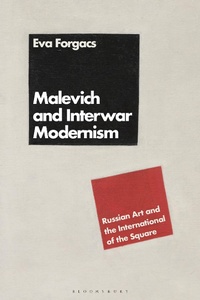
Malevich and Interwar Modernism
Russian Art and the International of the Square
1st Edition
Published on 13. January 2022
304 pages
978-1-350-20418-8 (ISBN)
Description

This book examines the legacy of international interwar modernism as a case of cultural transfer through the travels of a central motif: the square. The square was the most emblematic and widely known form/motif of the international avant-garde in the interwar years. It originated from the Russian artist Kazimir Malevich who painted The Black Square on White Ground in 1915 and was then picked up by another Russian artist El Lissitzky and the Dutch artist Theo van Doesburg. It came to be understood as a symbol of a new internationalism and modernity and while Forgács uses it as part of her overall narrative, she focuses on it and its journey across borders to follow its significance, how it was used by the above key artists and how its meaning became modified in Western Europe.
It is unusual to discuss interwar modernism and its postwar survival, but this book's chapters work together to argue that the interwar developments signified a turning point in twentieth-century art that led to much creativity and innovation. Forgács supports her theory with newly found and newly interpreted documents that prove how this exciting legacy was shaped by three major agents: Malevich, Lissitzsky and van Doesburg. She offers a wider interpretation of modernism that examines its postwar significance, reception and history up until the emergence of the New Left in 1956 and the seismic events of 1968.
It is unusual to discuss interwar modernism and its postwar survival, but this book's chapters work together to argue that the interwar developments signified a turning point in twentieth-century art that led to much creativity and innovation. Forgács supports her theory with newly found and newly interpreted documents that prove how this exciting legacy was shaped by three major agents: Malevich, Lissitzsky and van Doesburg. She offers a wider interpretation of modernism that examines its postwar significance, reception and history up until the emergence of the New Left in 1956 and the seismic events of 1968.
More details
Edition
1. Auflage
Language
English
Place of publication
London
United Kingdom
Publishing group
Bloomsbury Publishing PLC
Target group
College/higher education
Illustrations
24 bw illus
ISBN-13
978-1-350-20418-8 (9781350204188)
Copyright in bibliographic data and cover images is held by Nielsen Book Services Limited or by the publishers or by their respective licensors: all rights reserved.
Schweitzer Classification
Other editions
Additional editions
Book
07/2023
Bloomsbury Visual Arts
€55.95
Shipment within 15-20 days
Person
Éva Forgács is adjunct Professor of Art History at Art Center College of Design in Pasadena, California, USA.
Content
List of Illustrations
Acknowledgments
List of Abbreviations
Introduction
1. The sky is the limit: Malevich at the Vitebsk junction, 1919
2. The 8th Congress of the Bolshevik Party and El Lissitzky's grasp of suprematism, 1919
3. Theo van Doesburg, artist and strategist
4. The irreconcilable conflict between constructivism and suprematism in Moscow
5. The Mirage of world revolution: Post-revolution, postwar Berlin and Moscow 1918-1922
6. As many narratives as narrators: Russian accounts of the new Russian art in the west
7. The First Russian Exhibition in Berlin, 1922, and its reception
8. Respectfully challenging the master: Lissitzky and Malevich
9. The book that was not. Van Doesburg's thumbs-down on the Malevich volume
10. The book that was not. Van Doesburg's thumbs-down on the Malevich volume
11. The Postwar Scene and The Stedelijk Museum, Amsterdam's Malevich exhibition, 1957
12. The New Left's role in retrieving the interwar avant-gardes and reclaiming the Russian Avant-Garde in the 1960s
Notes
Bibliography
Index
Acknowledgments
List of Abbreviations
Introduction
1. The sky is the limit: Malevich at the Vitebsk junction, 1919
2. The 8th Congress of the Bolshevik Party and El Lissitzky's grasp of suprematism, 1919
3. Theo van Doesburg, artist and strategist
4. The irreconcilable conflict between constructivism and suprematism in Moscow
5. The Mirage of world revolution: Post-revolution, postwar Berlin and Moscow 1918-1922
6. As many narratives as narrators: Russian accounts of the new Russian art in the west
7. The First Russian Exhibition in Berlin, 1922, and its reception
8. Respectfully challenging the master: Lissitzky and Malevich
9. The book that was not. Van Doesburg's thumbs-down on the Malevich volume
10. The book that was not. Van Doesburg's thumbs-down on the Malevich volume
11. The Postwar Scene and The Stedelijk Museum, Amsterdam's Malevich exhibition, 1957
12. The New Left's role in retrieving the interwar avant-gardes and reclaiming the Russian Avant-Garde in the 1960s
Notes
Bibliography
Index
