

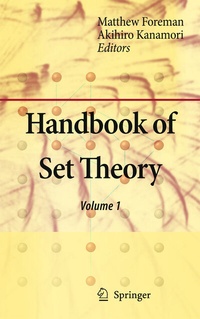
Handbook of Set Theory
1st Edition
Published on 10. December 2009
XIV, 2230 pages
978-1-4020-5764-9 (ISBN)
Description

Numbers imitate space, which is of such a di?erent nature -Blaise Pascal It is fair to date the study of the foundation of mathematics back to the ancient Greeks. The urge to understand and systematize the mathematics of the time led Euclid to postulate axioms in an early attempt to put geometry on a ?rm footing. With roots in the Elements, the distinctive methodology of mathematics has become proof. Inevitably two questions arise: What are proofs? and What assumptions are proofs based on? The ?rst question, traditionally an internal question of the ?eld of logic, was also wrestled with in antiquity. Aristotle gave his famous syllogistic s- tems, and the Stoics had a nascent propositional logic. This study continued with ?ts and starts, through Boethius, the Arabs and the medieval logicians in Paris and London. The early germs of logic emerged in the context of philosophy and theology. The development of analytic geometry, as exempli?ed by Descartes, ill- tratedoneofthedi?cultiesinherentinfoundingmathematics. Itisclassically phrased as the question ofhow one reconciles the arithmetic with the geom- ric. Arenumbers onetypeofthingand geometricobjectsanother? Whatare the relationships between these two types of objects? How can they interact? Discovery of new types of mathematical objects, such as imaginary numbers and, much later, formal objects such as free groups and formal power series make the problem of ?nding a common playing ?eld for all of mathematics importunate. Several pressures made foundational issues urgent in the 19th century.
Reviews / Votes
From the reviews:
"This Handbook is written for graduate students and researchers . . The 24 chapters and a long introduction are written by acknowledged experts, major research figures in their areas. . The Handbook is completed by an extensive Index." (Martin Weese, Zentralblatt MATH, Vol. 1197, 2010)More details
Other editions
Additional editions
Matthew Foreman | Akihiro Kanamori
Handbook of Set Theory
Book
01/2010
1st Edition
Springer
€909.49
Article exhausted; check different version
Content
Stationary Sets.- Partition Relations.- Coherent Sequences.- Borel Equivalence Relations.- Proper Forcing.- Combinatorial Cardinal Characteristics of the Continuum.- Invariants of Measure and Category.- Constructibility and Class Forcing.- Fine Structure.- ? Fine Structure.- Elementary Embeddings and Algebra.- Iterated Forcing and Elementary Embeddings.- Ideals and Generic Elementary Embeddings.- Cardinal Arithmetic.- Successors of Singular Cardinals.- Prikry-Type Forcings.- Beginning Inner Model Theory.- The Covering Lemma.- An Outline of Inner Model Theory.- A Core Model Toolbox and Guide.- Structural Consequences of AD.- Determinacy in (?).- Large Cardinals from Determinacy.- Forcing over Models of Determinacy.
Introduction (p. 1-2)
field of mathematics with broad foundational significance, and this Handbook with its expanse and variety amply attests to the fecundity and sophistication of the subject. Indeed, in set theory's further reaches one sees tremendous progress both in its continuing development of its historical heritage, the investigation of the transfinite numbers and of definable sets of reals, as well as its analysis of strong propositions and consistency strength in terms of large cardinal hypotheses and inner models.
This introduction provides a historical and organizational frame for both modern set theory and this Handbook, the chapter summaries at the end being a final elaboration. To the purpose of drawing in the serious, mathematically experienced reader and providing context for the prospective researcher, we initially recapitulate the consequential historical developments leading to modern set theory as a field of mathematics. In the process we affirm basic concepts and terminology, chart out the motivating issues and driving initiatives, and describe the salient features of the field's internal practices. As the narrative proceeds, there will be a natural inversion: Less and less will be said about more and more as one progresses from basic concepts to elaborate structures, from seminal proofs to complex argumentation, from individual moves to collective enterprise. We try to put matters in a succinct yet illuminating manner, but be that as it may, according to one's experience or interest one can skim the all too familiar or too obscure. To the historian this account would not properly be history-t is, rather, a deliberate arrangement, in significant part to lay the ground for the coming chapters.
To the seasoned set theorist there may be issues of under-emphasis or overemphasis, of omissions or commissions. In any case, we take refuge in a wise aphorism: If it's worth doing, it's worth doing badly.
1. Beginnings
1.1. Cantor
Set theory was born on that day in December 1873 when Georg Cantor (1845-918) established that the continuum is not countable-here is no one-to-one correspondence between the real numbers and the natural numbers 0, 1, 2, . . . . Given a (countable) sequence of reals, Cantor defined nested intervals so that any real in their intersection will not be in the sequence. In the course of his earlier investigations of trigonometric series Cantor had developed a definition of the reals and had begun to entertain infinite totalities of reals for their own sake. Now with his uncountability result Cantor embarked on a full-fledged investigation that would initiate an expansion of the very concept of number. Articulating cardinality as based on bijection (one-to-one correspondence) Cantor soon established positive results about the existence of bijections between sets of reals, subsets of the plane, and the like. By 1878 his investigations had led him to assert that there are only two
field of mathematics with broad foundational significance, and this Handbook with its expanse and variety amply attests to the fecundity and sophistication of the subject. Indeed, in set theory's further reaches one sees tremendous progress both in its continuing development of its historical heritage, the investigation of the transfinite numbers and of definable sets of reals, as well as its analysis of strong propositions and consistency strength in terms of large cardinal hypotheses and inner models.
This introduction provides a historical and organizational frame for both modern set theory and this Handbook, the chapter summaries at the end being a final elaboration. To the purpose of drawing in the serious, mathematically experienced reader and providing context for the prospective researcher, we initially recapitulate the consequential historical developments leading to modern set theory as a field of mathematics. In the process we affirm basic concepts and terminology, chart out the motivating issues and driving initiatives, and describe the salient features of the field's internal practices. As the narrative proceeds, there will be a natural inversion: Less and less will be said about more and more as one progresses from basic concepts to elaborate structures, from seminal proofs to complex argumentation, from individual moves to collective enterprise. We try to put matters in a succinct yet illuminating manner, but be that as it may, according to one's experience or interest one can skim the all too familiar or too obscure. To the historian this account would not properly be history-t is, rather, a deliberate arrangement, in significant part to lay the ground for the coming chapters.
To the seasoned set theorist there may be issues of under-emphasis or overemphasis, of omissions or commissions. In any case, we take refuge in a wise aphorism: If it's worth doing, it's worth doing badly.
1. Beginnings
1.1. Cantor
Set theory was born on that day in December 1873 when Georg Cantor (1845-918) established that the continuum is not countable-here is no one-to-one correspondence between the real numbers and the natural numbers 0, 1, 2, . . . . Given a (countable) sequence of reals, Cantor defined nested intervals so that any real in their intersection will not be in the sequence. In the course of his earlier investigations of trigonometric series Cantor had developed a definition of the reals and had begun to entertain infinite totalities of reals for their own sake. Now with his uncountability result Cantor embarked on a full-fledged investigation that would initiate an expansion of the very concept of number. Articulating cardinality as based on bijection (one-to-one correspondence) Cantor soon established positive results about the existence of bijections between sets of reals, subsets of the plane, and the like. By 1878 his investigations had led him to assert that there are only two
