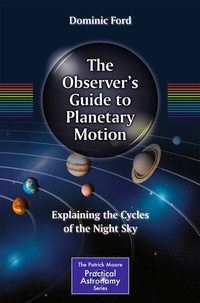
The Observer's Guide to Planetary Motion
Description

To the naked eye, the most evident defining feature of the planets is their motion across the night sky. It was this motion that allowed ancient civilizations to single them out as different from fixed stars. "The Observer's Guide to Planetary Motion" takes each planet and its moons (if it has them) in turn and describes how the geometry of the Solar System gives rise to its observed motions.
Although the motions of the planets may be described as simple elliptical orbits around the Sun, we have to observe them from a particular vantage point: the Earth, which spins daily on its axis and circles around the Sun each year. The motions of the planets as observed relative to this spinning observatory take on more complicated patterns. Periodically, objects become prominent in the night sky for a few weeks or months, while at other times they pass too close to the Sun to be observed. "The Observer's Guide to Planetary Motion" provides accurate tables of the best time for observing each planet, together with other notable events in their orbits, helping amateur astronomers plan when and what to observe. Uniquely each of the chapters includes extensive explanatory text, relating the events listed to the physical geometry of the Solar System.
Along the way, many questions are answered: Why does Mars take over two years between apparitions (the times when it is visible from Earth) in the night sky, while Uranus and Neptune take almost exactly a year? Why do planets appear higher in the night sky when they're visible in the winter months? Why do Saturn's rings appear to open and close every 15 years? This book places seemingly disparate astronomical events into an understandable three-dimensional structure, enabling an appreciation that, for example, very good apparitions of Mars come around roughly every 15 years and that those in 2018 and 2035 will be nearly as good as that seen in 2003.
Events are listed for the time period2010-2030 and in the case of rarer events (such as eclipses and apparitions of Mars) even longer time periods are covered. A short closing chapter describes the seasonal appearance of deep sky objects, which follow an annual cycle as a result of Earth's orbital motion around the Sun.
Reviews / Votes
From the book reviews:
"This concise little primer . takes a refreshing pragmatic approach to understanding the motions that any casual observer of the night sky will eventually notice. . The book also contains some very useful tables listing several decades of lunar phases, eclipses, planetary transits, planetary configurations, etc. That alone makes it a reference well worth having long after the basics have been mastered. Summing Up: Highly recommended. All levels/libraries." (T. D. Oswalt, Choice, Vol. 52 (6), February, 2015)More details
Other editions
Additional editions