

It Was the Nightingale
Published on 31. October 2012
386 pages
978-1-84777-696-9 (ISBN)
Description

During a Christmas leave in London, Ford Madox Ford attended a party at the French Embassy, 'a heavy blond man in a faded uniform', wearied by years of war, recalled to a longing for the life of a writer. The evening marks the beginning of a new phase of Ford's life, the years of It Was the Nightingale.
Ford evokes the literary milieux of London, Paris and New York between the wars with sparkle, wit and energy. Recollections range across time in a subtle and flexible narrative that fuses fiction and memoir. A memory of a dark January day in Paris, in the weeks 'between dog and wolf', when Ford read the news of the death of the novelist John Galsworthy, triggers an exploration of the transition from an entire pre-war world: a ghost had passed, writes Ford, and Nancy Cunard steps forward 'like a jewelled tropical bird'. Here is James Joyce, whom Ford found dull company with his 'thin little jokes'; Ezra Pound playing Provencal songs on the bassoon; Gertrude Stein driving through the streets of Paris with the solemn 'snail-like precision' of a Pharoah. Behind the vivacity other ghosts, too, are always present: men killed and damaged in the war, mental breakdown and betrayal, out of which Ford was to create his best-loved novel, Parade's End.
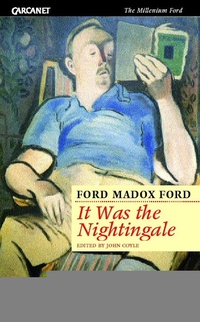
Cover painting Janice Biala, Ford Madox Ford in Toulon, 1932. Private collection.
Ford evokes the literary milieux of London, Paris and New York between the wars with sparkle, wit and energy. Recollections range across time in a subtle and flexible narrative that fuses fiction and memoir. A memory of a dark January day in Paris, in the weeks 'between dog and wolf', when Ford read the news of the death of the novelist John Galsworthy, triggers an exploration of the transition from an entire pre-war world: a ghost had passed, writes Ford, and Nancy Cunard steps forward 'like a jewelled tropical bird'. Here is James Joyce, whom Ford found dull company with his 'thin little jokes'; Ezra Pound playing Provencal songs on the bassoon; Gertrude Stein driving through the streets of Paris with the solemn 'snail-like precision' of a Pharoah. Behind the vivacity other ghosts, too, are always present: men killed and damaged in the war, mental breakdown and betrayal, out of which Ford was to create his best-loved novel, Parade's End.
Cover painting Janice Biala, Ford Madox Ford in Toulon, 1932. Private collection.
Reviews / Votes
I always came out second-best in all my stories", admitted Ford Madox Ford, who has fared little better in death. Prolific novelist, poet ("supposedly great", by his own reckoning), and, as the founder of two influential magazines, a powerful force in literary modernism, he is best remembered today for The Good Soldier (1915) and the epic tetralogy Parade's End (1924-8). Yet, while countless of his friends and contemporaries have been immortalized, Ford himself has a more obscure legacy. "He is the author who is recognized only as he disappears round the corner", observed Rebecca West.Congenial, sometimes even colloquial, his lively narrative voice never gained significant traction with the British readership, for whom "I presume I am too much in earnest". He found a more appreciative audience in America, where his memoir-cum-novel It Was the Nightingale was first published in 1933. Newly reissued by Carcanet Press in an edition adapted from the original British printing (1934), this "fictional reminiscence", a fusion of anecdote, elision and invention, represents what John Coyle in his lucid introduction calls "a book of transitions, in which Ford portrays himself as crossing a shadow line between an earlier self and a new embodiment". Our narrator is "unreliable", warns Coyle - as William Carlos Williams put it in his obituary poem for Ford, "damnit you lied grossly" - but "this is to be expected of . . . an explorer of the relation between memory,subjectivity, and narrative".
Twice in the memoir, Ford proclaims himself a "master of the time-shift". Accordingly, his first paragraph skips across five decades before landing in 1919, when the author, newly discharged from the army, finds himself in a post-war Britain which is "drifting towards a weir". His own life has already slipped over the falls: "I was not an artist . . . . I was no longer a literary figure and I was battered and mournful". But even here, at "the lowest ebb of my life", Ford proves good company. Fleeing London for Sussex, he turns to horticulture, naming his potato plants after fellow writers; "Mr. 'Enry James have picked up proper", his man servant reports, "but Mr. Conrad is yallowin'".
Meanwhile, the narrative darts and lunges, swirls and eddies, as Ford emigrates first to Paris and then to New York, rehabilitating his spirit, writing Parade's End, and establishing (then fourteen months later, dismantling) the transatlantic review, before finally settling in the South of France. This supple chronology makes the text both allusive and elusive. Ford repeatedly refers to, but does not identify, "what I consider to be my best work"; and while he names dozens of contemporaries, from Gertrude Stein to Theodore Dreiser, other figures are simply called "Dash". The work of an author who required "as often as not quite preposterous length to get effect", It Was the Nightingale is notably elliptical in both form - dots and dashes mark every page - and content: Ford describes his infantry service without mentioning the breakdown he suffered after the Somme, and his numerous sexual conquests (among them Jean Rhys) go unremarked.
This digressive technique is more artful than it seems. "You may call it slipshod or discursive", Ford argues, but "actually it contains nothing that has not been selected to carry forward the story or the mood." As a story, It Was the Nightingale lacks narrative shape; as a mood piece, it triumphs. Here is 1920s Paris, a milieu that "gyrated, seethed, clamoured, roared with the Arts"; here is Red Ford, Ford's ramshackle Sussex abode, "almost too old and too mouldering"; and the cramped Manhattan offices of the transatlantic, which "tilt against windmills". Ford comments glibly on detective fiction ("it should be immensely read"), golf ("that derivative for the half-witted") and intellectual life in England ("there is no intellectual life in England"), but beneath the pith and gloss, spectres loom and wraiths crawl: the deaths of George Moore and John Galsworthy, the threat of financial ruin, a litany of suicides. Time and again, Ford conjures the atmosphere of a spring afternoon, then sends thunderclouds scudding in.
Only when he rhapsodizes about la vie artistique does his agreeably dilatory narrative drag its heels. An artist's is "the only life worth living", he declares; "one's art is a small enclosed garden (where) one moves administering certain manures". Such platitudes contrast with his self deprecation elsewhere; one wonders how a self-described humanist could divide mankind "into those who are merely the stuff to fill graves and those who are artists". Nonetheless, It Was the Nightingale remains an evocative and entertaining memoir of the modernist era. This reissue will introduce a new audienceto a man who deserves his recognition at last. Among the literary giants of the early 20th century - Conrad, Hardy, D.H. Lawrence and Hemingway - the writings of Ford Madox Ford have got lost.But he knew or worked with them all, and has a claim to be their equal.
In republishing It Was the Nightingale for the first time since 1933, Carcanet have brought correct attention to him once again.The book contains brilliant social observations on the literary salons of Paris and London, and the values that may be evoked by owning a small farm, as he did in Kent in the 1930s.
This autobiographical novel explores what it meant to him to be British - he fought in the First World War in the Welch Regiment, despite his father being German.He describes dinners with Hemingway, dancing with Nancy Cunard, and getting a journalist called Regan a job as a gamekeeper after he was run over - not an easy thing in those days - reporting on a story in a country lane.
'I have never been in the Tower or St Paul's,' writes Ford.'Americans will not understand that. Every Londoner will.'Ford's sightseeing was into the souls of men.His guidebook was himself, his journey the thoughtful steps of a sad harlequin.
By: Rory Knight Bruce
More details
Edition
New ed.
Language
English
Place of publication
Manchester
United Kingdom
Publishing group
Carcanet Press Ltd
File size
0,72 MB
ISBN-13
978-1-84777-696-9 (9781847776969)
Copyright in bibliographic data and cover images is held by Nielsen Book Services Limited or by the publishers or by their respective licensors: all rights reserved.
Schweitzer Classification
Other editions
Additional editions
Ford Madox Ford
It Was the Nightingale
Book
08/2007
Lives and Letters
€29.50
Article exhausted; check different version
Persons
Dr John Coyle is a Lecturer in English Literature at the University of Glasgow, where he specialises in comparative literature and the twentieth-century novel. His main research interests lie in the field of modernist and postmodernist literature from an international perspective. He has published articles on F. Scott Fitzgerald, Alain-Fournier, Proust and Joyce, and has edited two introductory studies on Joyce. He is currently writing on the relations between literary modernism and advertising, and on recent American fiction.
Content
Introduction
A Note on the Text
It Was the Nightingale
To Eugene Pressly, Esquire
Part One "Domine Dirige Nos"
Chapter One
Chapter Two
Chapter Three
Chapter Four
Part Two "Fluctuat Nec Mergitur"
Chapter One
Chapter Two
Chapter Three
Part Three"E Pluribus Multa"
Chapter One
Chapter Two
Chapter Three
Index
A Note on the Text
It Was the Nightingale
To Eugene Pressly, Esquire
Part One "Domine Dirige Nos"
Chapter One
Chapter Two
Chapter Three
Chapter Four
Part Two "Fluctuat Nec Mergitur"
Chapter One
Chapter Two
Chapter Three
Part Three"E Pluribus Multa"
Chapter One
Chapter Two
Chapter Three
Index
