

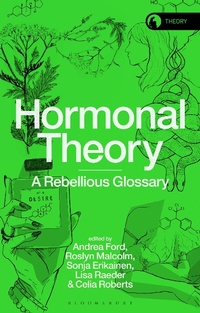
Hormonal Theory
A Rebellious Glossary
1st Edition
Published on 8. February 2024
248 pages
978-1-350-32301-8 (ISBN)
Description

A 2024 Choice Outstanding Academic Title
From angiotensin to cortisol, testosterone to xenoestrogens, and dopamine to endocrine disruptors, hormones are everywhere. These chemical entities are foundational to biological life and shape social, cultural, and political forces, while simultaneously being shaped by them. Hormones are increasingly central not only to medical and other body-shaping practices and contemporary science, but also environmentally-oriented conversations. Throughout Hormonal Theory, authors trace how biomedical, social, political, and experiential forces entangle to produce hormones as we know them today. It illuminates how hormones emerge and exist as complex entities that permeate every sphere of our lives.
Each glossary entry takes a particular hormonal compound as its starting point, yet works to elaborate and complicate understandings of hormones as distinct biological or chemical entities. The entries collectively show how hormones never operate in isolation from other hormones, nor bodies in isolation from other human and non-human bodies and their socio-ecological surroundings. Indeed, they "cascade" into one another. This volume, then, is not simply a qualitatively-rich companion to medical knowledge about hormones, but a challenge to the conceptual underpinnings of current dominant understandings of disease, wellness, and normalcy.
From angiotensin to cortisol, testosterone to xenoestrogens, and dopamine to endocrine disruptors, hormones are everywhere. These chemical entities are foundational to biological life and shape social, cultural, and political forces, while simultaneously being shaped by them. Hormones are increasingly central not only to medical and other body-shaping practices and contemporary science, but also environmentally-oriented conversations. Throughout Hormonal Theory, authors trace how biomedical, social, political, and experiential forces entangle to produce hormones as we know them today. It illuminates how hormones emerge and exist as complex entities that permeate every sphere of our lives.
Each glossary entry takes a particular hormonal compound as its starting point, yet works to elaborate and complicate understandings of hormones as distinct biological or chemical entities. The entries collectively show how hormones never operate in isolation from other hormones, nor bodies in isolation from other human and non-human bodies and their socio-ecological surroundings. Indeed, they "cascade" into one another. This volume, then, is not simply a qualitatively-rich companion to medical knowledge about hormones, but a challenge to the conceptual underpinnings of current dominant understandings of disease, wellness, and normalcy.
More details
Series
Edition
1. Auflage
Language
English
Place of publication
London
United Kingdom
Publishing group
Bloomsbury Publishing PLC
Target group
College/higher education
ISBN-13
978-1-350-32301-8 (9781350323018)
Copyright in bibliographic data and cover images is held by Nielsen Book Services Limited or by the publishers or by their respective licensors: all rights reserved.
Schweitzer Classification
Other editions
Additional editions
Book
03/2024
Bloomsbury Academic
€29.00
Shipment within 15-20 days
Persons
Sonja Erikainen is Research Fellow at the Centre for Biomedicine, Self and Society, Usher Institute, The University of Edinburgh, UK.
Andrea Ford is Research Fellow at the Centre for Biomedicine, Self and Society, Usher Institute, The University of Edinburgh, UK.
Rosalyn Malcolm is Assistant Professor in Anthropology at Durham University, UK.
Lisa Raeder is a qualitative researcher and PhD candidate at the Centre for Biomedicine, Self, and Society at the University of Edinburgh, UK.
Celia Roberts is Professor of Gender and Women's Studies, Australian National University, Australia.
Andrea Ford is Research Fellow at the Centre for Biomedicine, Self and Society, Usher Institute, The University of Edinburgh, UK.
Rosalyn Malcolm is Assistant Professor in Anthropology at Durham University, UK.
Lisa Raeder is a qualitative researcher and PhD candidate at the Centre for Biomedicine, Self, and Society at the University of Edinburgh, UK.
Celia Roberts is Professor of Gender and Women's Studies, Australian National University, Australia.
Content
List of Contributors
Acknowledgements
Hormonal Cascades: An Introduction
1. Adrenaline, Celia Roberts (Australian National University, Canberra)
2. Angiotensin, Anne Pollock (King's College London, UK)
3. Cortisol, Roslyn Malcolm (Durham University, UK)
4. Diethylstilbestrol (DES), Jacquelyne Luce (Mount Holyoke College, USA), Anjali Rao-Herel (Mount Holyoke College, USA) with the Feminist Technoscience Governance Collaboratory
5. Dichloro-diphenyl-trichloroethane (DDT), Norah MacKendrick (Rutgers University, USA)
6. Dopamine, Tom Boylston (University of Edinburgh, UK)
7. Endocrine Disrupting Chemicals (EDCs), Wibke Straube (Karlstad University, Sweden)
8. Follicle Stimulating Hormone (FSH) and Lutenizing Hormone (LH), Risa Cromer (Purdue University, USA)
9. Gonadotropin-releasing hormone analogues (GnRHa), Cronan Cronshaw (Lancaster University, UK)
10. Growth Hormone, Magdalena Radkowska-Walkowicz (University of Warsaw, Poland)
11. Human Chorionic Gonadotropin (hCG), Emily Ross (University of Sheffield, UK)
12. Hydrocortisone, Ian Harper (University of Edinburgh, UK)
13. Mifepristone and Misoprostol, Leah Eades (University of Edinburgh, UK)
14. Oestrogen, Charlotte Jones (Swansea University, UK) and Kriss Fearon (De Montfort University, UK)
15. Oxytocin, Arbel Griner (Princeton University, USA) and Rafaela Zorzanelli (University of Rio de Janeiro, Brazil)
16. Pitocin, Andrea Ford (University of Edinburgh, UK)
17. Progesterone, Nayantara Sheoran Appleton (Victoria University of Wellington, Aotearoa New Zealand)
18. Progestogens, Mariana Rios Sandoval
19. Testosterone, Fabíola Rohden (Federal University at Rio Grande do Sul, Brazil)
Index
Acknowledgements
Hormonal Cascades: An Introduction
1. Adrenaline, Celia Roberts (Australian National University, Canberra)
2. Angiotensin, Anne Pollock (King's College London, UK)
3. Cortisol, Roslyn Malcolm (Durham University, UK)
4. Diethylstilbestrol (DES), Jacquelyne Luce (Mount Holyoke College, USA), Anjali Rao-Herel (Mount Holyoke College, USA) with the Feminist Technoscience Governance Collaboratory
5. Dichloro-diphenyl-trichloroethane (DDT), Norah MacKendrick (Rutgers University, USA)
6. Dopamine, Tom Boylston (University of Edinburgh, UK)
7. Endocrine Disrupting Chemicals (EDCs), Wibke Straube (Karlstad University, Sweden)
8. Follicle Stimulating Hormone (FSH) and Lutenizing Hormone (LH), Risa Cromer (Purdue University, USA)
9. Gonadotropin-releasing hormone analogues (GnRHa), Cronan Cronshaw (Lancaster University, UK)
10. Growth Hormone, Magdalena Radkowska-Walkowicz (University of Warsaw, Poland)
11. Human Chorionic Gonadotropin (hCG), Emily Ross (University of Sheffield, UK)
12. Hydrocortisone, Ian Harper (University of Edinburgh, UK)
13. Mifepristone and Misoprostol, Leah Eades (University of Edinburgh, UK)
14. Oestrogen, Charlotte Jones (Swansea University, UK) and Kriss Fearon (De Montfort University, UK)
15. Oxytocin, Arbel Griner (Princeton University, USA) and Rafaela Zorzanelli (University of Rio de Janeiro, Brazil)
16. Pitocin, Andrea Ford (University of Edinburgh, UK)
17. Progesterone, Nayantara Sheoran Appleton (Victoria University of Wellington, Aotearoa New Zealand)
18. Progestogens, Mariana Rios Sandoval
19. Testosterone, Fabíola Rohden (Federal University at Rio Grande do Sul, Brazil)
Index
