

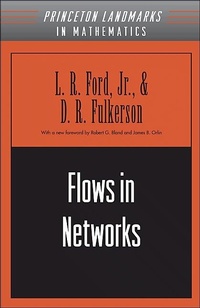
Flows in Networks
1st Edition
Published on 3. December 2024
216 pages
978-0-691-27345-7 (ISBN)
Description

A landmark work that belongs on the bookshelf of every researcher working with networks
In this classic book, first published in 1962, L. R. Ford, Jr., and D. R. Fulkerson set the foundation for the study of network flow problems. The models and algorithms introduced in Flows in Networks are used widely today in the fields of transportation systems, manufacturing, inventory planning, image processing, and Internet traffic. The techniques presented by Ford and Fulkerson spurred the development of powerful computational tools for solving and analyzing network flow models, and also furthered the understanding of linear programming. In addition, the book helped illuminate and unify results in combinatorial mathematics while emphasizing proofs based on computationally efficient construction. With an incisive foreword by Robert Bland and James Orlin, Flows in Networks is rich with insights that remain relevant to current research in engineering, management, and other sciences.
In this classic book, first published in 1962, L. R. Ford, Jr., and D. R. Fulkerson set the foundation for the study of network flow problems. The models and algorithms introduced in Flows in Networks are used widely today in the fields of transportation systems, manufacturing, inventory planning, image processing, and Internet traffic. The techniques presented by Ford and Fulkerson spurred the development of powerful computational tools for solving and analyzing network flow models, and also furthered the understanding of linear programming. In addition, the book helped illuminate and unify results in combinatorial mathematics while emphasizing proofs based on computationally efficient construction. With an incisive foreword by Robert Bland and James Orlin, Flows in Networks is rich with insights that remain relevant to current research in engineering, management, and other sciences.
More details
Other editions
Additional editions
Lester Randolph Ford | D. R. Fulkerson
Flows in Networks
Book
12/2024
Princeton University Press
€42.50
Shipment within 10-20 days
Lester Randolph Ford | D. R. Fulkerson
Flows in Networks
Book
10/2010
Princeton University Press
€39.62
Article exhausted; check different version
Persons
L. R. Ford, Jr.,(1927-2017) was a researcher at CEIR Inc. and the Rand Corporation. D. R. Fulkerson (1924-1976) was a mathematician at the Rand Corporation.
Content
- Cover
- Title Page
- Copyright
- Dedication
- Contents
- Foreword to the 2010 Edition
- Preface
- Acknowledgements
- Chapter I. Static Maximal Flow
- Introduction
- 1. Networks
- 2. Flows in Networks
- 3. Notation
- 4. Cuts
- 5. Maximal Flow
- 6. Disconnecting Sets and Cuts
- 7. Multiple Sources and Sinks.
- 8. The Labeling Method For Solving Maximal Flow Problems
- 9. Lower Bounds On Arc Flows.
- 10. Flows in Undirected and Mixed Networks .
- 11. Node Capacities and Other Extensions
- 12. Linear Programming and Duality Principles
- 13. Maximal Flow Value as a Function of Two Arc Capacities
- References
- Chapter II. Feasibility Theorems and Combinatorial Applications
- Introduction
- 1. A supply-Demand Theorem
- 2. A Symmetric Supply-Demand Theorem
- 3. Circulation Theorem
- 4. The Konig-Egervary and Menger Graph Theorems
- 5. Construction of a Maximal Independent Set of Admissible Cells
- 6. A bottleneck Assignment Problem
- 7. Unicursal Graphs
- 8. Dilworth's Chain Decomposition Theorem For Partially Ordered Sets
- 9. Minimal Number of Individuals to Meet A Fixed Schedule of Tasks
- 10. Set Representatives
- 11. The Subgraph Problem for Directed Graphs
- 12. Matrices Composed of O's and l's
- References
- Chapter III. Minimal Cost Flow Problems
- Introduction
- 1. The Hitchcock Problem
- 2. The Optimal Assignment Problem
- 3. The General Minimal Cost Flow Problem
- 4. Equivalence of Hitchcock and Minimal Cost Flow Problems
- 5. A Shortest Chain Algorithm
- 6. The Minimal Cost Supply-Demand Problem: Non-Negative Directed Cycle Costs
- 7. The Warehousing Problem
- 8. The Caterer Problem
- 9. Maximal Dynamic Flow
- 10. Project Cost Curves
- 11. Constructing Minimal Cost Circulations
- References
- Chapter IV. Multi-Terminal Maximal Flows
- Introduction
- 1. Forests, Trees, and Spanning Subtrees
- 2. Realization Conditions
- 3. Equivalent Networks
- 4. Network Synthesis
- References
- Index
