

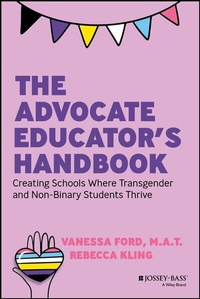
The Advocate Educator's Handbook
Description

A critical guide on creating inclusive classrooms for transgender students
Including a foreword from Dr. Peggy Brookins, President of the National Board for Professional Teaching Standards, The Advocate Educator's Handbook offers a tested framework for educators to use in their journeys to create inclusive classrooms for transgender and non-binary students. Centered on a framework of four principles - educate, affirm, include, and disrupt - this book provides a new way of thinking about inclusivity in the classroom, as well as practical ways to foster students' sense of belonging. The authors bring rich understanding to the topic - Kling as a transgender educator & advocate, Ford as a teacher & parent of a transgender child, and both authors being educators themselves. You'll also read stories from transgender and non-binary students, teachers, researchers, parents, and more, providing unique and important perspectives.
Inside the book, you'll find tools that you can start using on day one of being in the classroom. You'll also find model policies for teachers, schools administrators, and public policymakers, so you can begin the important work of advocating for and with trans and non-binary students. By engaging with trans youth and allies, we can build inclusivity in and beyond the classroom.
- Understand what it means to be transgender or non-binary and learn about the experiences of trans youth
- Learn how to support trans and non-binary students with dozens of firsthand accounts from experts serving the communities
- Find resources you can use as an educator in your journey toward inclusivity in education
- Recognize and respond to anti-trans policies and laws targeting trans students
- Identify important actions unique to your situation with personal reflection questions and scenarios
This book was created especially for K-12 educators, administrators, and others looking to enact change and create safe spaces for transgender and non-binary youth. From daily life in the classroom to policy at the highest levels, The Advocate Educator's Handbook will help educators & their community work toward meaningful change.
More details
Other editions
Additional editions
Persons
Vanessa Ford (she/her) is an award-winning educator and author. Her children's book, Calvin, won the 2022 Lambda Literary Award for Best Children's Book. Ford was a classroom teacher for 14 years in DC Public Schools and her advocacy has been featured in the New York Times, Washington Post, Boston Globe, Newsweek and NPR. She was a founding member of The Human Rights Campaign's Parents for Transgender Equality Council and sat for two years on the board of the National Center for Transgender Equality. She lives with her husband and two children, one of whom is trans, near Boston. Learn more about Vanessa's work at www.jrandvanessaford.com.
Rebecca Kling (she/her) is an educator, organizer, storyteller, and advocate for social change. Kling served as the community storytelling advocate and director of education programming at the National Center for Transgender Rights, as well as on the leadership team of Harbor Camps, a sleepaway summer camp for trans and non-binary youth. She is also the co-founder of Better World Collaborative, a social impact consulting firm working to combat the recent flood of anti-trans legislation. She lives in Chicago with her two cats. Learn about Rebecca's work at www.rebeccakling.com and www.bwcollab.com.
Content
Foreword xv
Author Bios xvii
Introduction 1
Using This Book 1
Focusing on Trans and Non-Binary Students 3
Becoming an Advocate Educator 10
Putting It into Practice 14
Part I Setting the Stage 19
Chapter 1 Background Information 21
A Brief History of Trans Identity 22
(Some of) The Many Ways to Be Trans 26
How Many Trans Students Are There? 27
Putting It into Practice 32
Chapter 2 Glossary of Terms and Definitions 37
Putting It into Practice 52
Chapter 3 Supporting Diverse Student Bodies 57
Race and Racism 58
Physical Disabilities 60
Neurodiversity 63
Economic Class 68
Family Structure and Dynamics 69
Putting It into Practice 70
Part II The Four Core Principles 75
Chapter 4 Educate 77
Determining Who to Train 78
Determining What to Teach 82
Determining Who Will Teach 89
Challenges Facing School Staff 91
Putting It into Practice 95
Chapter 5 Affirm 99
Affirming Policies and Legislation 101
Affirming Practices 117
Putting It into Practice 124
Chapter 6 Include 131
Windows and Mirrors 133
Inclusive Education Communities 136
Creating Inclusive Classrooms and Curricula 141
Creating Inclusive Extracurricular Activities 161
Putting It into Practice 166
Chapter 7 Disrupt 173
Responding to Students 174
Responding to Parents and Community Members 175
Responding to Anti-Trans Laws and Policies 180
Considering Legal Action 186
Advocating with Trans Students and Student Voices 186
Evaluating Your Comfort with Taking Risks 194
Taking Care of Yourself 196
Putting It into Practice 197
Conclusion 201
Afterword-Vanessa Ford 205
Afterword-Rebecca Kling 209
Acknowledgments 213
Appendix 1 Additional Resources 217
Books 217
Videos and Documentaries 218
Scholarly Articles, Research, and Data 218
Resources Intended Specifically for Educators 220
Sample Curriculum Resources 222
Courses and Professional Development for Educators 223
Model Policies, Assessments, and Guidelines for Schools and Districts 224
Real Policies and Guidelines for Schools and Districts 224
Professional Association Policy Positions and Best Practices 225
Other Government Docs and Resources 226
Resources for Students 227
Appendix 2 Professional Development Provider Options 229
A Queer Endeavor 229
Better World Collaborative 230
Glsen 231
The Human Rights Campaign's Welcoming Schools Program 232
Stonewall National Education Project (SNEP) Symposium 233
The Trevor Project 234
YES Institute 235
Appendix 3 Guidance Template for Classroom Libraries 237
Index 239
