

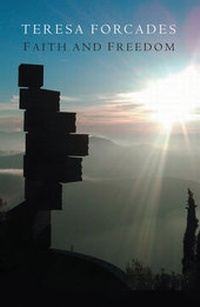
Faith and Freedom
Description

Reviews / Votes
?Teresa Forcades offers a lucid and inspiring reflection on the mutually enriching relationship between contemplation and action, the spiritual and the political, faith and feminism. Structuring her book around the liturgy of the hours, she shows how the Christian life can be lived in a way that is deeply rooted in prayer and tradition, but also radically engaged with the contemporary world.? Tina Beattie, University of Roehampton ?Sister Teresa's meditations, gracefully woven out of the daily Benedictine cycle of prayer, confront some of the most profound personal challenges of contemporary life. Let noone say that the religious life is a-political: Sister Teresa combines fearless intellectual analysis, radical resistance to injustice, and an unwavering commitment to the mystery and power of Christian forgiveness.? Sarah Coakley, University of Cambridge ?Eye-opening and invigorating, Faith and Freedom demonstrates the power of faith combined with inquiry.? Foreword ReviewsTeresa Forcades offers a lucid and inspiring reflection on the mutually enriching relationship between contemplation and action, the spiritual and the political, faith and feminism. Structuring her book around the liturgy of the hours, she shows how the Christian life can be lived in a way that is deeply rooted in prayer and tradition, but also radically engaged with the contemporary world. Tina Beattie, University of RoehamptonMore details
Other editions
Additional editions
Person
Content
2
Lauds: social justice
The half hour between matins and lauds passes very quickly. I usually meditate in my cell on the readings that will be proclaimed later in the daily Eucharist. But there was a time when I used this solitary prayer time quite differently. When I entered the monastery in 1997, and for a few years after that, I felt a need to go out after matins: out into nature, into the brisk morning air, to take in the wide horizon visible from our mountaintop. I still do it occasionally. I enjoy being outdoors and smelling the moist soil, surrounded at first by darkness and silence and then by a subtle light and sound imperceptibly increasing until the sun finally appears. I used to jump up and down quite vigorously to warm myself in the chilly winter air - so vigorously in fact that, a few months later, some of the nuns wondered what could have caused that hollow in our garden right at the spot where the village of Monistrol and the monastic cemetery, located on opposite slopes, can be seen simultaneously. While jumping, I watched alternately the village waking up to a new day and the cemetery, with the dead sisters reminding me that life is short.
The chapel is warmer at lauds and usually there are a few guests who share in our prayer; some are staying in our guesthouse, others drive up from the neighboring towns. The window with the hanging Christ above the altar is full of light now and prayer travels easily through it and beyond the monastic enclosure. "Come to me, all you that are weary and are carrying heavy burdens, and I will give you rest" (Matthew 11:28). The concern for social justice lies at the very heart of the Jewish and the Christian message. The ancient Israelites were slaves in Egypt and the biblical psalms - 150 beautiful ancient poems - bear witness to this, reminding all those who recite them that slavery is far from being over.
In September 2015, Oxfam International published a report entitled "A Europe for the many, not the few," denouncing the fact that today 123 million people in the European Union, almost a quarter of the EU population, live below the poverty line. Of those, 50 million live in plain misery, while the EU allows a level of tax avoidance and evasion worth an estimated 1 trillion euros annually that mostly favors big corporations. One trillion euros is five times the total amount invested in rescuing Greece and twice the amount invested in public health in the twenty-eight EU countries taken together. Eight and a half million European workers live in poverty despite having a full-time job, while the number of European multimillionaires increases. The divide between rich and poor grows alarmingly in Europe as in the rest of the world. In an earlier report from January 2015, "Wealth: Having it all and wanting more," Oxfam International had already denounced the widening gap between rich and poor: in 2010, 388 billionaires owned as much wealth as the bottom 50 percent of the world's population; by 2014, that figure had reduced to just 80 billionaires; in 2016, the report predicted, it will finally be true that 1 percent of the world's population will have accumulated more wealth than the remaining 99 percent.
"No one can serve two masters; for a slave will either hate the one and love the other, or be devoted to the one and despise the other. You cannot serve God and wealth" (Matthew 6:24). Those are Jesus' words, but the fact is that the richest countries in the world (in Europe and North America) have Christianity at their roots and continue to have Christianity as their main religion. So, however, do some of the poorer countries in the world (in Latin America) and it was in these countries that liberation theology was born in the 1970s. The author of the first book of theology I ever read, Leonardo Boff, was a Brazilian liberation theologian. The book's cover was bright red and had black prison bars bursting open in the middle. Being the first theology I encountered, liberation theology has never been for me a corrective to traditional theology; it has simply been normal theology, Christian theology. To this day, I am taken aback when reading theological treatises in which the issue of social justice is never addressed. " 'For I was hungry and you gave me no food, I was thirsty and you gave me nothing to drink, I was a stranger and you did not welcome me, naked and you did not give me clothing, sick and in prison and you did not visit me.' Then they also will answer, 'Lord, when was it that we saw you hungry or thirsty or a stranger or naked or sick or in prison, and did not take care of you?' Then he will answer them, 'Truly I tell you, just as you did not do it to one of the least of these, you did not do it to me'" (Matthew 25:35-40). It is God who talks in this passage in order to identify Herself quite clearly and directly with those who suffer for lack of material well-being.
In the fall of 2009 I visited Guatemala. In Uspantán, the village where the Maya leader and Nobel Prize winner Rigoberta Menchu was born, a small boy of five or six polished my shoes for a few coins before I climbed aboard a nine-seater jeep loaded with people; between those seated inside and those seated on the roof there were close to twenty of us. The jeep drove for a few hours on a dangerous winding road up to the tiny village of Lancetillo, in the middle of the jungle. Several times along the way we had to get off the jeep and help push it around a difficult turn or up a slope. It was in this area that tens of thousands of peasants from local "comunidades eclesiales de base" (ecclesial base communities) had organized themselves in the 1980s against the military dictatorships of Ríos Montt and Oscar Humberto Mejía Víctores. Thousands were horribly murdered by the military in one of the biggest massacres of the twentieth century. These peasants were convinced that their faith required them to oppose injustice and to help those in need. In Guatemala at that time, this meant risking one's life. I was deeply affected when I realized that all of this had been happening while I was in my early twenties: I was already Christian then and considered myself a socially conscious person - how did I not know about this massacre? I was going to mass every Sunday; why didn't we talk about what was happening in Guatemala?
In the context of the present economic crisis and the ongoing dismantling of the welfare state, many in Spain wish we could go back to "the good eighties." Whenever I hear this, I remember Guatemala. The 1980s meant massacre for Guatemala. Who was it that wanted to exploit the traditional land of the Maya peasants at the cost of tens of thousands of lives? And why? Rosa Luxemburg was convinced that capitalism, due to its constant need to expand, exports exploitation and destruction. Capitalism kills, often savagely, not by accident but out of structural need: it is based on competition and has to exploit in order to survive. In the 1980s, it was Latin America's turn. Now the exploitation and destruction has moved, at least partially, somewhere else, and it is taking its toll in Europe. Going back to the relative welfare of the 1980s is no solution. That would simply mean we have succeeded in pushing the crisis elsewhere. Going back is no solution: we need to move forward, beyond capitalism.
My opposition to capitalism has nothing to do with being against entrepreneurial initiative or private property. By my religious vows, I have renounced the right to hold individual private property and I consider this an advantage. But it is precisely because I appreciate the goodness of renouncing individual private property that I will never give support to a political regime that would force its citizens to give it up. Giving up individual private property in order to build a cooperative, for instance, can only work when the individuals involved are existentially motivated to do so. That being said, it is one thing to be against seizing all or most private property (and I am against it) and another to be ready to expropriate the excessive riches of a few to help the many in need, or to balance society and avoid abuse. I am in favor of expropriating the super-rich in order to help the poor, and in this I am in agreement with the social doctrine of the Roman Catholic Church when it clearly states that private property cannot be considered an absolute right. Nobody has the right to accumulate property unlimitedly while others starve as a consequence. Taking this seriously, as the present Pope Francis seems willing to do, would imply de facto declaring capitalism morally abhorrent and moving on with all urgency to start dismantling it - dismantling an economic system that produces enough food for 11 billion people on a planet of 7 billion while allowing close to 1 billion to suffer from chronic hunger; dismantling an economic system so intimately tied to the military industry that in order to survive it has to continually ignite wars that kill hundreds of thousands.
My critique of capitalism addresses the following three points: the capitalist notion of freedom; its orientation of economic activity to the maximization of profit; and its exploitation of workers.
The capitalist notion of freedom is a fallacy. From the protectionist policies of early capitalism to today's rescuing of banks "too big to fail," it is clear that capitalists have always counted on the support of the State to back them...
