

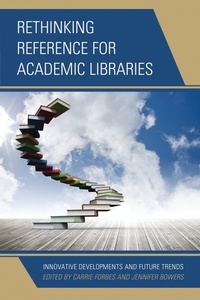
Rethinking Reference for Academic Libraries
Innovative Developments and Future Trends
1st Edition
Published on 5. December 2014
262 pages
979-8-216-28824-4 (ISBN)
Description

The rapid development of the Web and Web-based technologies has led to an ongoing redefinition of reference services in academic libraries. A growing diversity of users and the need and possibility for collaboration in delivering reference services bring additional pressures for change. At the same time, there are growing demands for libraries to show accountability and service value. All of these trends have impacted the field and will continue to shape reference and research services. And they have led to a need for increasingly specialized professional competencies and a literature to support them.
In order to reimagine reference service for twenty-first century learning environments, practitioners will need to understand several focal areas of emerging reference. In particular, collaboration with campus partners, diverse student populations, technological innovations, the need for assessment, and new professional competencies, present new challenges and opportunities for creating a twenty-first century learning environment. Librarians must not only understand, but also embrace these emerging reference practices. This edited volume, containing five sections and fourteen chapters, reviews the current state of reference services in academic libraries with an emphasis on innovative developments and future trends. The main theme that runs through the book is the urgent need for inventive, imaginative, and responsive reference and research services. Through literature reviews and case studies, this book provides professionals with a convenient compilation of timely issues and models at comparable institutions. As academic libraries shift from functioning primarily as collections repositories to serving as key players in discovery and knowledge creation, value-added services, such as reference, are even more central to libraries' and universities' changing missions.
In order to reimagine reference service for twenty-first century learning environments, practitioners will need to understand several focal areas of emerging reference. In particular, collaboration with campus partners, diverse student populations, technological innovations, the need for assessment, and new professional competencies, present new challenges and opportunities for creating a twenty-first century learning environment. Librarians must not only understand, but also embrace these emerging reference practices. This edited volume, containing five sections and fourteen chapters, reviews the current state of reference services in academic libraries with an emphasis on innovative developments and future trends. The main theme that runs through the book is the urgent need for inventive, imaginative, and responsive reference and research services. Through literature reviews and case studies, this book provides professionals with a convenient compilation of timely issues and models at comparable institutions. As academic libraries shift from functioning primarily as collections repositories to serving as key players in discovery and knowledge creation, value-added services, such as reference, are even more central to libraries' and universities' changing missions.
More details
Other editions
Additional editions
Carrie Forbes | Jennifer Bowers
Rethinking Reference for Academic Libraries
Innovative Developments and Future Trends
Book
12/2014
Rowman & Littlefield Publishers
€92.40
Shipment within 10-20 days
Persons
Carrie Forbes, Associate Dean for Student and Scholar Services, heads the public service units of Penrose Library at the University of Denver including reference, circulation, interlibrary loan, and reserves. She serves as the library liaison/subject specialist to Education, University College, The Women's College, and the Writing Program. Carrie's publications and presentations include a co-authored article in Reference Services Review onPenrose Library's Research Center which was selected for the ALA RSS Reference Research Review 2010 annual bibliography, a co-authored book chapter on analyzing usage statistics of reference-based online guides, and a recent paper presentation at the Quantitative and Qualitative Methods in Libraries in Limerick, Ireland on measuring the effectiveness of research consultations in an academic libraries.
Jennifer Bowers is Associate Professor, Social Sciences Librarian, University of Denver. She is co-editor of the Scarecrow Press series, Literary Research: Strategies and Sources, and the co-author of three volumes in the series. She has also published the co-authored article, "The Research Center: Creating an Environment for Interactive Research Consultations" that was selected for the ALA RSS Reference Research Review 2010 annual bibliography, in addition to two book chapters about interdisciplinary research and teaching with digital archival materials.
Jennifer Bowers is Associate Professor, Social Sciences Librarian, University of Denver. She is co-editor of the Scarecrow Press series, Literary Research: Strategies and Sources, and the co-author of three volumes in the series. She has also published the co-authored article, "The Research Center: Creating an Environment for Interactive Research Consultations" that was selected for the ALA RSS Reference Research Review 2010 annual bibliography, in addition to two book chapters about interdisciplinary research and teaching with digital archival materials.
Content
Acknowledgements
Introduction
Collaboration: Partnerships for Lifelong Learning
1Step Away from the Desk: Re-casting the Reference Librarian as Academic Partner
Michael Courtney and Angela Courtney
2 The Scholarly Commons: Emerging Research Services for Graduate Students and Faculty
Merinda Kaye Hensley
Diversity: Meeting the Information Needs of a Changing Demographic
3The Rainbow Connection: Reference Services for LGBT Community in Academic Libraries
Matthew P. Ciszek
4Reference Services in a Shifting World: Other Languages, Other Services
Valeria E. Molteni and Eileen K. Bosch
5As Needs Change, So Must We: A Case Study of Innovative Outreach to Changing Demographics
Li Fu
Technology: Reference Service Beyond the Library Walls
6Roving Reference: Taking the Library to Its Users
Zara Wilkinson
7Connecting Questions with Answers
Ellie Dworak and Carrie Moore
Assessment: Does Reference Make a Difference?
8Transforming Reference Services: More than Meets the Eye
Kawanna Bright, Consuella Askew, and Lori Driver
9Dialogic Mapping: Evolving Reference into an Instructional Support for Graduate Research
Corinne Laverty and Elizabeth A. Lee
10Does the Reference Desk Still Matter? Assessing the Desk Paradigm at the University of Washington Libraries
Deb Raftus and Kathleen Collins
Professional Competencies: Skills for a New Generation
11From Ready Reference to Research Conversations: The Role of Instruction in Academic Reference Service
Melanie Maksin
12Necessities of Librarianship: Competencies for a New Generation
Danielle Colbert-Lewis, Jamillah Scott-Branch, and David Rachlin
13Professional Competencies for the Virtual Reference Librarian: Digital Literacy, Soft Skills, and Customer Service
Christine Tobias
14Digital Primary Resources
Peggy Keeran
Index
About the Authors
Introduction
Collaboration: Partnerships for Lifelong Learning
1Step Away from the Desk: Re-casting the Reference Librarian as Academic Partner
Michael Courtney and Angela Courtney
2 The Scholarly Commons: Emerging Research Services for Graduate Students and Faculty
Merinda Kaye Hensley
Diversity: Meeting the Information Needs of a Changing Demographic
3The Rainbow Connection: Reference Services for LGBT Community in Academic Libraries
Matthew P. Ciszek
4Reference Services in a Shifting World: Other Languages, Other Services
Valeria E. Molteni and Eileen K. Bosch
5As Needs Change, So Must We: A Case Study of Innovative Outreach to Changing Demographics
Li Fu
Technology: Reference Service Beyond the Library Walls
6Roving Reference: Taking the Library to Its Users
Zara Wilkinson
7Connecting Questions with Answers
Ellie Dworak and Carrie Moore
Assessment: Does Reference Make a Difference?
8Transforming Reference Services: More than Meets the Eye
Kawanna Bright, Consuella Askew, and Lori Driver
9Dialogic Mapping: Evolving Reference into an Instructional Support for Graduate Research
Corinne Laverty and Elizabeth A. Lee
10Does the Reference Desk Still Matter? Assessing the Desk Paradigm at the University of Washington Libraries
Deb Raftus and Kathleen Collins
Professional Competencies: Skills for a New Generation
11From Ready Reference to Research Conversations: The Role of Instruction in Academic Reference Service
Melanie Maksin
12Necessities of Librarianship: Competencies for a New Generation
Danielle Colbert-Lewis, Jamillah Scott-Branch, and David Rachlin
13Professional Competencies for the Virtual Reference Librarian: Digital Literacy, Soft Skills, and Customer Service
Christine Tobias
14Digital Primary Resources
Peggy Keeran
Index
About the Authors
