

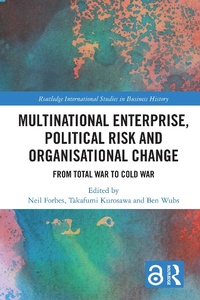
Multinational Enterprise, Political Risk and Organisational Change
From Total War to Cold War
1st Edition
Published on 17. December 2018
260 pages
978-1-351-69232-8 (ISBN)
Description

Hitherto, the organization of international business has been studied mostly from a managerial point of view or by examining the relationship between firms and the economy. Yet, the development of the modern, multinational firm - the most important type of business organisation - has been strongly influenced by the conflicts that bedeviled the twentieth century. The volatile macroeconomic and political environments experienced by international business point to how important it is to study political risk. Consequently, Multinational Enterprise, Political Risk and Organisational Change: From Total War to Cold War breaks new ground: it argues that non-market elements and historical context are key to understanding the way international business has been organised. This edited volume offers an historical approach to analysing how multinational enterprise has developed over time and around the world, through a series of well-crafted chapters, on important topics in international economic and business history, written by authorities in their respective fields of study and research. The study is based on the underlying premise that the coming of the two World Wars, the devastating and long-term consequences of such total wars, and the ideological challenge of the Cold War acted as a pivot points in shaping the nature and character of multinational firms. By examining such phenomena, this study offers insights to anyone who has an interest in business, economic or political history, management and business studies, or international relations.
Chapter 1 of this book is freely available as a downloadable Open Access PDF at http://www.taylorfrancis.com under a Creative Commons Attribution-Non Commercial-No Derivatives (CC-BY-NC-ND) 4.0 license.
Chapter 1 of this book is freely available as a downloadable Open Access PDF at http://www.taylorfrancis.com under a Creative Commons Attribution-Non Commercial-No Derivatives (CC-BY-NC-ND) 4.0 license.
More details
Series
Edition
1. Auflage
Language
English
Place of publication
London
United Kingdom
Publishing group
Taylor & Francis Ltd
Target group
College/higher education
Illustrations
2 Tables, black and white
File size
3,56 MB
ISBN-13
978-1-351-69232-8 (9781351692328)
Copyright in bibliographic data and cover images is held by Nielsen Book Services Limited or by the publishers or by their respective licensors: all rights reserved.
Schweitzer Classification
Other editions
Additional editions
Neil Forbes | Takafumi Kurosawa | Ben Wubs
Multinational Enterprise, Political Risk and Organisational Change
From Total War to Cold War
Book
12/2020
1st Edition
Routledge
€59.41
Shipment within 15-20 days
Neil Forbes | Takafumi Kurosawa | Ben Wubs
Multinational Enterprise, Political Risk and Organisational Change
From Total War to Cold War
Book
12/2018
1st Edition
Routledge
€233.30
Shipment within 10-20 days
Persons
Neil Forbes is Professor of International History and Associate Dean Research, Faculty of Arts & Humanities, Coventry University, UK. His research interests focus on the interaction of foreign policy formulation with the practices of multinational enterprise during the interwar years, Anglo-American relations and the rise of the Third Reich, and cultural heritage (especially in relation to conflict, contested landscapes and the memorialisation of war). Recent publications include: 'The Foreign Office, foreign policy and commerce: Anglo-German Relations in the 1930s', in The Foreign Office, Commerce and British Foreign Policy in the Twentieth Century edited by John Fisher, Effie G. H. Pedaliu, and Richard Smith (2016); and 'The Flows of International Finance after the First World War: the Bank of England and Hungary, 1920 - 1939', in The Impact of the First World War on International Business edited by Andrew Smith, Kevin D Tennent, and Simon Mollan (2017). As Principal Investigator or Co-ordinator, he has played a leading role in several UK and European research projects. He is a member of several advisory bodies and acts in a strategic capacity for UK Research Councils.
Takafumi Kurosawa is Professor of Economic Policy at the Graduate School of Economics, Kyoto University, where he received his PhD in 2001. His dissertation analysed the Swiss economy and the formation of cross-border economic regions in the nineteenth century. His English publications deal with multinational enterprises and political risks, industrial clusters, the paper and pulp industry, industrial policy, and historiography of business history, examining European and Japanese cases. In 2010, he published the Japanese translation of the final report of so-called "Bergier Commission" (Switzerland, National Socialism and the Second World War edited by Independent Commission of Experts Switzerland- Second World War, 2001), adding findings of original research by Japanese scholars as a second section of the volume. Other recent publications include, (with co-editors Bram Bouwens and Pierre-Yves Donze) Industries and Global Competition: A History of Business Beyond Borders Abingdon, UK (2018). He is Programme Director of the International Dual Award Doctoral Programme in the field of business history, set up in conjunction with the University of Glasgow.
Ben Wubs is Professor of International Business History at ESHCC, Erasmus University Rotterdam, and Appointed Project Professor at the Graduate School of Economics, Kyoto University. He is engaged in various research projects related to multinationals, business systems, transnational economic regions, Dutch-German economic relations and the transnational fashion industry. His publications include: International Business and National War Interests. Unilever between Reich and Empire Abingdon (2008); (with Keetie Sluyterman) Over Grenzen. Multinationals en de Nederlandse Markteconomie Amsterdam (2009); (with Ralf Banken), The Rhine Economy. A Transnational Economic History Baden-Baden (2017); and (with Regina Lee Blaszczyk), The Fashion Forecasters: The Hidden History of Color and Trend Prediction London (2018). He is a council member of the European Business History Association. From 2013-16, he was a Principal Investigator on a HERA II research project into the transnational connections of the fashion industry since 1945. He is Programme Director of an Erasmus Mundus project GLOCAL (Global Markets and Local Creativities), an International Master's set up by the Universities of Glasgow, Goettingen, Barcelona and Erasmus University Rotterdam.
Takafumi Kurosawa is Professor of Economic Policy at the Graduate School of Economics, Kyoto University, where he received his PhD in 2001. His dissertation analysed the Swiss economy and the formation of cross-border economic regions in the nineteenth century. His English publications deal with multinational enterprises and political risks, industrial clusters, the paper and pulp industry, industrial policy, and historiography of business history, examining European and Japanese cases. In 2010, he published the Japanese translation of the final report of so-called "Bergier Commission" (Switzerland, National Socialism and the Second World War edited by Independent Commission of Experts Switzerland- Second World War, 2001), adding findings of original research by Japanese scholars as a second section of the volume. Other recent publications include, (with co-editors Bram Bouwens and Pierre-Yves Donze) Industries and Global Competition: A History of Business Beyond Borders Abingdon, UK (2018). He is Programme Director of the International Dual Award Doctoral Programme in the field of business history, set up in conjunction with the University of Glasgow.
Ben Wubs is Professor of International Business History at ESHCC, Erasmus University Rotterdam, and Appointed Project Professor at the Graduate School of Economics, Kyoto University. He is engaged in various research projects related to multinationals, business systems, transnational economic regions, Dutch-German economic relations and the transnational fashion industry. His publications include: International Business and National War Interests. Unilever between Reich and Empire Abingdon (2008); (with Keetie Sluyterman) Over Grenzen. Multinationals en de Nederlandse Markteconomie Amsterdam (2009); (with Ralf Banken), The Rhine Economy. A Transnational Economic History Baden-Baden (2017); and (with Regina Lee Blaszczyk), The Fashion Forecasters: The Hidden History of Color and Trend Prediction London (2018). He is a council member of the European Business History Association. From 2013-16, he was a Principal Investigator on a HERA II research project into the transnational connections of the fashion industry since 1945. He is Programme Director of an Erasmus Mundus project GLOCAL (Global Markets and Local Creativities), an International Master's set up by the Universities of Glasgow, Goettingen, Barcelona and Erasmus University Rotterdam.
Content
Part I: Geopolitical Risks and Organizational Challenges
Swiss and (Anglo)-Dutch multinationals and organizational change in the era of Total War
Takafumi Kurosawa and Ben Wubs
Municipalisation, war, tax and nationalisation:
Imperial Continental Gas Association in an era of turmoil, 1824-1987
Ryo Izawa
Go west: C&A's motives and strategies for expansion from Europe into the western hemisphere, 1945-1962
Mark Spoerer
Foreign oil majors in Japan and the Second World War
Takeo Kikkawa
Part II: Total War and Long-Lasting Impact
Mutual attraction: Siemens activities in Italy 1855-1968
Luciano Segreto
Reinventing the Rio Tinto Company: Spain, political risk and corporate strategy before and after the Second World War
Neil Forbes
War and industry dynamics: The case of the industrial gases industry after 1940
Ray Stokes and Ralf Banken
Part III: Cold War and Corporate Strategies
The afterlife of a multinational enterprise: the case of Siemens' subsidiary in Hungary after the Second World War
Judit Klement
International business and the Cold War. The case of the Trans-European Pipeline, 1956-1960
Marten Boon
From Cold War to the Washington Consensus: evolution of the multinational corporations' strategies in Chile
Marcelo Bucheli
Swiss and (Anglo)-Dutch multinationals and organizational change in the era of Total War
Takafumi Kurosawa and Ben Wubs
Municipalisation, war, tax and nationalisation:
Imperial Continental Gas Association in an era of turmoil, 1824-1987
Ryo Izawa
Go west: C&A's motives and strategies for expansion from Europe into the western hemisphere, 1945-1962
Mark Spoerer
Foreign oil majors in Japan and the Second World War
Takeo Kikkawa
Part II: Total War and Long-Lasting Impact
Mutual attraction: Siemens activities in Italy 1855-1968
Luciano Segreto
Reinventing the Rio Tinto Company: Spain, political risk and corporate strategy before and after the Second World War
Neil Forbes
War and industry dynamics: The case of the industrial gases industry after 1940
Ray Stokes and Ralf Banken
Part III: Cold War and Corporate Strategies
The afterlife of a multinational enterprise: the case of Siemens' subsidiary in Hungary after the Second World War
Judit Klement
International business and the Cold War. The case of the Trans-European Pipeline, 1956-1960
Marten Boon
From Cold War to the Washington Consensus: evolution of the multinational corporations' strategies in Chile
Marcelo Bucheli
