

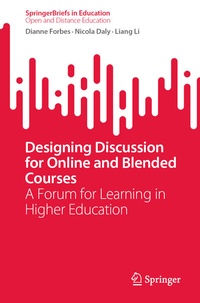
Designing Discussion for Online and Blended Courses
Description

Reviews / Votes
" Designing Discussion for Online and Blended Courses offers a much-needed intellectual intervention. . This book is a rare and timely contribution that translates a philosophical critique of educational technicalism into actionable pedagogical practice. . it offers both a conceptual and practical toolkit for educators who are ready to reclaim digital learning spaces from the logic of instrumentalism. It is an essential resource for teacher educators and researchers" (William Xaveriano Waresindo and Richardo Barry Astro, Asia-Paci?c Journal of Teacher Education, November 10, 2025)
More details
Other editions
Additional editions
Persons
Dr Dianne Forbes is a digital learning specialist with a background in teacher education and a particular interest in online (blended/hybrid) pedagogies in tertiary education. Her primary research interests are the human, social and relational dimensions of learning through digital technologies, including ethics and professionalism. She studies innovative pedagogies, from low-tech asynchronous forum discussions, to podcasts, video, social media and flipped/blended learning. A consistent focus of her work is the perspectives and experiences of students and teachers as participants in digital learning.
Associate Professor Nicola Daly is a sociolinguist in the Division of Education at the University of Waikato, New Zealand where she teaches children's literature online and leads the Postgraduate Certificate in Children's and Young Adult Literature. She also co-directs the Waikato Picturebook Research Unit. Her work explores multilingualism and language hierarchies in children's picturebooks, recognising the power of this often underestimated format in the development of language attitudes and the perpetuation of hegemonies. In 2019/2020 she was a Fulbright New Zealand Scholar at the University of Arizona, USA.
Dr Liang Li is working at the School of Arts and the School of Education at the University of Waikato. She is interested in using digital tools to enhance teaching and learning experiences. With a background in corpus linguistics, she actively contributes to the FLAX project and helps develop a corpus-based language learning and analysis tool tailored for EAP (English for Academic Purposes) learners and researchers. As an online instructor, she embraces various tools including asynchronous discussion forums, Perusall and Wikis to foster collaborative learning environments online.
Content
Chapter 1: Introduction the place of online discussion in higher education.- Chapter 2: Variety across disciplines.- Chapter 3: Effective learning through online discussion enhancing student strategies and experience.- Chapter 4: Effective teaching through online discussion enhancing pedagogy and practice.- Chapter 5: Assessment issues and practices.- Chapter 6: Innovative practices in online discussion.- Chapter 7: The future of online discussion.
