

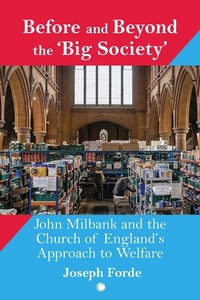
Before and Beyond the 'Big Society'
John Milbank and the Church of England's Approach to Welfare
Published on 26. May 2022
326 pages
978-0-227-17779-2 (ISBN)
Description

John Milbank's theology has shaped much modern political thinking both within and without the Church. In Before and Beyond the 'Big Society', Joseph Forde presents the first study devoted exclusively to John Milbank's theology of welfare, and how it has influenced policy in the Church of England since 2008. By examining the favourable response the Church gave to the 'Big Society' project in 2010-12, Forde shows that Milbank's Blue Socialist fingerprint increasingly dominates Church policy.
This theology has not evolved in a vacuum, however, and Forde expertly places it in its historical and theoretical context. He offers a detailed critical discussion of Milbank's own critique of what has been the mainstream (Temple) Anglican theology of welfare in the Church of England since the 1940s, and a fresh contribution to the assessment of Anglican social theology. Finally, he demonstrates how Milbank's ideas have been furthered by other influential Anglicans. It is this influence that will carry the greatest implications for the Church of England's policy on welfare in future, making this study relevant to all who care about its contribution to the provision of welfare.
This theology has not evolved in a vacuum, however, and Forde expertly places it in its historical and theoretical context. He offers a detailed critical discussion of Milbank's own critique of what has been the mainstream (Temple) Anglican theology of welfare in the Church of England since the 1940s, and a fresh contribution to the assessment of Anglican social theology. Finally, he demonstrates how Milbank's ideas have been furthered by other influential Anglicans. It is this influence that will carry the greatest implications for the Church of England's policy on welfare in future, making this study relevant to all who care about its contribution to the provision of welfare.
Reviews / Votes
{\rtf1\ansi\ansicpg1252\deff0\deflang2057{\fonttbl{\f0\fnil\fcharset0 Verdana;}}{\colortbl ;\red0\green0\blue0;}
\viewkind4\uc1\pard\hyphpar0\sl288\slmult1\qj\cf1\lang1033\outl\f0\fs20 In this wide-ranging book that does not shy away from bold policy suggestions, Joseph Forde offers a detailed exposition and critique of John Milbank, and a profound reflection on the Church\rquote s response to the reshaping of the Welfare State after the financial crash of 2008. Forde\rquote s lively and provocative book will stimulate all those who are interested in the Church\rquote s involvement with \line rebuilding society.\par
Mark D. Chapman, Professor of the History of Modern Theology, University of Oxford\par
\par
An accessible, balanced and compelling account of recent theological and political history. Dr Forde recalls how John Milbank and Radical Orthodoxy re-connected Anglican social thought and political policy in ways not seen since the 1980s, but also outlines the challenge the Church of England now faces to think beyond the Blue Labour/Big Society paradigm to a theology of the State that can meet existential social threats such as climate emergency, growing poverty and global pandemics.\par
Chris Baker, William Temple Professor of Religion, Belief and Public Life at Goldsmiths, University of London, and Director of Research at the William Temple Foundation\par
\pard\hyphpar0\sl252\slmult1\qj\par
\pard\hyphpar0\sl288\slmult1\qj John Milbank\rquote s influential political theology has played an important part in the current renewal of Anglican Social Theology. Forde expertly locates Milbank\rquote s work, scholarly and journalistic, in this Anglican tradition and assesses its contribution to debates on the \lquote Big Society\rquote and the future of welfare. Anyone interested in Anglican Social Theology, Blue Labour, and the contribution of theology to public life will benefit from reading this book.\par
Peter Scott, Samuel Ferguson Professor of Applied Theology and Director of the Lincoln Theological Institute, University of Manchester\par
\par
How does the Church, as well as thousands of voluntary agencies work alongside government to create a just, fair and compassionate society?\par
This book puts this important question in a much larger historical and theological timeframe. It is a must-read for all interested in such concerns for the welfare of all our fellow citizens.\par
Adrian Alker, Progressive Christianity Network, 5th July 2022\par
\par
This book, the outcome of doctoral research by Joe Forde, is a substantial contribution to the study of the Church of England\rquote s attitude to welfare provision over the last hundred years.\par
John Schofield, Centre for Radical Christianity Online, July 2022\par
\par
The book draws on a remarkably wide range of sources and contains many wise reflections on a subject dear to my heart - the role of the Church in relation to poverty, inequality and welfare...I recommend Joe\rquote s book as shedding much fascinating light on the role of Church and state in our society today.\par
David Price, Mark's Messenger - The Parish Magazine of St Mark's Church, July 2022\par
\par
The book is a thorough going examination of the Church of England\rquote s approach to welfare, historically and, more specifically, since 2010... It is good and worth reading. But don\rquote t take my word for it.\par
Ian K. Duffield, in Urban Theology Union newsletter, Autumn 2022\par
\par
Forde has produced an extremely helpful and readable book which offers an excellent provocation for a return to a Temple-like advocacy of welfare statism. Forde\rquote s argument will help those from different strands of Anglican social thought to interrogate and clarify their position\par
Revd Dr Matt Bullimore, in Modern Believing, Volume 64, Number 3\par
\par
\outl0\par
\pard\hyphpar0\sl252\slmult1\outl\par
\pard\cf0\lang2057\outl0\par
}
What is telling in this book, ultimately, is its ironic, tragic, carefully reconstituted account of how a socialist theologian inadvertently made it conceptually possible for the Church to naively baptise a neoliberal government, which did extraordinary social and economic damage, thinking all the time that its actions were socially and theologically prudent. Charles Pemberton In Studies in Christian Ethics, Volume 37, Issue 1, March 14, 2024.
More details
Language
English
Place of publication
Cambridge
United Kingdom
File size
1,33 MB
ISBN-13
978-0-227-17779-2 (9780227177792)
Copyright in bibliographic data and cover images is held by Nielsen Book Services Limited or by the publishers or by their respective licensors: all rights reserved.
Schweitzer Classification
Other editions
Additional editions
Greg W. Forbes
Before and Beyond the 'Big Society'
John Milbank and the Church of England's Approach to Welfare
Book
11/2022
James Clarke & Co Ltd
€37.50
Shipment within 10-20 days
Joseph Forde
Before and Beyond the 'Big Society'
John Milbank and the Church of England's Approach to Welfare
Book
05/2022
James Clarke & Co Ltd
€112.50
Shipment within 10-20 days
Person
Dr Joseph Forde is Honorary Research Fellow in Historical Theology at the Urban Theology Union, Sheffield. After working for twenty-six years in NHS management, he gained a PhD in Theology from the University of Manchester. He is Chair of Sheffield's Church Action on Poverty.
Content
Acknowledgements
Introduction
Part 1: Locating John Milbank's Thinking on Welfare and the Church within the Anglican Socialist Tradition
1. Three Anglican Socialist Strands: Welfare Statist, Christendom, Revolutionist
2. Anglican Socialism and the Rise and Fall of the British Welfare State Consensus
Part 2: John Milbank's Blue Socialist Thinking and His Perspective on the British Welfare State
3. John Milbank Writing in the Christendom Strand
4. John Milbank's Thinking on Welfare and the Church of England's Role in its Provision since 1945
Part 3: John Milbank, the 'Big Society' Project and the Church of England
5. The 'Big Society' Project and the Church of England: An Analysis of the Influences that Shaped GS1804
6. John Milbank and the Church of England's Future Approach to Welfare
Conclusion
Epilogue
Appendix 1: GS1804: 'The Big Society' and the Church of England
Appendix 2: List of Questions
Bibliography
Index
Introduction
Part 1: Locating John Milbank's Thinking on Welfare and the Church within the Anglican Socialist Tradition
1. Three Anglican Socialist Strands: Welfare Statist, Christendom, Revolutionist
2. Anglican Socialism and the Rise and Fall of the British Welfare State Consensus
Part 2: John Milbank's Blue Socialist Thinking and His Perspective on the British Welfare State
3. John Milbank Writing in the Christendom Strand
4. John Milbank's Thinking on Welfare and the Church of England's Role in its Provision since 1945
Part 3: John Milbank, the 'Big Society' Project and the Church of England
5. The 'Big Society' Project and the Church of England: An Analysis of the Influences that Shaped GS1804
6. John Milbank and the Church of England's Future Approach to Welfare
Conclusion
Epilogue
Appendix 1: GS1804: 'The Big Society' and the Church of England
Appendix 2: List of Questions
Bibliography
Index
