

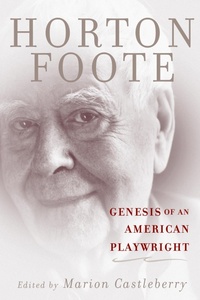
Genesis of an American Playwright
Description

In Genesis of an American Playwright Horton Foote, one of the greatest American playwrights of the twentieth century, reflects upon his journey from his childhood in Wharton, Texas, through his early experiences as an actor in the theatre, to his mature vocation as a playwright. All along the way, Foote carefully identifies the people and influences that shaped his character and nurtured his art. What is remarkable about this book is equally remarkable about his drama: he writes with an effortlessness that belies the intimacy of the art emanating from deep within. The stories are simply told but complex in their resonance. Foote not only reveals his immediate professional world but also provides a running commentary on the changes in American culture. This book makes for as fascinating reading as it does compelling history. On December 20, 2000, President Bill Clinton conferred the National Medal of Arts on Texas dramatist, Horton Foote, and noted that Foote's six-decade-long, award-winning career established him as the nation's most prolific writer for stage, film, and television. Foote's many awards include two Academy Awards, an Emmy, a Burkey Award and the Screen Laurel Award from the Writers Guild of America, the Lucille Lortel Award, and his induction into both the Theatre Hall of Fame and the American Academy of Arts and Letters. Without question, Horton Foote has enriched American literature with his unique writing style and his truthful examinations of the human condition. Besides To Kill A Mockingbird and The Trip To Bountiful, Foote has written a score of notable plays, teleplays, and films.
More details
Other editions
Additional editions
Persons
Horton Foote is one of the greatest American playwrights of the twentieth century.
Content
Acknowledgments
Chronology
Introduction
Chapter 1: Genesis of a PlaywrightSeeing and ImaginingPasadena and BeyondLearning to Write
Chapter 2: On Being a Southern WriterWharton, Then and NowWhat It Means to be a Southern WriterThe Trip to ParadiseThe Artist as MythmakerThings Have Ends and Beginnings
Chapter 3: Writing for the StageDance and Broadway (1944)Harrison, USASometimes the One-Act Play Says It AllAdvice to Young PlaywrightsHerbert BerghofThe Orphans' Home Cycle LectureHow To and How Not To: Some Lessons Learned along the WayIntroduction to The Young Man from Atlanta
Chapter 4: Writing for the ScreenThe Little BoxOn First Dramatizing FaulknerThe McDermott LectureWriting for FilmWilla Cather
Chapter 5: Thoughts on the American TheatreThe New York Theatre (1930--1940)The Changing of the GuardThe Vanishing World and Renewals
Appendix: Cast Lists and Production Information
Bibliography of Published and Produced Works (1939-2003)
Notes
Index
